 Vietnamnet.vn

 Podcast



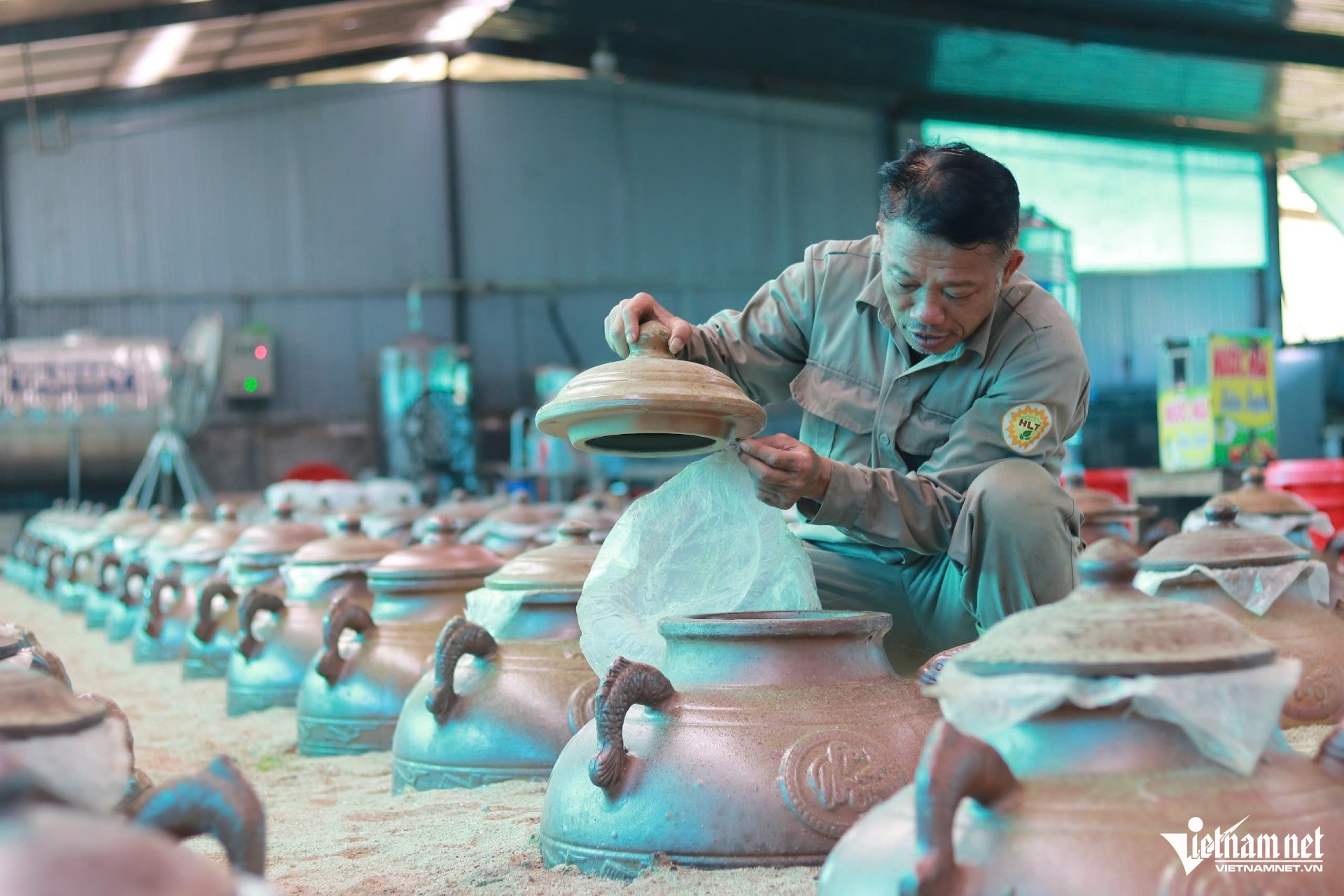
In the border area of Son Hong commune (Ha Tinh), once considered "rough land" where people mainly relied on forestry, the integrated farm model of Le Duc Toan (born in 1974, residing in Village 12) is becoming a bright spot in agricultural economic development.
Once a freelance laborer who failed many times in production and business, Toan has successfully built a model of "crops below, solar power above, livestock in between," enriching his family and creating stable jobs for tens of local workers.
Born and raised in a mountainous border commune, Toan's family life previously relied mainly on the forest. When the "forest gates" closed, he had to struggle in various jobs to make a living.
In 2015, realizing that his grandfather's 2,000 sqm garden, located next to a stream and surrounded by forest, was lying fallow, Toan came up with the idea of starting a business right on his homeland.
Without hesitation, he borrowed VND2 billion to hire machinery for land leveling, built barns, and implemented a model of raising 100 sows and 50 cows. However, in 2017-2018, the price of live pigs plummeted, making it impossible to sell them when they reached maturity.
“At that time, continuing to raise pigs meant losses, and selling them was impossible because no one would buy. Bankruptcy was imminent. There were nights I stayed awake by the pigpen, looking at the herd in helplessness, thinking I would lose everything with such a large debt,” Toan recalled.
In that difficult time, local authorities and people joined hands to "rescue" the pigs. Many teachers and villagers were willing to buy meat for storage, helping him overcome the crisis.
Although the pigs were rescued, the pressure of debt discouraged Toan, and he left his hometown for the South to find a new direction. In 2019, encouraged by relatives, he decided to return to his hometown to start over. This time, he continued to borrow capital, shifting to deer farming while expanding the farm scale from 2 hectares to 5 hectares.
Currently, on an area of 5 hectares, Toan's farm maintains 100 sows, 80 deer, and 10 cows. The model is designed as a closed loop, with a solar power system installed above and the livestock area below. Empty plots of land are utilized to grow about 4 hectares of Polyscias fruticosa with nearly 70,000 plants, serving as medicinal herbs and for wine processing.
Toan invested in machinery to produce wine (ruou dong dong) right on the farm premises. Each year, the facility supplies about 15,000-20,000 liters of wine to the market at a price of VND70,000 per liter, bringing in revenue of VND1.2-1.4 billion.
The raw material for brewing is Lao glutinous rice; after distillation, the wine is stored in ceramic jars with fragrant young glutinous rice from Bac Ninh, creating a characteristic flavor favored by the market. Toan is completing the application to build the OCOP (One Commune, One Product) brand for his "earth-buried wine."
According to Toan, in 2024 alone, his family earned about VND1.5 billion from selling breeding pigs, with each batch consisting of 300-400 heads. In the same year, he sold 40 breeding deer at prices ranging from VND14-20 million per head and 34 pairs of deer velvet (0.8-1.2 kg per pair), earning over VND300 million from the velvet.
The integrated farm model currently creates regular jobs for eight local workers with an average income of about VND8 million per person per month. During peak season, the farm hires about 30 additional seasonal workers at a wage of VND300,000 per day.
Asked about future directions, Toan said he will continue to expand production, developing about 20 hectares of forest land to grow medicinal herbs such as Morinda officinalis, Polyscias fruticosa, and Aquilaria crassna. “Through training sessions by the Farmers' Union, I realized that utilizing forest land to grow medicinal herbs is a very promising direction,” Toan said.
Commenting on this model, Nguyen Thanh Dong, Secretary of the Son Hong Commune Party Committee, said that Le Duc Toan's integrated economic model is a typical example in effectively combining livestock, medicinal herbs, wine production, and solar power, bringing in billions of VND in revenue annually.
Not only enriching his family, the model also contributes to providing jobs for many local laborers.
Thien Luong
.svg)
