 Vietnamnet.vn

 Podcast



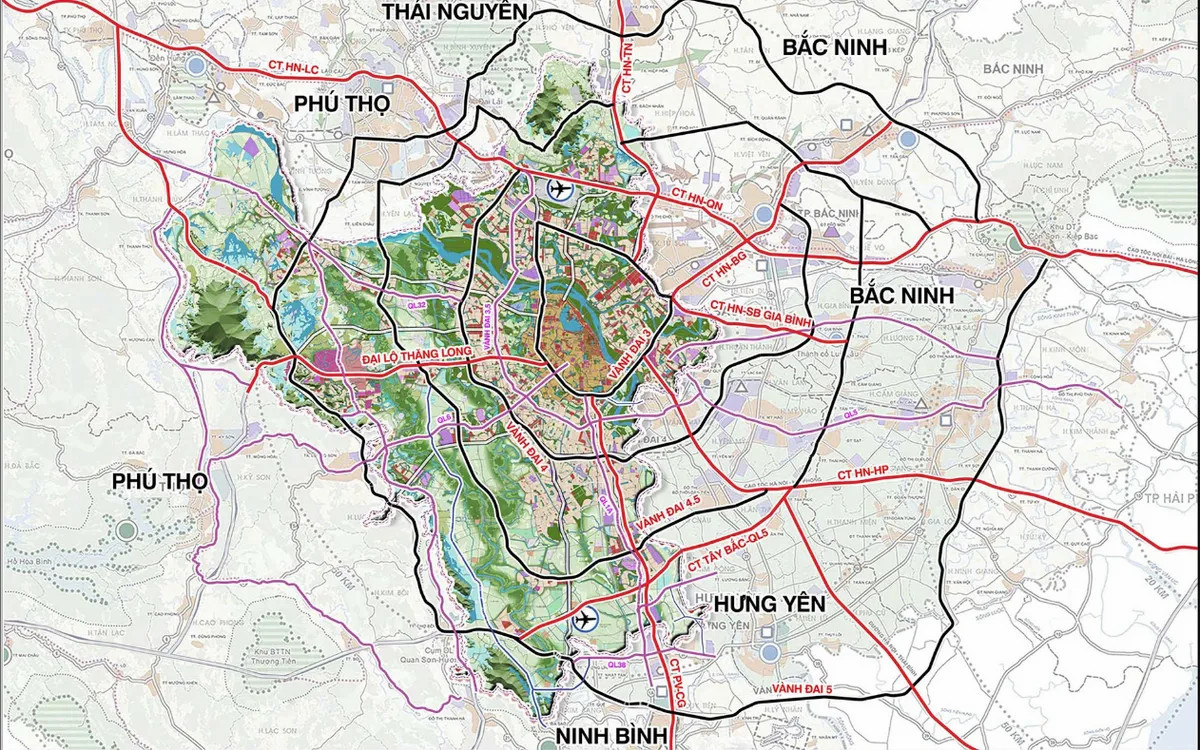
Providing an update on planning efforts to implement Hanoi's 100-year Capital Master Plan, Dao Minh Tam, deputy director of the Hanoi Department of Construction, said funding had been allocated for most commune master plans and consultants had been selected for all of them.
Local authorities are now accelerating the preparation, public consultation and completion of planning documents.
What is a commune master plan?
A commune master plan determines the spatial organization, architecture and landscape, technical and social infrastructure, and land use within a commune, providing a framework for socioeconomic development and environmental protection over a period of 10 to 20 years.
"The goal is to submit the commune master plans for appraisal before Oct. 31, 2026, conduct the appraisals in November and aim for approval in December 2026," Tam said.
For urban zoning plans, several projects have completed their preparatory stages and are undergoing appraisal before being submitted for approval.
Nine urban zoning plans and one functional-area zoning plan are expected to be ready for approval in October.
Hanoi implementing 125 planning projects
According to Tam, Hanoi's 100-year Capital Master Plan was approved by the Hanoi People's Committee under Decision No. 2512 on May 13, 2026.
To implement the master plan, the city issued Plan No. 331 on Aug. 24, 2026.
The plan translates the master plan's directions, objectives and tasks into specific assignments, programs and planning projects. It also defines the work, schedules and responsibilities of agencies, organizations and local authorities to gradually put the master plan into practice.
Tam said one of the key priorities is reviewing and completing the planning system at all levels to translate Hanoi's spatial development strategy into detailed plans.
The city is focusing on urban zoning, functional-area zoning, underground space, technical infrastructure and commune master plans.
Hanoi is currently implementing 125 planning projects, comprising 63 urban zoning plans, 13 functional-area zoning plans, five plans for underground space and specialized technical infrastructure, and 44 commune master plans.
"So far, implementation is generally progressing according to schedule," Tam said.
In the coming period, the Department of Construction will continue monitoring and accelerating individual planning projects, prioritizing those that are ready for completion while speeding up work on those still under development.
Any difficulties or obstacles beyond the department's authority will be reported to the Hanoi People's Committee for consideration and resolution.
Existing plans that remain appropriate will not be redone
Regarding implementation, Tam said Hanoi would retain existing plans whose development directions remain broadly consistent and stable under the city's 100-year Capital Master Plan.
Areas with approved plans, plans already under development or development orientations consistent with the new master plan will continue to build on those frameworks, complete them and implement them as approved.
Where necessary, specific elements will be reviewed and updated to ensure consistency with the new overarching master plan.
For areas subject to new development directions or requiring changes to spatial organization, land-use functions, infrastructure, or key development hubs and corridors, Hanoi will prepare new plans or revise existing ones in accordance with regulations.
"This ensures continuity, avoids overlap and prevents work from being repeated where existing plans remain appropriate, while also providing a basis for implementing the capital's new development directions," Tam said.
The deputy director said completing Hanoi's planning system must ensure consistency with the city's 100-year vision.
The process should preserve established plans that remain appropriate while promptly translating new development directions into detailed frameworks, providing a foundation for urban management, investment and Hanoi's development in the years ahead.
Thanh Hue
.svg)
