 Vietnamnet.vn

 Podcast



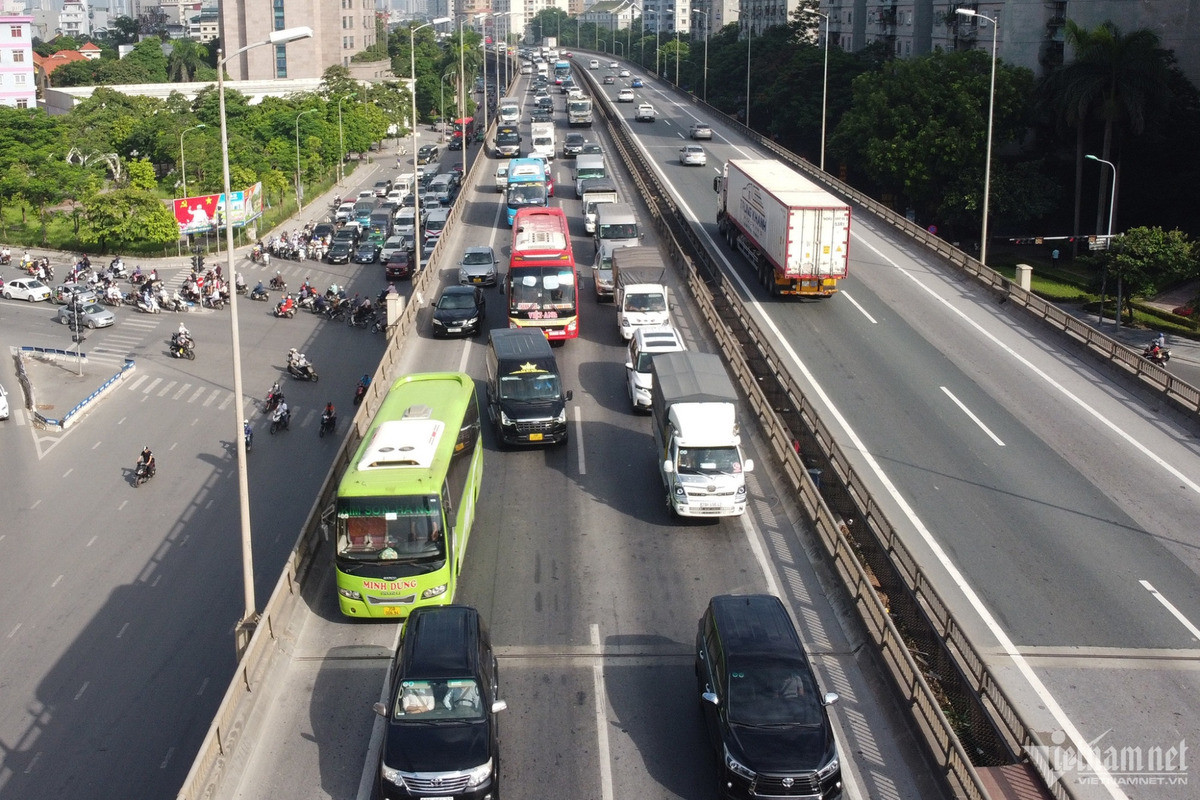
The Hanoi Department of Construction recently issued an official response to the Traffic Police Department (Ministry of Public Security) regarding proposed traffic reorganization on the elevated Ring Road 3.
Previously, the Traffic Police Department proposed studying remarking road lines, signs, and lane divisions to organize vehicles into three lanes per direction, removing emergency stopping lanes, and lowering operational speeds to ensure uniform speed across the entire route.
After coordinating with the Municipal Police Traffic Department, consultancy units, and relevant agencies to review current conditions, the Department of Construction concluded that this option failed to comply with standards and is not feasible.
Ring Road 3 carries 120,000 vehicles per day
According to the Department of Construction, the elevated Ring Road 3 segment from Thanh Tri Bridge to Thang Long Bridge was invested under urban expressway standards, designed with 4 lanes and a design speed of 100 km/h.
Currently, operational speeds on the section from Thanh Tri Bridge to Mai Dịch Intersection and from Hoa Binh Park to Thang Long Bridge are capped at 80 km/h. The Mai Dịch – Hoa Binh Park section operates at a maximum speed of 100 km/h.
Each roadway direction measures 10.75m wide, consisting of two automobile lanes measuring 3.75m wide each and one emergency lane measuring 2.5m wide.
The traffic volume currently reaches 100,000 to 120,000 vehicle trips per day and night, or 6 to 8 times higher than the initial design capacity (approximately 15,000 to 16,000 trips per day and night).
Traffic congestion is no longer confined to peak hours, tending to stretch throughout the day, particularly on weekends, holidays, or during rain.
Severe congestion is often concentrated at entry and exit ramps such as Phap Van-Cau Gie, Nguyen Trai-Khuat Duy Tien, Big C Thang Long-Tran Duy Hung and the section crossing Thanh Tri Bridge.
"Add lanes" by removing emergency lane?
Regarding the proposal to organize three lanes per direction, the Department of Construction stated it cross-referenced existing technical standards.
Under QCVN 117:2024/BGTVT, minimum lane width is 3.75m for Class 100 and Class 120 roads, and 3.5m for Class 80 roads.
Even if operational speeds were lowered to 60 km/h or even 50 km/h, the minimum width for an automobile lane must still reach 3.5m, alongside a minimum safety strip of 0.25m.
With a roadway width of 10.75m per direction, reallocating into three lanes would require establishing one lane measuring only 3 to 3.25m wide while narrowing the safety strip below 0.5m.
The Department of Construction assessed that the organization fails to ensure current automobile road design standards. Because compliance with technical regulations is mandatory, the option to divide into three lanes and eliminate the emergency lane was deemed non-compliant.
Beyond regulatory obstacles, the Department of Construction expressed concern over incident risks.
Elevated Ring Road 3 functions virtually as a single-access corridor. If the emergency lane is removed, a single stalled engine, blown tire, or collision would occupy a traffic lane, rapidly creating a bottleneck. This would also hamper fire engines, ambulances, and rescue vehicles from accessing scene locations.
In particular, at locations such as Thanh Xuan, Trung Hoa and the approach to Thang Long Bridge, the road cross-section narrows to about 9m and there is no emergency stopping lane. If three lanes were introduced and then reduced back to two lanes, the risk of creating additional bottlenecks would increase.
Hanoi plans alternative measures
Instead of removing the emergency lane, Hanoi announced several implemented solutions increasing corridor capacity.
At interchanges, solid road markings were modified into broken lines within 100m before exit ramps and 100m after entry ramps, allowing vehicles to merge and diverge more easily.
During congestion, the Hanoi Traffic Police Division allows vehicles to use the emergency stopping lane.
The city has also adjusted traffic on roads below the elevated Ring Road 3. Under the new arrangement, trucks weighing more than 10 tons are prohibited from traveling from National Highway 32 and Thang Long Boulevard onto the elevated Ring Road 3 during peak hours. Traffic has also been reorganized at the Khuat Duy Tien-Nguyen Trai and Nghiem Xuan Yem-Nguyen Huu Tho intersections.
In the long term, Hanoi needs to reduce pressure on Ring Road 3 by accelerating construction of Ring Road 4, Ring Road 3.5 and bridges across the Red River, including Tu Lien, Tran Hung Dao, Ngoc Hoi and Thuong Cat bridges.
Vu Diep
.svg)
