 Vietnamnet.vn

 Podcast



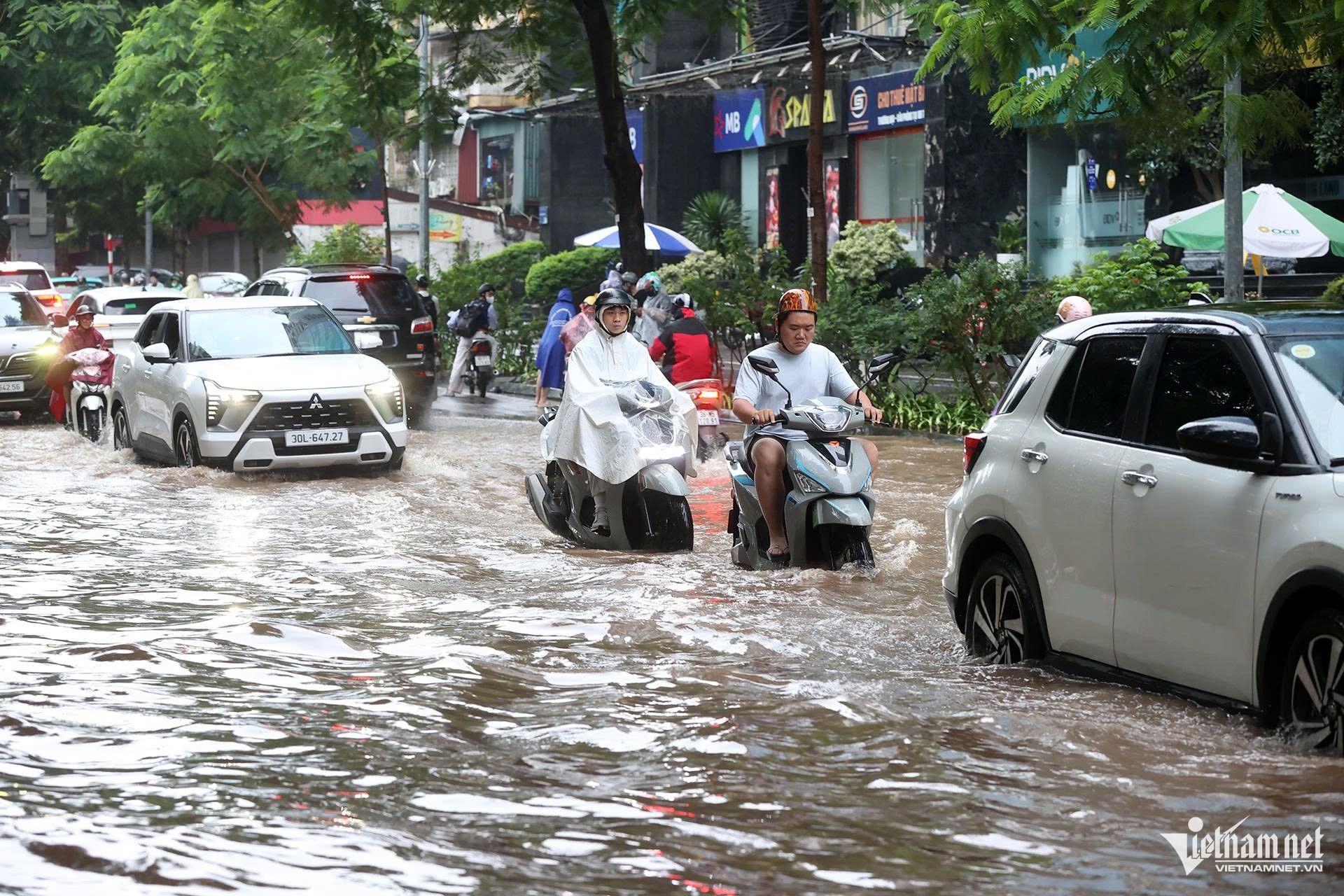
Following heavy downpours in September, several areas previously considered flooding hotspots showed marked improvements. Along Vo Chi Cong and My Dinh, floodwaters occasionally reached 15 cm, but receded quickly post-rain. The Resco and EcoHome areas experienced only mild flooding, draining faster once water redirected into the Thuy Phuong canal.
Notably, locations that once required 4 to 10 hours to drain now clear within 30 minutes to 2 hours.
These results stem from intensified municipal operations at pumping stations, regulating lakes, canals and headworks, coupled with maintenance of existing networks and deployment of urgent flood control projects.
After five months of implementation, urgent projects stand largely complete and demonstrate early effectiveness. Concurrently, municipal authorities also formulated response plans under varying rainfall scenarios, maintaining duty shifts, running pumping stations, and addressing high-risk flooding spots.
These changes indicate that targeted infrastructure investments and proactive operations significantly enhance response capabilities during heavy rainfall. However, these represent only preliminary results, bringing temporary relief to residents when downpours strike.
A single rainstorm highlights larger puzzle
In 2025, Hanoi recorded 220 flooding points. Certain areas registered water depths of 50-70 cm lasting three to five days. Some rainstorms delivered 500-600 mm of rainfall, far exceeding network design capacities.
These figures illustrate that Hanoi cannot resolve flooding simply by tackling isolated spots.
According to the Department of Construction, the municipal drainage network lacks full investment aligned with master plans; headworks, regulating reservoirs, supply canals, and pumping stations remain insufficient and uncoordinated. Headworks capacity reaches about 20 percent, while regulating lake surface area stands at roughly 18.7 percent compared to 2013 planning targets.
Simply put, Hanoi lacks both "drainage pathways" and "water retention space".
When heavy rains occur on a large scale, total rainfall overwhelms the capacity of sewers, canals, lakes, and pumping stations. Without connecting facilities into a basin-wide network, increasing capacity at a single location fails to guarantee flood relief for the whole region.
Recent rainstorms thus demonstrate both initial progress from urgent projects and the necessity for foundational investment.
Hanoi is executing 12 planned drainage projects, prioritizing headworks, regulating reservoirs, pumping stations, and supply canals across the Ta Nhue, Huu Nhue, Long Bien, North Red River, Ha Dong, and western city basins.
These projects require substantial resources and a long implementation period. But if investment is carried out basin by basin, Hanoi can move beyond tackling individual flood hotspots and gradually build a system capable of receiving and regulating rainwater. The ultimate goal is to ensure that every rainstorm no longer turns into a race against rising water.
The “every rain means flooding” fear
Alongside upgrading general drainage networks, Hanoi must confront another bottleneck: rapid urban expansion outstripping drainage infrastructure.
New urban areas are expanding, while the amount of concrete surfaces is increasing and natural water absorption capacity is declining. When drainage networks lack adequate calculations or synchronization with general infrastructure, rainwater readily surges into neighboring areas, turning single downpours into regional pressures.
Conditions in some urban areas such as An Khanh, My Dinh and Cau Giay show that these shortcomings are often most apparent during heavy rain.
Homes and roads may already be completed, but if there are insufficient regulating reservoirs or drainage pipes, or if the system has not been properly connected to the wider network, there is still no adequate “route” for the water to go.
The challenge, therefore, is not simply to install more drainage pipes after flooding occurs, but to plan for where water will go from the very beginning.
A modern city needs not only places to live and roads to travel on, but also enough space to retain and channel water. Drainage must be treated as essential infrastructure and developed alongside housing and roads, rather than being left until the final stage.
According to the Hanoi Department of Construction, for urban areas that are basically completed but have not yet been handed over, developers must complete their drainage systems, connect them to the broader infrastructure network and ensure that they are ready for operation. During the transition period, developers remain responsible for management and maintenance.
In the long term, these issues must be addressed at the planning stage, including ground elevations, drainage directions, regulating reservoirs, drainage capacity and the ability to connect with the wider system.
Vu Diep
.svg)
