 Vietnamnet.vn

 Podcast


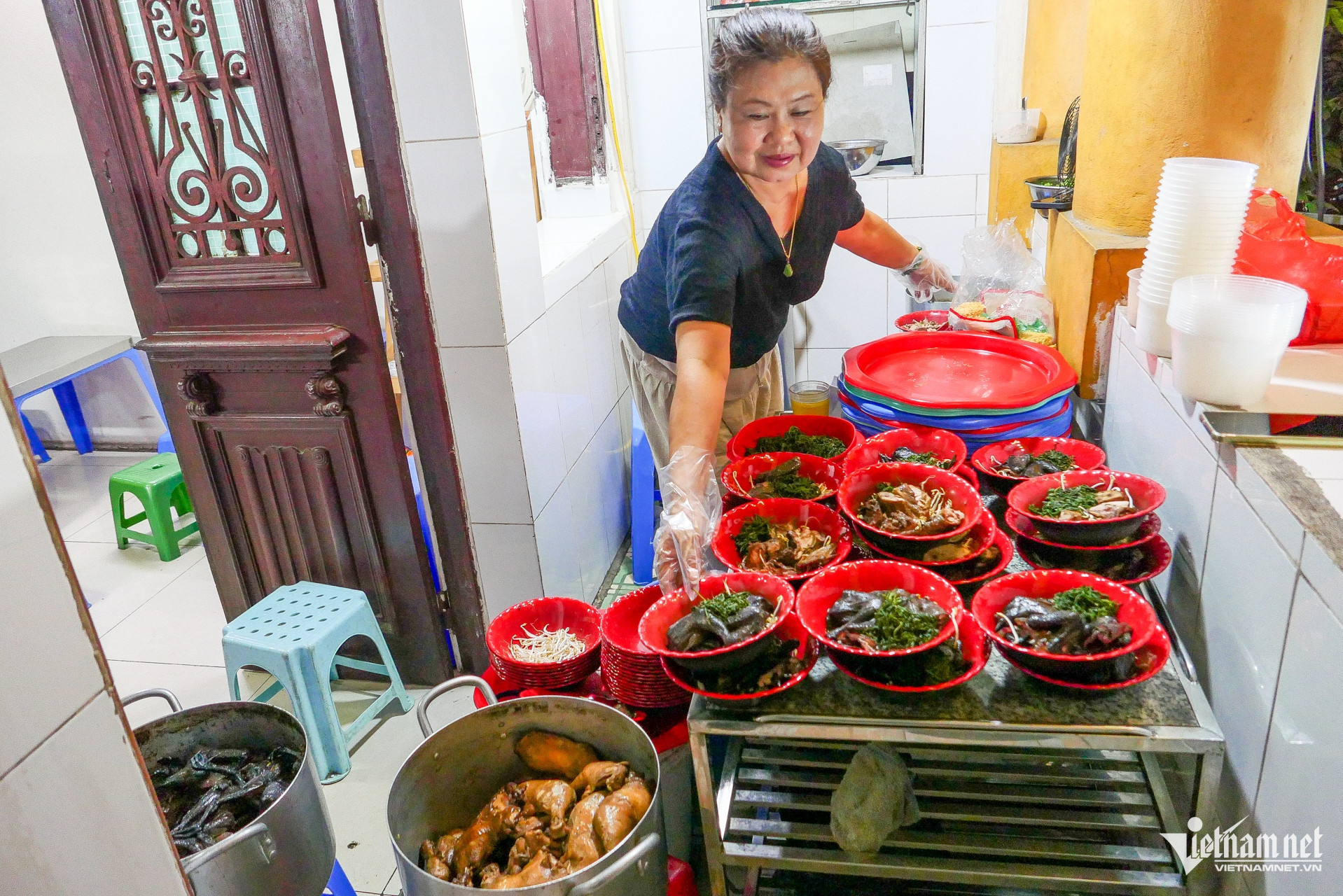
At 6:30pm, Hang Bo Street in Hoan Kiem Ward, Hanoi, is bustling with traffic and busy shops and restaurants. The narrow alley at No. 24 Hang Bo, barely wide enough for two people to pass without squeezing against the walls, begins to fill with activity as diners make their way to the herbal chicken noodle shop hidden deep inside.
Following the cramped passage under dim lighting, diners must also climb a flight of old stairs to reach the second floor. The restaurant is tucked away inside an Old Quarter townhouse, with no spacious frontage or prominent sign. Only after reaching the second floor do diners find a room that is almost always full, with the distinctive aroma of traditional herbs lingering in the air.
The herbal chicken shop first opened in 1992 on a sidewalk corner on Hang Bo Street. In early 2026, it moved into the private family home of owner Pham Thuy Lien, 61. The 47-sqm space had been home to her husband's family for four generations and has now been renovated into a restaurant that can serve 50-60 diners at a time.
After briefly selling clothes, Lien began running a sidewalk food stall in 1992, serving dishes that were not particularly common at the time, including minced pork porridge, herbal chicken and herbal chicken noodles. The setup was very basic.
Lien's husband built the wooden tables and chairs himself and neatly arranged them in a corner of the Hang Bo sidewalk under dim lights. He was a government employee at the time and would usually return home after work to look after their two sons so that his wife could focus on selling food.
“I visited several places that served herbal chicken to see how they prepared it. Then I went home and cooked it myself, adjusting the recipe in my own way. I focus on achieving a balanced flavor because many people are afraid of the bitterness of traditional herbs and mugwort,” Lien said.
During the first 20 years, herbal chicken porridge was one of the shop's signature dishes. However, as the number of customers increased, stirring porridge over a charcoal stove in the cramped space became increasingly difficult. Lien decided to drop the porridge and focus on herbal chicken and herbal chicken noodles.
In 2011, herbal chicken noodles became particularly popular with younger diners, causing sales to rise sharply. In subsequent years, the shop also began attracting international customers, including visitors from the US, Japan and South Korea.
Recipe unchanged for 34 years
Lien said the main ingredients in the herbal chicken and herbal chicken noodle dishes are chicken, traditional herbs and mugwort.
To serve herbal chicken noodles in the evening, preparations have to begin early in the morning. From selecting and preparing the chicken to simmering the herbs and stewing the chicken, every step is carefully supervised by Lien and her daughter-in-law, with the broth requiring the most elaborate preparation.
The shop uses silkie chicken, also known as black chicken, and free-range Vietnamese chicken, sourced from a trusted supplier she has worked with for many years. The chickens are raised to the size and for the length of time specified by Lien, undergo veterinary inspection, and are then prepared and delivered to the shop every day.
After more than 30 years in the kitchen, Lien can tell whether a chicken is fresh simply by looking at its skin and shape and pressing it lightly with her hand. Chickens that fail to meet her standards are rejected immediately, as the quality of the meat directly affects the quality of the dish.
The distinctive flavor of the dish comes from herbal broth made with five ingredients: goji berries, Angelica sinensis, red dates, Prepared rehmannia root and coix seeds.
“When making the herbal broth, I don't add too much of any one ingredient because I want to avoid a strong or bitter taste like traditional herbal medicine. For 34 years, I have continued to measure the herbs myself rather than leaving it to the staff,” Lien said.
The herbs are simmered for several hours. The long cooking time allows the ingredients to release their sweetness and delicate aroma, but the process must be carefully controlled so the broth does not become too strong or bitter. Once the herbal concentrate is ready, Lien mixes it with bone broth according to the shop's own proportions to create a balanced base for the herbal dishes.
Linh Trang

