 Vietnamnet.vn

 Podcast



The Hanoi People's Committee held a signing ceremony for contracts covering urban railway lines 1, 2, 8, 10 and 14.
The agreements were signed between the Hanoi Metropolitan Railway Management Board (MRB) and a consortium comprising Vinhomes Joint Stock Company and SGC Investment and Construction Joint Stock Company.
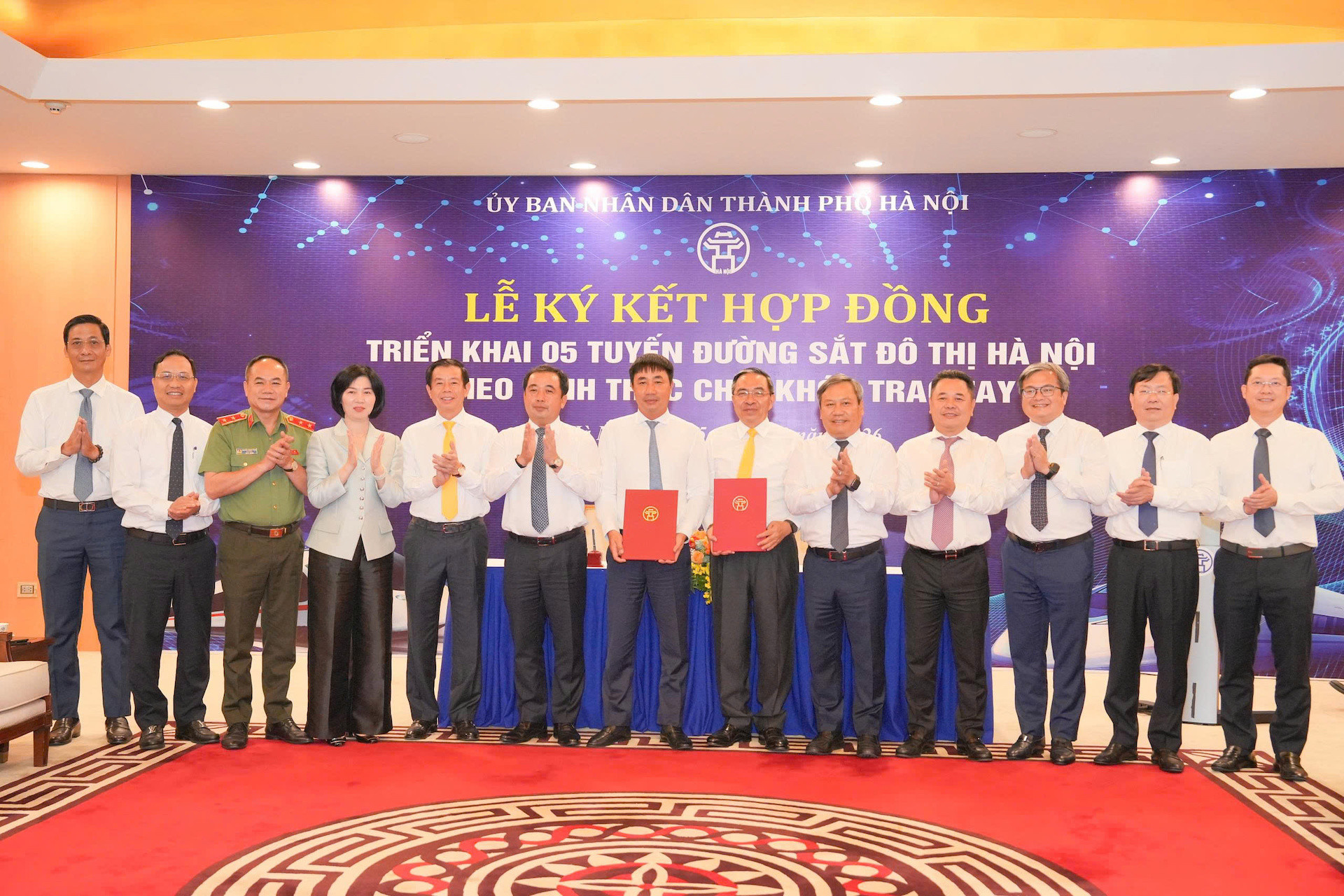
The projects will be implemented under engineering, procurement and construction (EPC) turnkey contracts based on the standards of the International Federation of Consulting Engineers (FIDIC).
Five metro lines spanning more than 253km
According to the announced plans, the five urban railway lines will have a combined length of approximately 253.5km, supported by depots for train maintenance, repairs and operations.
Line 1 will stretch approximately 59km, connecting Hung Vuong Stadium, the railway industrial park, Ngoc Hoi, Hanoi Railway Station, Yen Vien, Thu Lam Urban Area and Noi Bai International Airport.
Line 2 will run for about 60km, linking Noi Bai International Airport with Nam Thang Long, Tran Hung Dao, Thuong Dinh and either Thuong Phuc or Hung Vuong Stadium.
Line 8, approximately 64km long, will connect Hoa Lac, Son Dong, Mai Dich, Ring Road 3, Linh Nam and Thuan An.
Line 10 will cover about 38.7km, passing through Vo Chi Cong, Ring Road 2.5, the Times City/Vinh Tuy area and Co Loa/Dong Anh.
Meanwhile, Line 14 will extend approximately 31.8km, linking Thang Long Bridge, Hong Ha and the Ocean Park/Gia Lam area.
The network is designed to connect central Hanoi with satellite urban areas, emerging development zones, airports and major transport hubs.
Once operational, the lines are expected to increase public transport capacity, ease pressure on the road network and support transit-oriented development (TOD).
Speaking at the signing ceremony, Hanoi People's Committee Chairman Vu Dai Thang said the simultaneous implementation of five urban railway lines would be particularly significant for the capital's development.
"These projects are exceptionally large in scale, technically complex and subject to a tight implementation schedule, with completion targeted for 2030," he said.
"Once completed, the five railway lines will play an important role in establishing a high-capacity public transport network, reducing traffic congestion, improving the environment and facilitating the development of transit-oriented urban areas."
Moving toward fully driverless train operations
On the technology front, the five metro lines are planned around a unified set of technical standards, laying the foundation for integrated connectivity and consistent operations across the network.
Proposed specifications include the standard 1,435mm track gauge and communications-based train control (CBTC) systems.
Notably, the projects are intended to adopt Grade of Automation 4 (GoA4), the highest level of train automation, allowing fully automated operations without onboard drivers or operating staff, subject to approved designs and safety procedures.
Digital technology will also be incorporated throughout the projects' life cycles, from design and construction to management, operation and maintenance.
The proposed solutions include front-end engineering design (FEED), building information modeling (BIM), geographic information systems (GIS) and a project common data environment (PCDE).
These technologies are intended to improve design coordination, quantity management, change control and the efficiency of infrastructure management and maintenance.
Hanoi also plans to establish a Network Operations Control Center (NOCC) capable of centrally monitoring, coordinating and managing multiple urban railway lines.
Alongside requirements for construction quality, delivery schedules and investment efficiency, the projects aim to increase domestic participation, strengthen technological capabilities and encourage Vietnamese businesses to take a greater role in the urban railway supply chain.
The five metro projects form part of Hanoi's long-term development strategy, which takes a 100-year perspective and is linked to special policy mechanisms and planning frameworks approved by the relevant authorities.
Thanh Hue
.svg)
