 Vietnamnet.vn

 Podcast



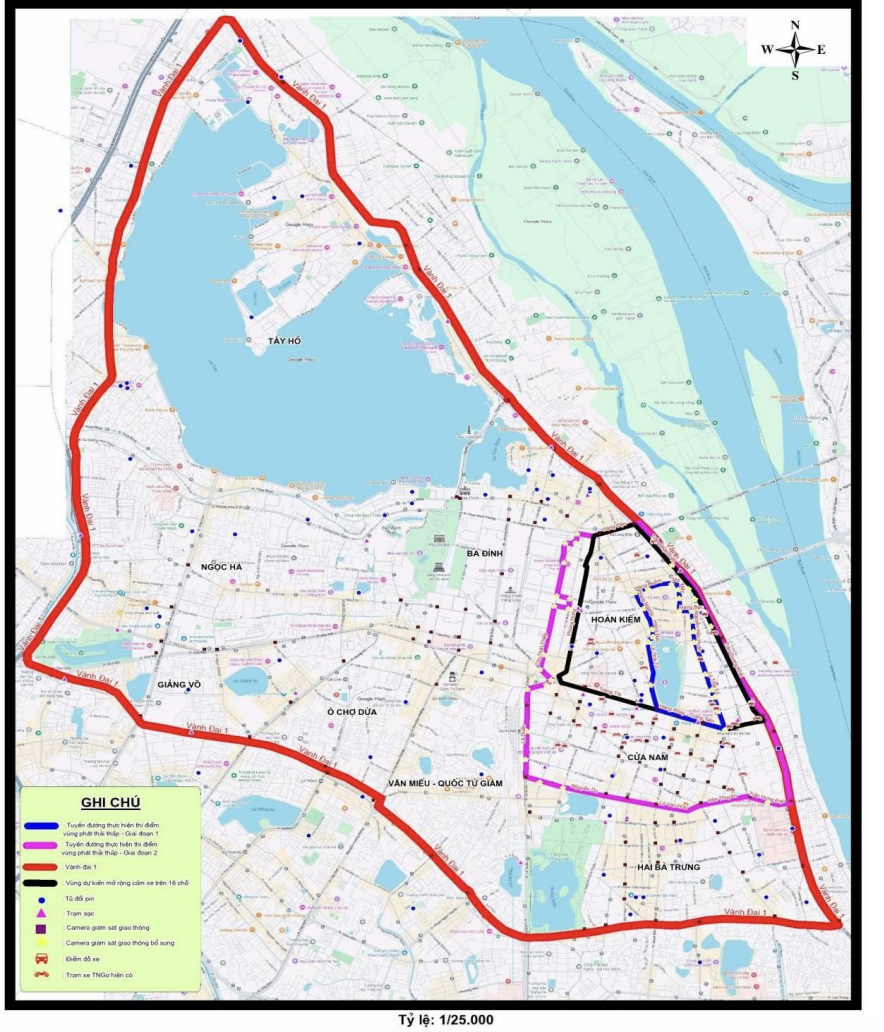
Map showing the implementation phases of the low-emission zone within Ring Road 1.
The Hanoi People’s Committee has submitted a draft resolution to the municipal People’s Council on the “Low-emission zone within Ring Road 1” project, aimed at controlling air pollution in the capital’s central districts.
According to the proposal, the plan will be implemented in three phases, beginning with a pilot programme in Hoan Kiem Ward before expanding across the entire Ring Road 1 area.
In Phase 1, from July 1 to December 31, 2026, Hanoi will pilot the scheme in Hoan Kiem Ward. The buffer zone will cover a perimeter of 5.5km and an area of 1.65sq.km, bounded by Hang Dau, Phung Hung, Trang Thi, Hang Khay, Trang Tien, Tran Quang Khai and Tran Nhat Duat streets, surrounding the Old Quarter.
The core low-emission zone within Hoan Kiem Ward will span around 0.5sq.km with a perimeter of 3.5km and a population of roughly 20,000 residents. The area will be enclosed by 11 streets, including Trang Tien, Hang Khay, Le Thai To, Hang Dao, Hang Ngang, Hang Buom, Ma May, Hang Bac, Hang Mam, Nguyen Huu Huan and Ly Thai To.
Phase 2, from January 1 to December 31, 2027, will expand the pilot zone to Cua Nam Ward. The implementation area will cover approximately 3.6sq.km with a perimeter of 8.3km and a population of around 136,947 people.
The core area during this phase will be bounded by 14 streets, including Nguyen Du, Han Thuyen, Tran Hung Dao, Tran Khanh Du, Tran Quang Khai, Tran Nhat Duat, Hang Dau, Cua Dong, Ly Nam De, Ton That Thiep, Dien Bien Phu, Hang Bong, Cua Nam and Le Duan.
City authorities plan to assess the pilot programme between October and December 2027.
Phase 3, running from January 1, 2028 to December 31, 2029, will extend the low-emission zone across the entire Ring Road 1 area. The zone will cover roughly 26.07sq.km with a perimeter of about 25km and a population of around 625,000 people.
The area includes nine wards bounded by Hoang Cau, De La Thanh, O Cho Dua, Xa Dan, Dai Co Viet, Tran Khat Chan, Nguyen Khoai, Tran Khanh Du, Tran Quang Khai, Tran Nhat Duat, Yen Phu, Nghi Tam, Au Co, An Duong Vuong, Lac Long Quan, Buoi and Cau Giay streets.
Key measures in the first pilot phase
One of the most notable aspects of the initial pilot phase is that from July 1 to October 1, 2026, residents in the pilot area will register online with local authorities regarding their plans to transition away from petrol-powered motorbikes.
The city is encouraging residents to switch to greener transport options.
Beginning July 1, 2026, Hanoi also plans to restrict circulation during specific hours, from 6pm Friday to midnight Friday, and from 6am to midnight on Saturdays and Sundays.
Under the proposal, petrol-powered ride-hailing motorbikes will not be allowed to operate within the low-emission zone from July 1, 2026.
In addition to motorbikes, Hanoi also plans stricter emissions controls for petrol and diesel cars. Passenger vehicles with fewer than 16 seats entering the core zone must meet Level 4 emissions standards, while trucks weighing from 2 to under 3.5 tonnes will only be permitted to operate during nighttime hours and must comply with equivalent emissions standards.
Hanoi to expand green transport network
From July 1, 2027, Hanoi plans to begin emissions testing for motorcycles and mopeds using fossil fuels, following the Prime Minister’s roadmap. The city will gradually restrict vehicles that fail to meet emissions requirements from operating within low-emission zones.
During the 2028-2029 phase, when the scheme expands across Ring Road 1, Hanoi will begin enforcing specific emissions standards for motorbikes. Under the proposal, motorcycles and mopeds that fail to meet Level 3 emissions standards will be banned from low-emission zones.
From 2030 onwards, the city plans to further tighten emissions standards, strengthen green transport systems and complete smart monitoring infrastructure.
Alongside restrictions on high-emission vehicles, Hanoi also plans to expand green public transport in pilot areas.
According to the proposal, from July 1, 2026, all buses operating within the pilot zone will use green energy. The city also plans to introduce additional mini bus routes, expand public electric bicycle services and build charging and battery-swapping infrastructure throughout Ring Road 1.
Surveys conducted by the city identified around 180 suitable locations for battery-swapping cabinets and 44 sites capable of supporting electric vehicle charging stations, including 13 sites within the core zone.
The Hanoi People’s Committee said transport is currently the largest source of emissions in the inner city. According to a 2023-2025 study by the Ministry of Agriculture and Environment, transport accounts for around 25% of PM2.5 particulate pollution citywide, rising to 59% among pollution sources generated within Hanoi itself.
Thanh Hue
.svg)
