 Vietnamnet.vn

 Podcast



Hanoi Party Secretary Tran Duc Thang has urged Vietnam’s central leadership to accelerate decentralization, establish legal frameworks for emerging industries and create stronger incentives for high-quality talent as the capital seeks to reposition itself as a regional innovation and technology hub.
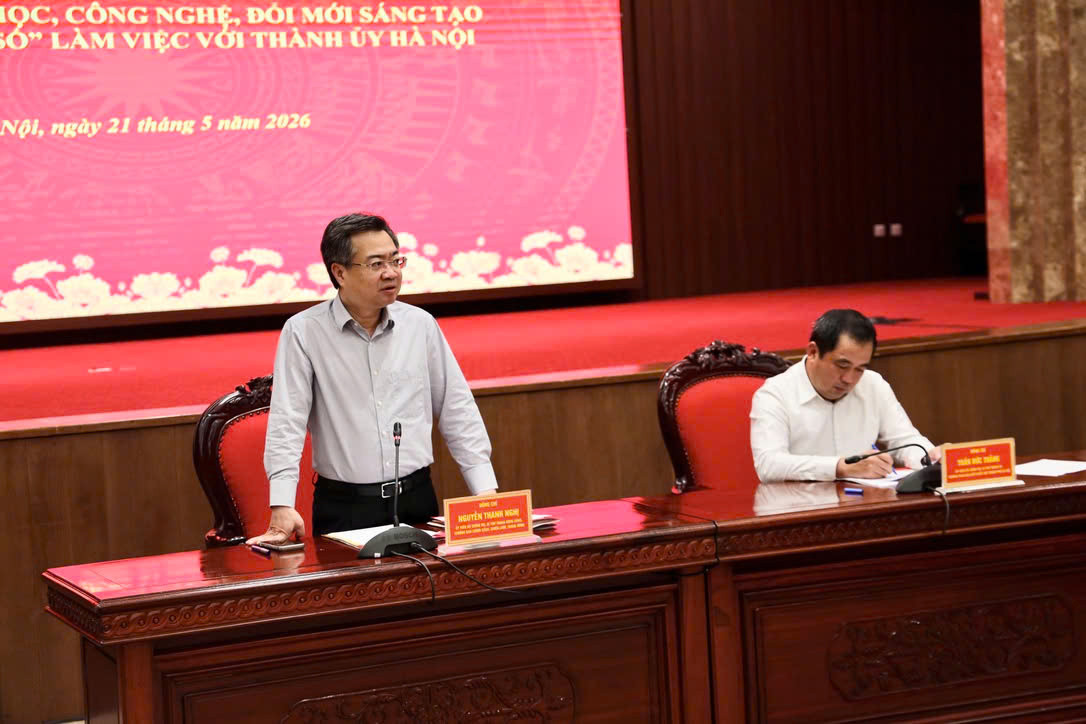
Nguyen Thanh Nghi, head of the Party Central Committee’s Policy and Strategy Commission, speaks during a working session with Hanoi officials on May 21.
Speaking at a working session on May 21 with a central government delegation led by Nguyen Thanh Nghi, Tran Duc Thang said Hanoi was entering “the most favorable period ever” to fundamentally transform its development model.
The meeting focused on preparations for a national strategy project titled “Renewing the country’s development model based on science, technology, innovation and digital transformation,” which is being drafted for submission to the 14th Party Central Committee.
Nguyen Thanh Nghi said Hanoi’s experience would play a critical role in shaping the national proposal because the capital serves not only as Vietnam’s political and administrative center but also as a major hub for economics, education, science, technology and international integration.
Officials discussed topics including a new urban growth model, transforming Hanoi into a national and regional center for innovation and digital technology, developing smart multi-center urban governance systems and strengthening cultural and human capital as new growth drivers.
Tran Duc Thang said Hanoi was currently finalizing a new development framework built around “three pillars, five growth drivers and four development spaces.”
According to the Hanoi Party chief, the city aims to implement three major shifts: moving away from growth driven by capital, land and low-cost labor toward growth based on productivity, knowledge, technology and innovation; transitioning from state-led investment toward public investment designed to mobilize broader social resources; and replacing traditional industries with knowledge-based sectors, high-value services, green industries and circular economy models.
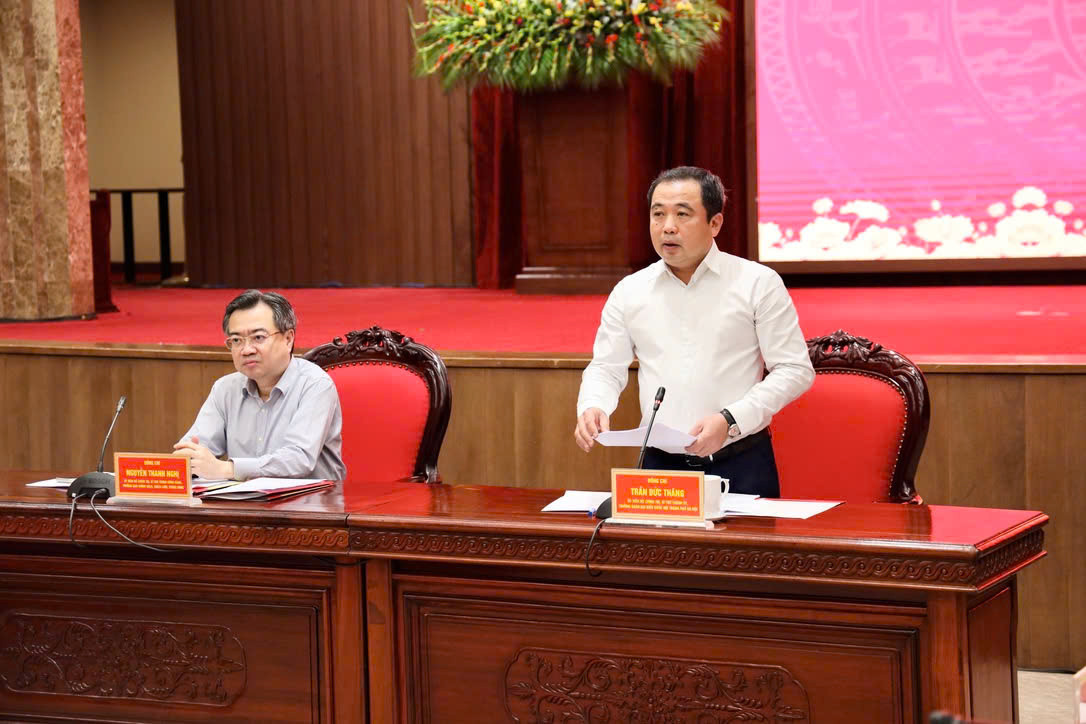
“This is not only an economic transformation but also a transformation in development thinking,” Tran Duc Thang said.
He noted that Hanoi’s long-term strategy is supported by several major policy foundations, including Politburo Resolution No. 02 on the capital’s development in a new era, the 2026 Capital Law and a 100-year master plan envisioning Hanoi as a multi-polar urban cluster centered around the Red River.
Tran Duc Thang also called on the central government to focus on three major policy areas.
First, he proposed further decentralization combined with stronger digital governance, comprehensive data integration and clearer accountability mechanisms.
Second, he urged the creation of national legal frameworks for emerging sectors already outlined in the 2026 Capital Law but still lacking synchronized nationwide regulations.
Third, he called for stronger mechanisms to attract and develop high-quality human resources across all sectors, describing talent as “the most important strategic resource” for Vietnam’s future development.
The Hanoi leader said the city remained committed to innovation, discipline and institutional reform and was willing to pilot new governance models under the expanded powers granted by the 2026 Capital Law.
Concluding the meeting, Nguyen Thanh Nghi praised Hanoi’s efforts in implementing science- and technology-driven growth policies and acknowledged early progress in digital transformation and innovation development.
However, he warned that Hanoi still faced major challenges, including clarifying the core characteristics of the new development model, strengthening institutions, treating data as foundational infrastructure, developing science and innovation markets, balancing rapid growth with sustainability and improving regional connectivity and international integration.
The Policy and Strategy Commission said it would continue reviewing Hanoi’s proposals and practical experiences while finalizing the national strategy for submission to the Politburo and Party Central Committee.
Thanh Hue
.svg)
