 Vietnamnet.vn

 Podcast



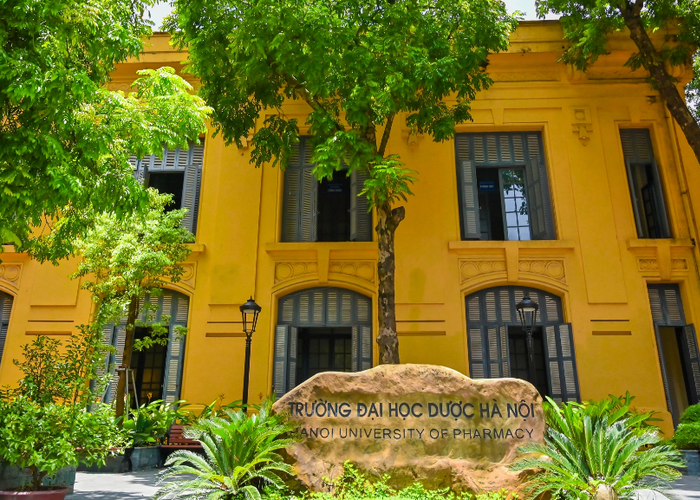
The Hanoi People's Committee recently submitted to the City People's Council for consideration the Capital Master Plan with a 100-year vision, which proposes converting the university campus at No19 Le Thanh Tong into a museum space. This proposal is causing many conflicting opinions.
Under the conversion plan, the land plot at 19 Le Thanh Tong is oriented to become the University Museum of the Ho Chi Minh Era, based on the relocation of Hanoi University of Pharmacy and the Faculty of Chemistry of the Vietnam University of Natural Sciences, Hanoi.
During the consultation process, many intellectuals, lecturers, and students requested to maintain the educational function at Hanoi University of Pharmacy. Opinions suggest that complete conversion to a museum could waste intellectual resources while reducing the vitality of a space tied to academic activities.
The university believes the conversion of the school area into a museum needs to be considered cautiously. The school area is a typical architectural ensemble from the early 20th century, associated with the formation of the Indochina University of Medicine and Pharmacy and the University of Indochina, the first higher education center in Vietnam and Southeast Asia.
In terms of academic value, it is linked to training and research activities in which Hanoi University of Pharmacy is the leading center for pharmaceutical training and research in the country. Meanwhile, the units under the University of Natural Sciences hold a foundational role in basic sciences.
The presence of universities here has contributed to forming a “knowledge zone” in the heart of Hanoi, a crossroads between education, research, and urban life.
According to modern theories on conservation, this is precisely the expression of “Genius Loci” - the spirit of the place, a value inseparable from living activities. Preserving only the architectural form without maintaining the function will diminish this identity.
Also according to Hanoi University of Pharmacy, the school is not just an architectural monument. Here, thousands of students, lecturers, and scientists are participating in training, and drug development research, contributing to the national health system.
“Universities are dynamic ecosystems, not static real estate. Relocating and converting this campus into a museum could disrupt the flow of academic activities, replace a living knowledge space with a static exhibition space, and weaken the interaction between people and place,” a university representative said.
Major global universities in the world such as Sorbonne University, University of Paris Cité, University of Oxford, University of Cambridge, and Harvard University typically retain their historic campuses in city centers while expanding elsewhere. A common approach is to preserve academic functions rather than turning old campuses into museums.
Hanoi University of Pharmacy proposed maintaining its current campus for specialized training, scientific research, innovation, and academic ceremonies, while expanding to new facilities to scale up education and modern laboratories.
The university also suggested opening part of the space for public visits, exhibitions, and educational showcases operated by the institution itself and integrated with real academic activities.
“If not carefully considered, converting the campus into a museum could erode the true value of the heritage, dismantle a valuable academic ecosystem, and impoverish urban cultural life,” the university stated.
Hanoi University of Pharmacy is a public institution under the Ministry of Health, originally the Faculty of Pharmacy of the Indochina Medical College, and has operated independently since 1961. Its campus retains distinctive early 20th-century architecture and is considered a valuable historical heritage site in Hanoi.
Nguyen Phuoc Thang from Hoa Binh University has also called for thorough consideration of the proposal, though he agrees that Hanoi is facing urban infrastructure overloading and restructuring.
He said some countries, instead of relocating all universities to the suburbs, choose a flexible spatial classification that retains their core foundations.
When expansion was needed, Berlin only relocated natural sciences - physics and chemistry - which require vast spaces for laboratories, to the Adlershof high-tech park in the suburbs. For the historic Humboldt University or the massive Charité medical complex, the government remained determined to keep them in the heart of the city. The 'one university, two campus model is suitable for Vietnam.
Thanh Hung
.svg)
