 Vietnamnet.vn

 Podcast



In recent years, Hanoi has grown at a remarkable pace - but living here has become increasingly stressful. Dust fills the air on main roads, even light rain can cause flooding, and rush hour often means severe gridlock. Meanwhile, parents face intensifying pressure over school admissions.
These problems have become so familiar that they’re no longer treated as occasional breakdowns. Instead, they are now a defining part of urban life.
A city nearing its limits
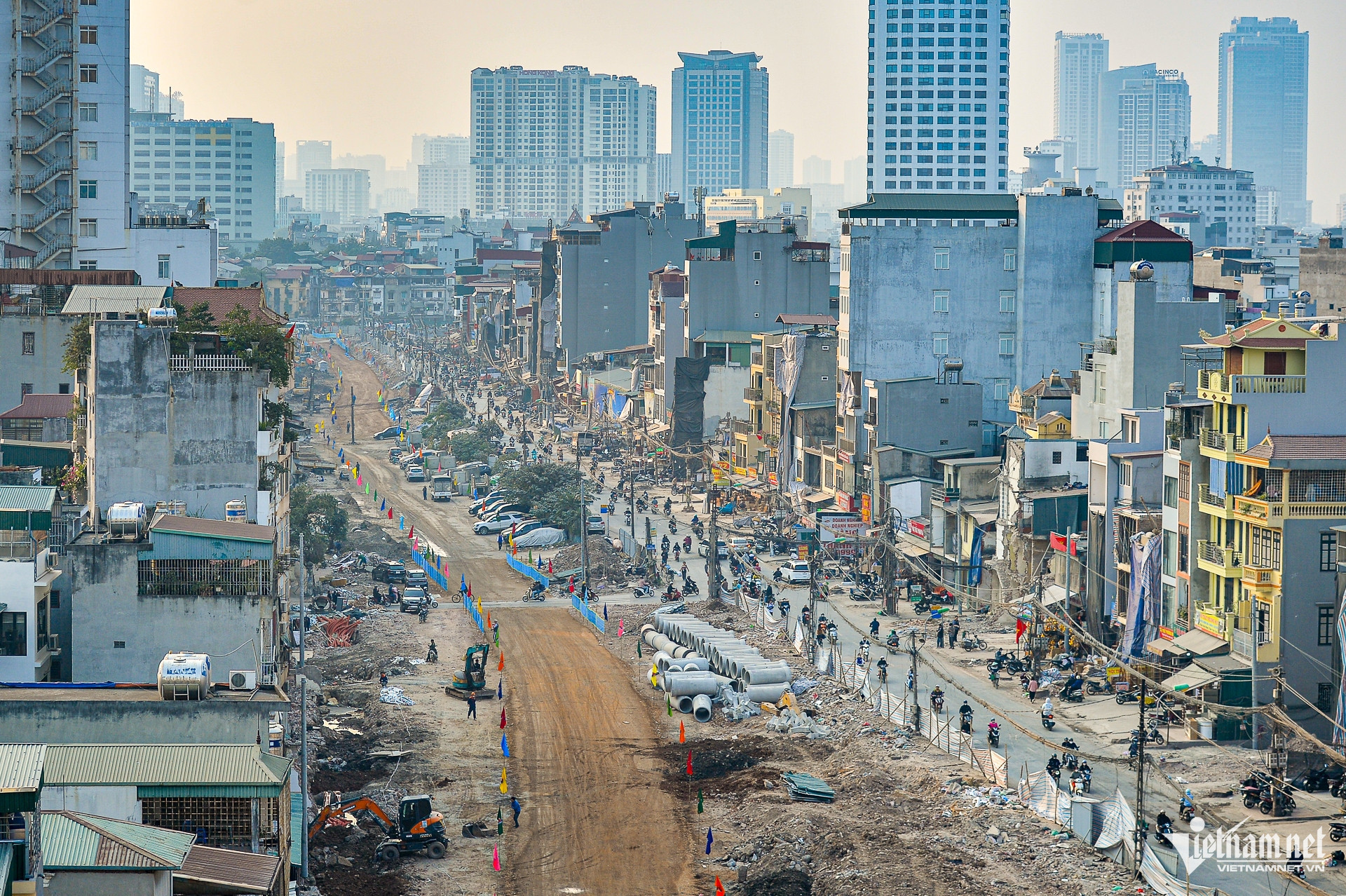
With nearly 9 million people, Hanoi continues to rise - buildings grow taller, traffic increases, and lights shine brighter. But amid these developments, the city’s livability appears to be declining.
This reveals a stark truth: Hanoi is approaching the limits of its old development model - where rapid growth has outpaced infrastructure capacity and diminished quality of life.
For years, Hanoi’s expansion has moved vertically and densely. High-rise buildings fill the skyline, traffic intensifies annually, and life speeds up. But while the city expands in height and population, roads haven’t kept up. Drainage systems lag behind urban concrete, and hospitals and schools in many districts remain overcrowded.
Some new urban areas look modern but lack parks, playgrounds, or breathing spaces. Air quality is poor for much of the year. Minor rain still triggers flooding. Rush hour now stretches longer than ever.
In central districts, too many functions - residential, work, education, healthcare - are still concentrated in the old core. Infrastructure and the natural environment haven’t scaled to meet demand.
Fixes are no longer enough
For years, the city’s approach was to fix one issue at a time: open a road where traffic jams, upgrade sewers where floods occur. These solutions addressed symptoms, not root causes.
Fix one bottleneck and another emerges - because the problem lies in a model of “growth swelling in place.” Everything gets pushed into the same space. Eventually, patches aren’t enough. The city must rethink spatial development altogether.
That means no longer squeezing the core but relieving it.
A plan to decentralize the urban core
One of the most closely watched policies is the plan to relocate more than 860,000 residents from the inner city - mainly within the Ring Road 3 area - to allow for urban renewal and ease pressure on the core.
This touches deeply on the homes, livelihoods, and memories of hundreds of thousands of families.
But the truth is plain: when people, infrastructure, and public services are crammed into tight spaces, it becomes nearly impossible to resolve traffic, flooding, and pollution with short-term fixes.
The decentralization plan matters because it aims to offer those relocated a better life - with access to schools, hospitals, jobs, transport, and green space. If executed well, it could raise the quality of life both in the core and in the emerging areas, creating a fresh development engine.
The rise of satellite cities
Crucially, Hanoi is no longer speaking in vague terms about relocation. It is mapping out concrete directions.
Zones such as Hoa Lac, Dong Anh, Gia Lam, and Soc Son are being defined as new development poles - not just dormitories, but full-fledged communities with homes, workplaces, and services.
Hoa Lac is envisioned as a science and education hub, with universities, research institutes, and high-tech industries. Dong Anh and Gia Lam, with their strategic locations and connectivity across the Red River, are being positioned as new urban cities that can absorb both population and infrastructure demand from the historic core.
If these satellite cities can offer jobs and services, then relocating residents becomes a move toward opportunity, not forced displacement.
Metro as the city’s backbone
For years, Hanoi’s metro seemed like a far-off dream. But with the Cat Linh–Ha Dong and Nhon–Hanoi Station lines now in operation, a new reality is emerging: when public transit is good, people are willing to leave their cars behind.
From now until 2030, the city aims to complete a network of backbone metro lines while investing in new bridges over the Red River to expand growth space.
Metro won’t solve everything. But without it, Hanoi’s roads will remain clogged, and decentralization to satellite cities will falter.
Trust lies in consistent delivery
People don’t just believe in promises. They look at specifics: Will plans hold firm? Will projects finish on time? Will today’s decisions last beyond political cycles, or get reversed midway?
Hanoi still faces many entanglements. But there are reasons for optimism. The city is now asking the right questions and confronting its most entrenched issues.
A livable city isn’t one without problems - it’s one where those problems aren’t left to fester year after year.
To be fair, Hanoi today is showing a different spirit. The city’s new leadership is more decisive, particularly in long-stalled, contentious areas like land clearance. Projects that were gridlocked for years - like Ring Road 1, Ring Road 2.5, and other major arteries - are now being accelerated with more resolve and clarity.
These shifts won’t fix everything overnight. But they signal something vital: the city has begun to face its toughest knots head-on. And in a city searching for relief from smog, flooding, and traffic, the determination to see hard things through may matter just as much as any urban blueprint.
Lan Anh
.svg)
