 Vietnamnet.vn

 Podcast



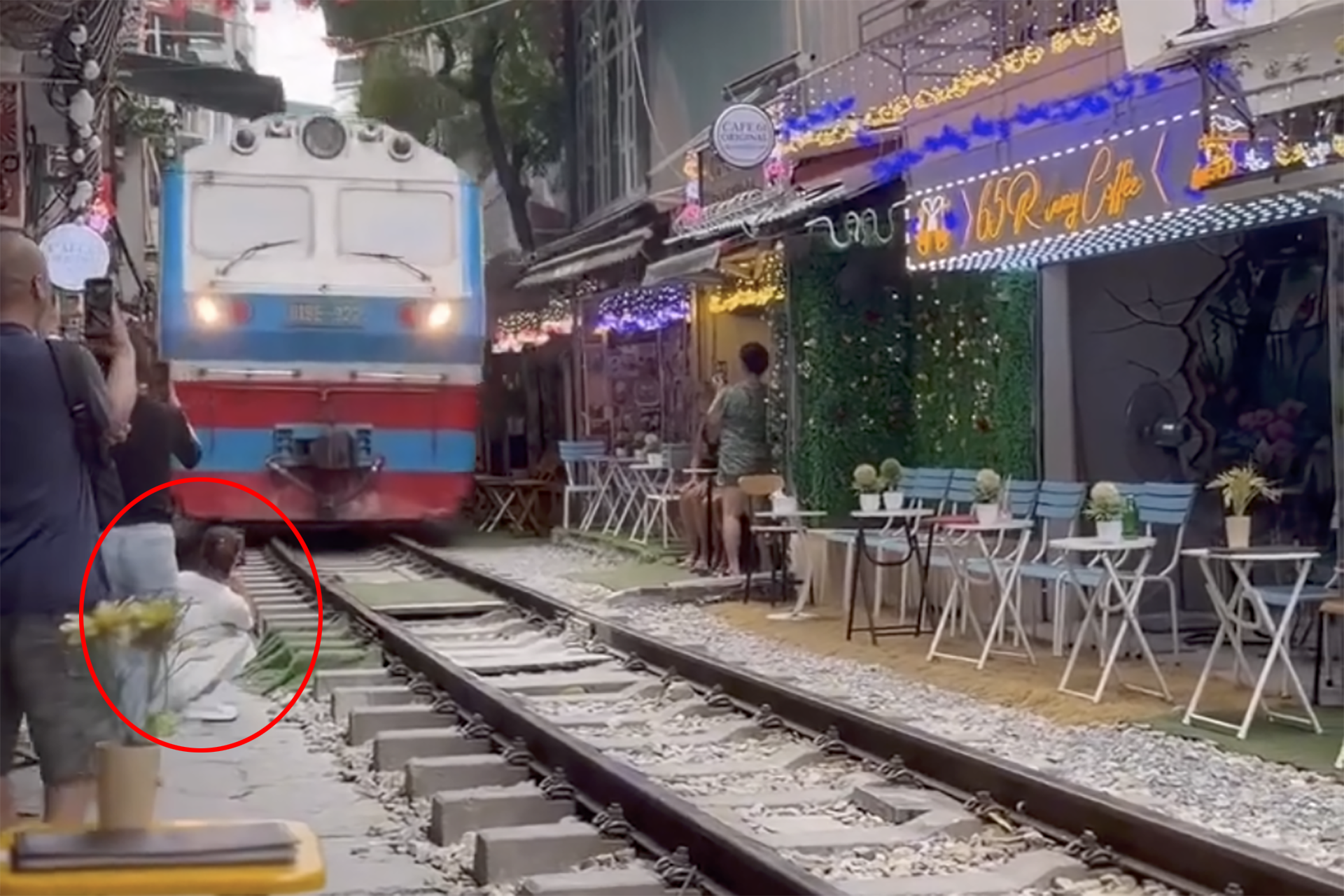
On the afternoon of Aug. 11, the Hanoi Traffic Police Division announced the results of its investigation and enforcement action following the incident, which occurred on a section of railway in Van Mieu - Quoc Tu Giam Ward.
At around 1:30 p.m. on Aug. 7, a group of four foreign tourists, whose identities and nationalities have yet to be determined, gathered near the railway in front of buildings 14B and 28C in the Nha Dau residential complex to film a passing train.
One of the women sat close to the tracks and used her phone to record the approaching train. As it passed, the train struck her phone, sending the device flying and damaging it.
The tourist was not injured. She left the scene afterward without reporting the incident to police.
Authorities are continuing to verify the woman’s identity and nationality, as well as other details surrounding the incident.
As part of the investigation, Road Traffic Police Team No. 4 worked with police in Van Mieu - Quoc Tu Giam Ward to inspect businesses operating in the area.
Based on the findings, ward police issued an administrative violation record against N.T.D., born in 1963 and identified as the owner of a cafe, for “selling goods within the railway traffic safety corridor.”
The incident, however, has done little to deter visitors from flocking to Hanoi’s well-known railway cafe area.
A VietNamNet reporter visiting another section of “Train Street” in Hoan Kiem Ward on the morning of Aug. 11 found the area still bustling with residents and tourists waiting for trains to pass.
Visitors could be seen posing for photographs on the railway tracks, while some even placed their phones between the rails to take pictures.
Dozens of cafes and beverage shops had also set up tables and chairs close to the tracks, within the railway safety corridor.
To help maintain railway safety, Road Traffic Police Team No. 1 under the Hanoi Traffic Police Division has assigned officers to the area around the clock, repeatedly warning residents and tourists not to sit or stand too close to the tracks.
Enforcement remains difficult, however, because of the large number of visitors and businesses operating along the railway. Police said that while officers may be dealing with violations in one section, similar behavior can quickly occur elsewhere.
Road Traffic Police Team No. 1 is responsible for sections of the Hanoi-Dong Dang railway from Km0+456 at the Le Duan railway crossing to Km0+534 at the Nguyen Thai Hoc crossing, as well as from Km0+790 at the Tran Phu crossing to Km3+056 at span No. 9 of Long Bien Bridge.
According to a representative of the team, households living along the railway sections under its jurisdiction were allocated land and granted permits to build homes within what is now the railway safety corridor before the Railway Law was introduced. This has made relocation and clearance particularly difficult.
Regulations require a safety distance of 8.6 meters on each side of the railway. In reality, however, many homes along Train Street stand just three to four meters from the outer edge of the tracks, falling short of the required distance.
Traffic police also face limits on their authority when handling railway-related violations.
“The traffic police’s authority to deal with railway violations remains limited. Traffic police do not have sufficient authority to temporarily seize business licenses, identity documents or other certificates belonging to individuals and businesses to ensure compliance with penalty decisions,” a representative of Road Traffic Police Team No. 1 said.
Coordination among relevant authorities has also not been sufficiently regular or consistent, with the railway running through areas administered by several neighboring wards. As a result, enforcement can be strict on one section of the same railway but more relaxed just a short distance away.
Many residents along the tracks are retired railway workers living on modest pensions. Some have renovated parts of their homes to welcome tourists, turning the spaces into cafes and making tourism a major source of household income.
According to Road Traffic Police Team No. 1, 107 cases involving vehicles stopping or parking near the railway safety zone have been handled since July 15.
Following the Aug. 7 incident, Road Traffic Police Team No. 4 will continue coordinating with police in Van Mieu - Quoc Tu Giam Ward to monitor train schedules and deploy officers to maintain traffic safety and public order along railway sections in the area.
Authorities will also step up inspections and strictly deal with violations of the railway safety corridor, particularly those involving cafes operating along the tracks.
The Hanoi Traffic Police Division has urged businesses not to place merchandise, tables or chairs within railway safety corridors. Residents and tourists have also been warned not to stand, sit, take photographs or film on the tracks or within railway safety zones, in an effort to prevent potentially serious accidents.
Dinh Hieu
.svg)
