 Vietnamnet.vn

 Podcast



Today, as the world faces multidimensional crises spanning environmental, social and psychological domains, a fundamental question becomes increasingly urgent: What is the purpose of development if people are not happy?
For Vietnam, especially as it enters a new development era following the 14th National Party Congress, “the happiness of the people” is no longer an abstract concept. It is gradually becoming a core benchmark for all policies and actions.
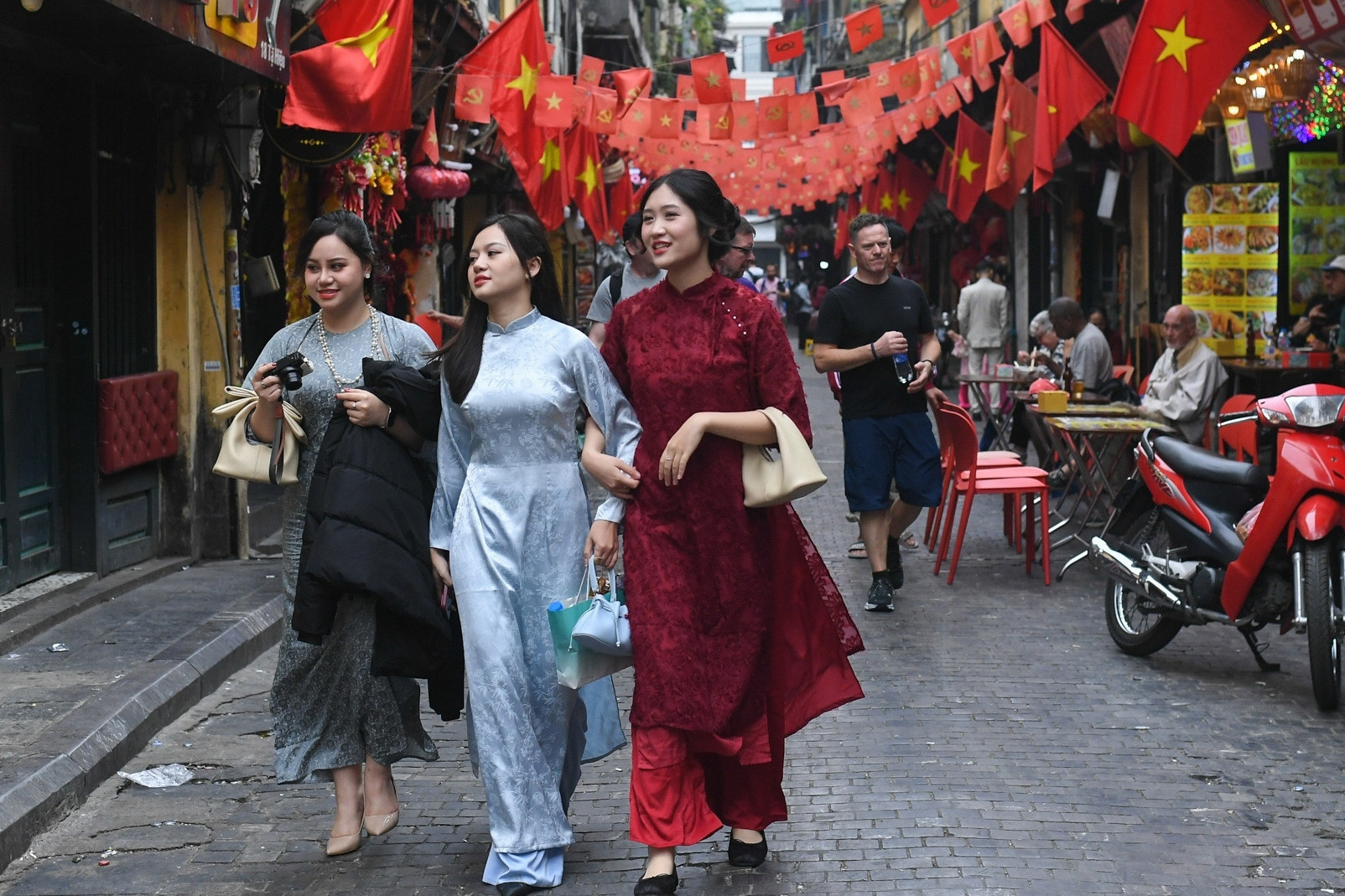
When happiness is considered a measure of development, it is not merely an economic issue but also one of culture and people. Photo: VietNamNet
Perhaps never before has the concept of “happiness” appeared so frequently in political documents, leadership speeches and social discourse. Yet what matters is not the frequency of its mention, but the shift in how it is understood and acted upon.
In the past, development was often measured through numbers: GDP growth rates, per capita income and economic scale. These indicators remain important, as material foundations are essential for higher values. However, stopping there leaves development incomplete. A society may grow wealthier, yet still contain individuals who feel isolated, insecure or deprived of meaningful opportunities.
This is why the transition from “economic growth” to “human-centered development,” where happiness becomes a key measure, is not merely a choice but an inevitable trend of our time.
Globally, many countries have recognized this shift. Bhutan’s Gross National Happiness index is a notable example, but not the only one. The United Nations publishes the World Happiness Report annually, while many developed nations have introduced metrics to assess citizens’ life satisfaction, even incorporating well-being into public policy evaluation. These trends reflect a shared understanding: development cannot be measured solely by material wealth, but must be experienced in people’s daily lives.
For Vietnam, this perspective is not unfamiliar. As early as the 1945 Declaration of Independence, President Ho Chi Minh affirmed the right of every citizen to “life, liberty and the pursuit of happiness.” This was not only a political declaration, but also a long-standing development philosophy. Today, in a new context, that philosophy is being articulated more clearly than ever.
The 14th National Party Congress has outlined an ambitious vision for national development through 2030 and 2045. Notably, within these strategic directions, the human factor is consistently placed at the center.
Resolution 80 on cultural development further affirms that culture is not only the spiritual foundation of society but also an endogenous resource and a regulatory force for development. Within this framework, human happiness becomes the ultimate destination.
This orientation is gradually taking shape in concrete policies. Proposals for community-based elderly care by the health sector, efforts in education to build not only effective but also humane learning environments, and local investments in green spaces, cultural institutions and quality of life all reflect a clear shift: from development “for its own sake” to development “for people.”
Hanoi offers a representative example. In aiming to build a “civilized, cultured and modern capital,” the city is guided by a deeper philosophy: development is not only about becoming larger, but about becoming more livable. Pedestrian spaces around Hoan Kiem Lake, cultural streets, and efforts to improve air quality, transportation and public services all serve a tangible goal - enabling residents to feel happier in their daily lives.
Yet happiness cannot be reduced to infrastructure or services alone. It is also a state of mind, a deep personal perception of one’s life. Here, culture plays a particularly important role.
A society may be materially advanced, but without cultural values - community cohesion, compassion, trust and identity - individuals may still feel empty. Conversely, in times of hardship, culture can serve as a source of resilience, helping people find meaning and joy.
Thus, when happiness is considered a measure of development, it is not only an economic issue, but also one of culture and humanity. It involves building an environment where individuals are respected, heard and able to grow; a society where positive values are nurtured and shared.
However, translating this vision into action is not simple. How can happiness be measured? How can a subjective concept be transformed into a policy criterion? How can equal access to happiness be ensured across regions and communities? These are complex questions, but not without answers.
First, it is necessary to develop a system of happiness indicators suited to Vietnam’s context, combining objective factors such as income, healthcare, education and environment with subjective measures like life satisfaction and personal perception. The goal is not to replicate other countries’ models, but to create an approach aligned with Vietnam’s cultural and social realities.
Second, happiness must be placed at the center of policymaking. Every development decision - from urban planning and infrastructure investment to administrative reform - should be evaluated through a simple question: Does this make people happier? Does it reduce their burdens, anxieties and uncertainties?
Third, the role of communities and individuals must be strengthened. Happiness cannot be imposed from above; it must be built from within - by individuals, families and communities. A happy society is one in which each person takes responsibility for themselves and for others.
Finally, a shift in how success is defined is essential. Success is not only about wealth, but also about balance, peace of mind and connection. A successful nation is not only economically strong, but one where its people feel proud, confident and happy.
International Day of Happiness, therefore, is not merely an occasion to celebrate positive values, but a reminder: development must place people at its core, and human happiness must be its ultimate goal.
As Vietnam moves toward 2030 and 2045, it stands at a pivotal moment to shape a new development model - one based not only on growth, but on happiness. This is not an easy path, but it is the right one.
Because ultimately, all efforts in development, all policies and strategies, lose their meaning if they do not lead to a better, happier life for people.
And when every citizen feels content in their daily life, that is when we can say with confidence that the country is developing in the right direction - where the future is defined not only by numbers, but by smiles.
Bui Hoai Son
.svg)
