 Vietnamnet.vn

 Podcast



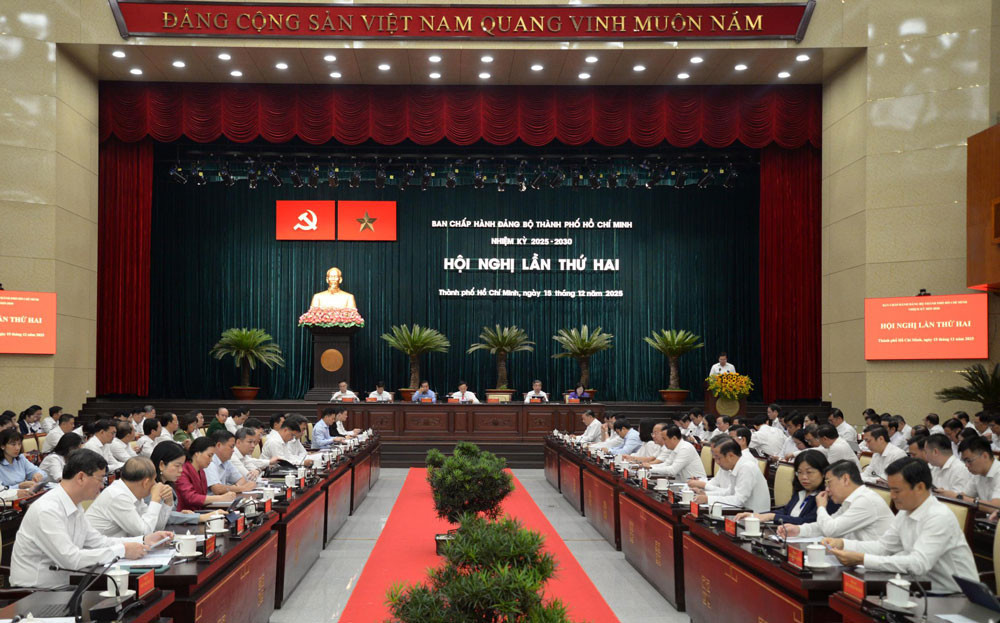
At the second session of the Ho Chi Minh City Party Committee for the 2025–2030 term, Party Secretary Tran Luu Quang identified nine priority tasks, calling for immediate efforts to resolve bottlenecks and maximize the city’s resources.
Held on December 15, the conference focused on the socio-economic situation in 2025 and strategic solutions for 2026. Key discussions included Party-building, administrative reforms, and citizen engagement. Two pressing urban issues - traffic congestion and public safety - were prioritized in the agenda due to their direct impact on residents' quality of life.
Solving the ‘compressed urban’ crisis with nearly 400 km of metro rail
According to Tran Quang Lam, Director of the Ho Chi Minh City Department of Construction, the city is under "tremendous infrastructure pressure," with more than 1 million cars and nearly 10 million motorbikes. Road usage has reached 100% of available urban transport land. The city center - overburdened by concentrated government offices and services - is now likened to a “compressed urban core,” with traffic at gateway areas spiking by 24%.
To solve this, the transportation sector is moving toward a sustainable and modern infrastructure model. There is promising progress in metro system development, thanks to new legal mechanisms provided by Resolution 188 and amendments to Resolution 98. These changes give the city unprecedented authority to fast-track major projects.
“We’ve never moved this quickly before. From now to 2030, we aim to complete six metro lines totaling 190 km. By 2035, five more lines will be built, bringing the total to nearly 400 km. These are the backbone corridors now being aggressively pursued by investors,” said Lam.
However, he warned that infrastructure alone isn't enough. Drawing on lessons from Singapore, he emphasized the need for a “push-and-pull” approach: making public transportation more accessible while discouraging private vehicle use. Technology will also play a central role in management and regulation.
Another high-priority area is the fight against drug crime. Major General Ta Van Dep, Deputy Director of the Ho Chi Minh City Police Department, stated that while the national target is to reduce drug presence in 50% of communes, HCMC and Hai Phong are aiming for a much more ambitious goal: 100% drug-free communes, wards, and townships by 2030.
To achieve this, the city police proposed four key solutions, emphasizing strong leadership and public consensus as critical components.
Nine strategic tasks to capitalize on the ‘diamond opportunity’

In his closing remarks, Secretary Tran Luu Quang said 2025 had yielded encouraging results, particularly in the early success of the new two-tier local government model and broad public support for revolutionary institutional and procedural reforms.
He described Resolution 260 - passed on December 11 to amend and supplement Resolution 98/2023/QH15 - as a “diamond opportunity” for the city’s development. The resolution introduces four major breakthrough mechanisms:
Leveraging land value around transit-oriented development (TOD) zones and allowing the city to retain 100% of the related revenue
Integrating economic and construction planning into a unified framework
Allowing strategic investors in 12 sectors to be directly appointed
Establishing a 3,800-hectare free trade zone in Can Gio
He also stressed the urgency of action, noting that if Resolution 98 expires in July 2026, the city will have only 18 months left to make meaningful use of its new powers.
To harness this limited window, the Secretary outlined nine specific tasks to be initiated at the beginning of 2026:
The Party Committee of the HCMC People’s Committee must develop a detailed implementation plan for Resolution 260.
Propose special mechanisms - within the city’s jurisdiction - to resolve lingering problems.
For key public and private investment projects, assign clear accountability to designated members of the Standing Committee.
Audit and digitize all public assets, especially land and buildings. Many properties are underused or misused, so a comprehensive public asset database is essential.
Accelerate the city’s overall economic and urban planning in line with Resolution 260 - this must be completed by the end of 2026.
Implement population redistribution by relocating universities and hospitals to nearby provinces such as Binh Duong and Ba Ria–Vung Tau.
Reorganize some party organizations to report directly to the City Party Committee.
Ensure uninterrupted electricity supply in all circumstances.
Establish a clear fiscal reward mechanism for local-level governments that meet key targets, encouraging grassroots excellence.
To conclude, Secretary Tran Luu Quang summed up the city’s action motto for 2026 in three “no” principles:
No avoiding difficult tasks
No waiting for others to take initiative
No passing the buck on interconnected responsibilities
This “three no” message is designed to help Ho Chi Minh City finally resolve long-standing issues - such as flooding, traffic jams, and stalled projects - and step confidently into a new phase of dynamic growth as the nation’s leading economic engine.
Quoc Ngoc
.svg)
