 Vietnamnet.vn

 Podcast



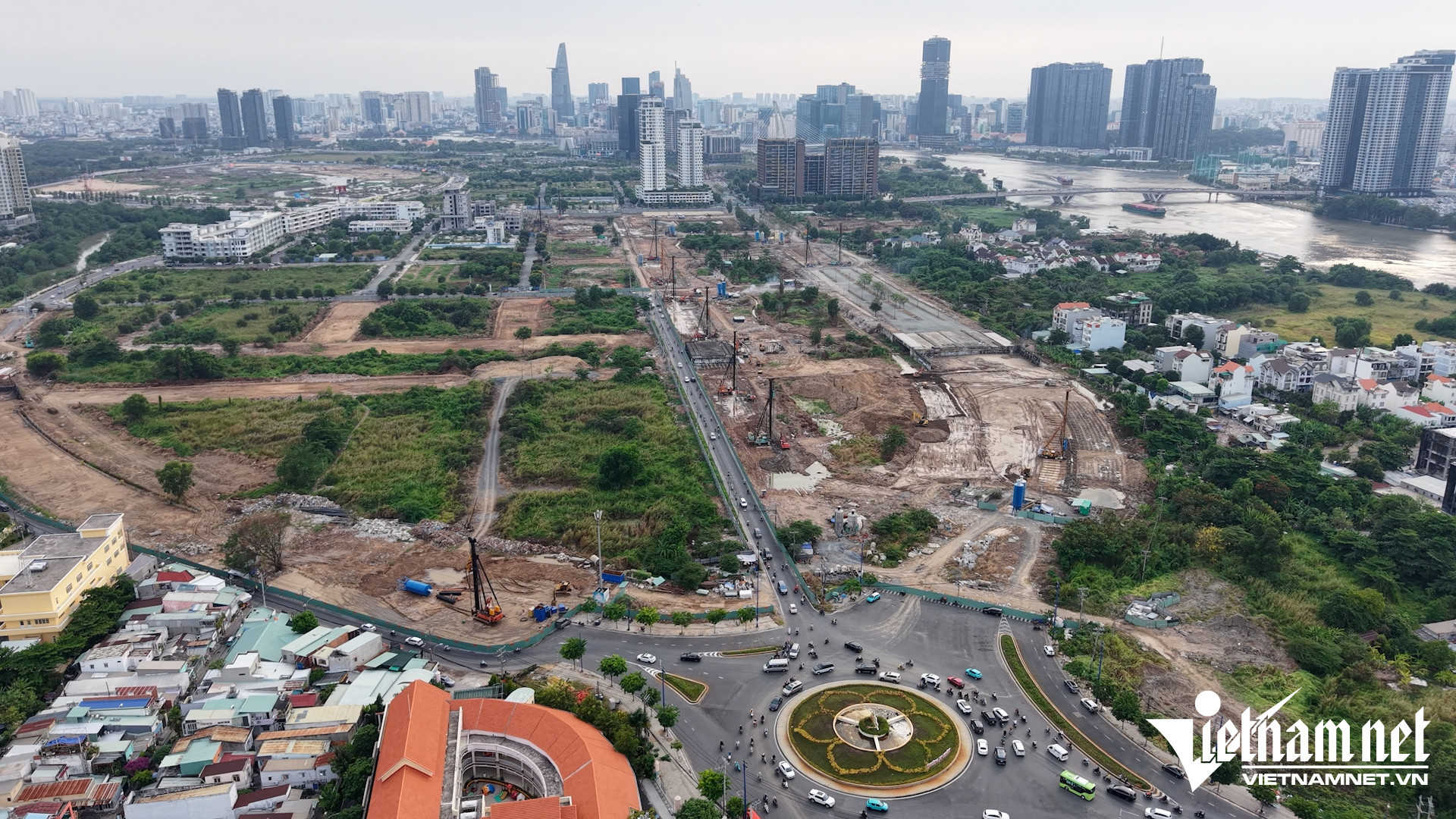
Ho Chi Minh City plans to use approximately 55 million cubic meters of offshore sea sand as filling material for infrastructure projects, while allowing stone quarries to extend extraction depths by another 50 to 100 meters to ease construction material shortages.
The measures were announced on October 15 by Nguyen Toan Thang, Director of the municipal Department of Agriculture and Environment, at a conference reviewing the city's socio-economic performance in the first nine months of 2026.
According to Thang, ongoing projects require approximately 44 million cubic meters of filling materials, but current supplies can meet only 5 million to 8 million cubic meters of that demand.
To ensure sufficient materials for public investment projects, the department is implementing three main measures.
First, the city has introduced an integrated planning approach for the first time, allowing quarries in the former Ba Ria-Vung Tau and Binh Duong areas to extend their extraction depths by 50 to 100 meters to increase output.
Second, the city is shortening the time required to process applications for mining licenses, license extensions and production capacity increases from 67-70 days to just 20 days.
Third, the department is applying provisions of the Urban Development Law to simplify or waive certain land and environmental procedures for quarries seeking to expand production capacity or extend their operating permits.
At the conference, Hoang Vu Thanh, Director of the municipal Department of Finance, reported that Ho Chi Minh City had disbursed approximately VND111.5 trillion (US$4.3 billion) in public investment funds as of September 30, equivalent to 75.5% of the annual target assigned by the Prime Minister.
To achieve its goal of disbursing 100% of the year's allocated public investment capital, the city must release an additional VND36.1 trillion (approximately US$1.39 billion) during the fourth quarter.
The Department of Finance has called on relevant agencies to accelerate administrative procedures and resolve obstacles affecting individual projects. It also urged authorities to clearly identify the agencies responsible for each task, set completion deadlines and specify the expected outcomes.
Regarding major infrastructure projects, Tran Quang Lam, Director of the municipal Department of Construction, said the city had held groundbreaking ceremonies or started construction on 19 projects since the beginning of the year.
Public investment disbursement for key transport projects has reached 95%, while compensation, land clearance and technical infrastructure relocation for public-private partnership (PPP) projects have reached 80% completion.
According to Lam, PPP and privately funded projects previously faced difficulties due to unclear regulations governing payment arrangements combining land and state budget funds, the timing of land allocation and land valuation methods.
Recently issued Decree 377/2026 has helped address these obstacles, particularly those affecting project appraisal, approval and contract signing.
In addition, the Urban Development Law, which took effect on October 1, introduces special accelerated procedures for major and strategically important projects.
Under the new provisions, compensation and land clearance can be separated from the main project and carried out in advance. Administrative procedures may also be processed simultaneously, while investors are granted greater flexibility in preparing project designs and cost estimates.
The city expects these measures to help speed up infrastructure development and maintain progress toward its public investment targets for 2026.
Phuoc Sang
.svg)
