Ho Chi Minh City is drafting special policies to develop science and technology urban hubs that connect research, high-tech manufacturing and commercialization, while preventing innovation projects from becoming property developments in disguise.
The HCMC Development Research Board, in coordination with committees of the municipal People's Council and relevant departments, held a workshop on November 23 to discuss the proposed urban development model.
The event was attended and chaired by Minister of Science and Technology Vu Hai Quan, HCMC People's Council Chairman Vo Van Minh, Vietnam National University-HCMC Director Nguyen Thi Thanh Mai and HCMC People's Committee Vice Chairman Truong Minh Huy Vu.
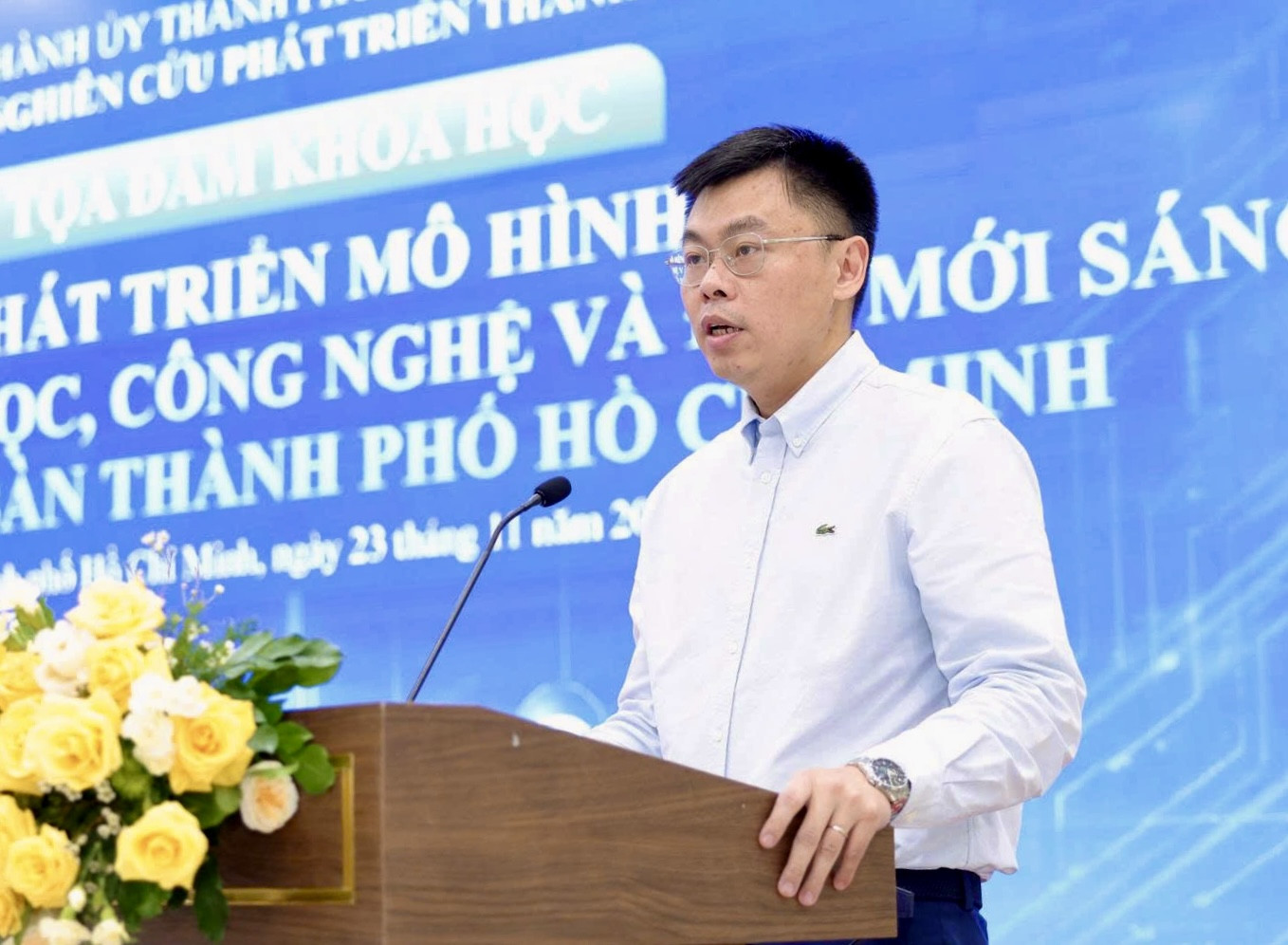
HCMC People's Committee Vice Chairman Truong Minh Huy Vu delivers the opening remarks at the workshop on November 23. Photo: Lan Phuong
Opening the workshop, Vice Chairman Vu said the city was at a strategic turning point in its development.
To maintain its position as Vietnam's leading economic hub and improve its global competitiveness, HCMC must move away from extensive growth toward a model driven by science, technology and innovation.
The direction is outlined in the Politburo's Resolution 09-NQ/TW and HCMC's master plan for 2025-2050, with a 100-year vision.
Under these plans, science, technology and innovation urban areas are identified as a key development model linking scientific research, pilot production and the commercialization of new products.
Vu said the workshop aimed to gather expert input for a draft resolution of the HCMC People's Council establishing criteria, mechanisms and policies for developing these urban areas.
Discussions focused on legal frameworks, administrative decentralization, delegation of authority and stronger cooperation among government agencies, universities, research institutions and businesses.
Science and technology urban hubs must not become property projects
HCMC People's Council Chairman Vo Van Minh said the workshop had received 50 papers from experts, scientists, universities, research institutes and businesses.
The submissions addressed the development model, a multi-centered network of connected innovation spaces, governance mechanisms, financing, skilled human resources and implementation challenges.
Minh outlined six priority areas for the city, beginning with a clear understanding of what constitutes a science, technology and innovation urban area.
Such developments must function as integrated ecosystems connecting research, education, manufacturing, business and urban life, rather than simply serving as designated functional zones or infrastructure projects.
In terms of spatial planning, HCMC should capitalize on the strengths of Vietnam National University-HCMC, other universities, research institutions, high-tech parks, industrial zones and businesses.
The goal is to establish an interconnected network supporting research, technology development, manufacturing and commercialization.
Minh also called for the urgent completion of the draft municipal People's Council resolution on criteria, mechanisms and policies for science and technology urban development, in accordance with the 2026 Law on Urban Development.
The proposed policies should address obstacles involving investment, land use, public assets, intellectual property, technology transfer and regulatory sandboxes.
Administrative procedures should be simplified through a single on-site management mechanism, fewer intermediary steps and a stronger shift from prior approval toward post-implementation supervision based on digital data and measurable outcomes.
The city should also prioritize suitable land for laboratories, testing centers, workforce training facilities, data infrastructure and innovation spaces.
Covers content
Not interested
Inappropriate
Seen too often
ADBRO is the full service ad network for high impact contextual advertising with direct access to the exclusive in-image inventories across major local publishers.
We provide free creative adaptation into rich media, interactive and playable ads formats. Campaigns in our channel are delivered under guaranteed prices for actions with programmatic & managed delivery. We provide contextually segmented in-target audiences for over 60 industries with a full range of brand safety solutions.
ADBRO operates across SE Asia, including Singapore, Vietnam, Indonesia, Thailand, Philippines and Malaysia.
To test our channel for your advertising campaigns or consider partnership programs for publishers, please contact us at www.adbro.me
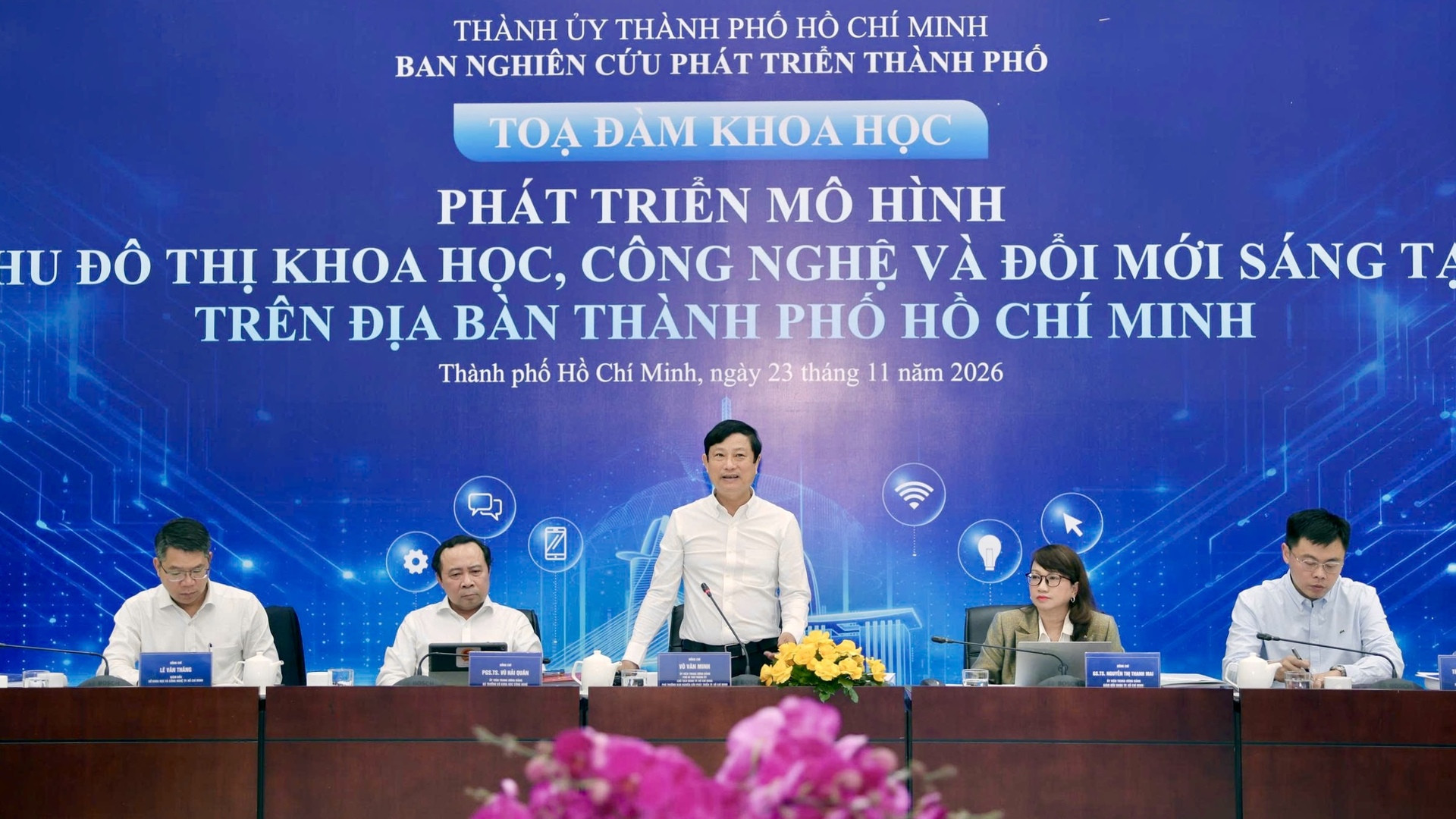
HCMC People's Council Chairman Vo Van Minh speaks at the workshop.
Regarding financing, Minh proposed using the municipal budget as seed capital for essential infrastructure, shared laboratories, data centers, high-speed networks and business incubation facilities.
At the same time, the city should attract private investment, expand public-private partnerships and develop a highly skilled workforce.
He particularly warned against establishing urban developments that use science, technology and innovation labels merely to qualify for incentives without conducting meaningful research or technological development.
"Policies must encourage innovation while remaining transparent, conditional and subject to risk controls, without allowing development to drift toward real estate," Minh stressed.
The proposed model should include evaluation criteria covering research capacity, commercialization outcomes, institutional connectivity, governance effectiveness and contributions to economic growth.
HCMC aims to establish a development roadmap through 2030, identifying feasible models, locations and priority tasks.
Minh urged the municipal People's Committee to assign relevant agencies, with the Department of Science and Technology serving as the coordinating body, to incorporate feedback and finalize the draft resolution for consideration at the People's Council's regular meeting in December 2026.
The city must also complete the resolution dossier, define development models and spatial arrangements consistent with its master plan, and prepare an implementation plan specifying responsibilities, timelines and expected outcomes.
Northern HCMC proposed as a high-tech innovation hub
At the workshop, business representatives proposed developing a science and technology urban area in northern HCMC under an integrated model.
The proposal features a central zone for research, education and innovation, surrounded by a high-tech manufacturing belt and supported by a multi-layered connectivity network.
The model seeks to bring universities, research institutions, high-tech parks and businesses together in a continuous value chain spanning research, experimentation, manufacturing and technology commercialization.
Priority industries would include semiconductor chips, artificial intelligence, robotics and automation.
To turn the proposal into reality, business representatives recommended four breakthrough programs covering transport infrastructure, industrial relocation, science and technology development and innovation, resource mobilization and workforce improvement.
They also emphasized the need to develop social infrastructure, housing and urban amenities to attract experts and highly skilled workers.
 Vietnamnet.vn

 Podcast