 Vietnamnet.vn

 Podcast



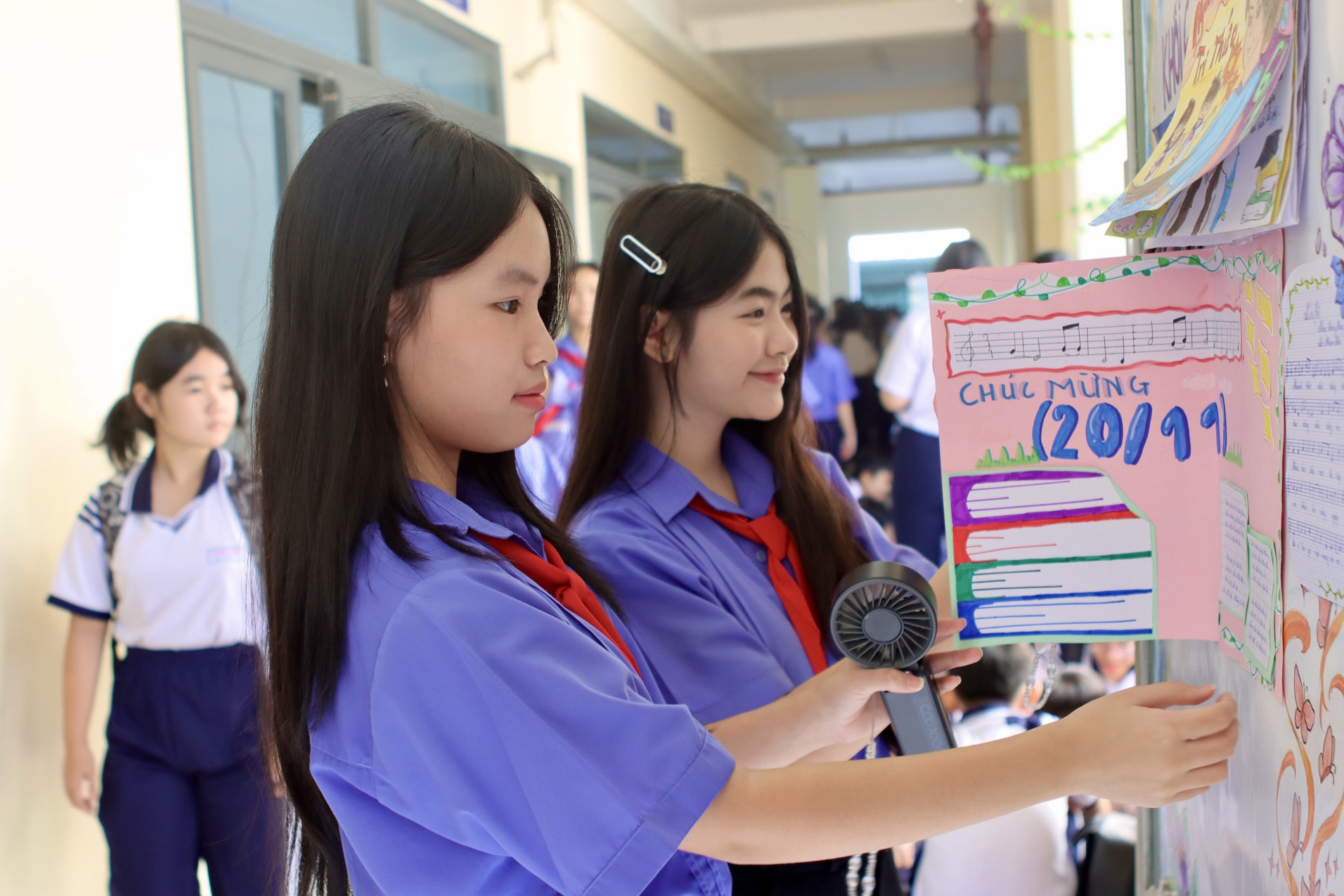
While Nguyen Van Luong Secondary School has caught public attention with the story that students only have to pay VND10,000 a month, many other schools show that parents are burdened because of multiple fees.
At the secondary school, fees are minimized to the lowest possible level. Integrated and enhanced programs are organized on a voluntary basis, where parents and students have the right to choose whether to participate. Opting out of these programs does not affect the students' core curriculum.
In reality, the highest total amount a student at Nguyen Van Luong Secondary School has to pay in a month, if participating in all services such as enhanced English program, boarding, and drinking water, is VND1,210,000.
Meanwhile, students who do not register for boarding do not have to pay for lunch and boarding service fees. Those who do not participate in any integrated or enhanced programs only pay VND10,000 for drinking water per month.
Tuition-free but other fees remain
In contrast to this model, social media has recently seen many posts from parents reflecting the burden of paying various kinds of fees at schools in HCMC, despite the general policy of tuition exemption. On the "HCMC Education" page, hundreds of parents shared details of the monthly fees they must pay for their children.
The account of Nga Thi Nguyen stated that at a secondary school in Nhieu Loc ward (HCMC), her family's total bill reached over VND2 million. Of this, many monthly fees stem from integrated programs such as: enhanced foreign language VND120,000; foreign language with foreign teachers VND235,000; life skills VND80,000; and STEM education VND100,000.
Similarly, the account of T. Huyen shared information about fees at a primary school in Binh Trung ward, HCMC. According to this parent, besides regular expenses, the family has to pay extra for integrated programs: enhanced foreign language VND30,000 per month, life skills VND80,000 per month, and thinking skills VND100,000 per month. The English program with foreign teachers integrated with Math and Science costs up to VND550,000 per month.
The account of Phan Thi Thanh Van reported fees at a primary school in Tay Thanh ward, HCMC. This parent noted that monthly integrated programs include: life skills VND70,000, STEM education VND90,000, and foreign language with foreigners VND195,000. Specifically, the integrated Math and Science English program costs VND550,000 per month. Additionally, students pay for elective IT and enhanced foreign language at VND34,000 per month each.
Another parent at a primary school in Bay Hien ward, HCMC said they pay for integrated programs like: life skills VND70,000, English with foreign teachers VND210,000, talent classes, elective physical exercise, and clubs VND170,000. Furthermore, the family pays an additional VND90,000 per month for the STEM education program.
Voluntary or mandatory?
Le Thi Huyen, a mother with a child studying in HCMC, said that at the start of the school year, homeroom teachers usually collect opinions on registering for integrated subjects.
Although schools affirm that participation is voluntary, she feels that if parents do not register, students are often separated to self-study or engage in separate activities during those hours.
This can easily make children feel different or even develop an inferiority complex compared to their peers. Consequently, many parents reluctantly register for their children.
From this reality, many parents argue that although students are exempt from tuition by law, the actual total monthly cost remains high due to excessive fees from integrated programs.
This raises questions about the nature of "being voluntary," the necessity, and the appropriateness of these fees in the current public education environment.
At a press conference on December 18, Ho Tan Minh, Chief of Office of the HCMC Department of Education and Training, affirmed that the 2018 General Education Program does not have "voluntary subjects" or "integrated subjects."
Instead, it aims to form 10 competencies and five qualities for students through core subjects and educational activities.
Beyond official school hours, schools may organize supplementary activities such as experiential learning, career orientation, STEM/STEAM, and reading culture tailored to student needs.
Minh emphasized that programs must be built transparently, approved by the school board and the parents' representative committee; parents have the right to choose, and students are not forced.
Thanh Hung
.svg)
