 Vietnamnet.vn

 Podcast



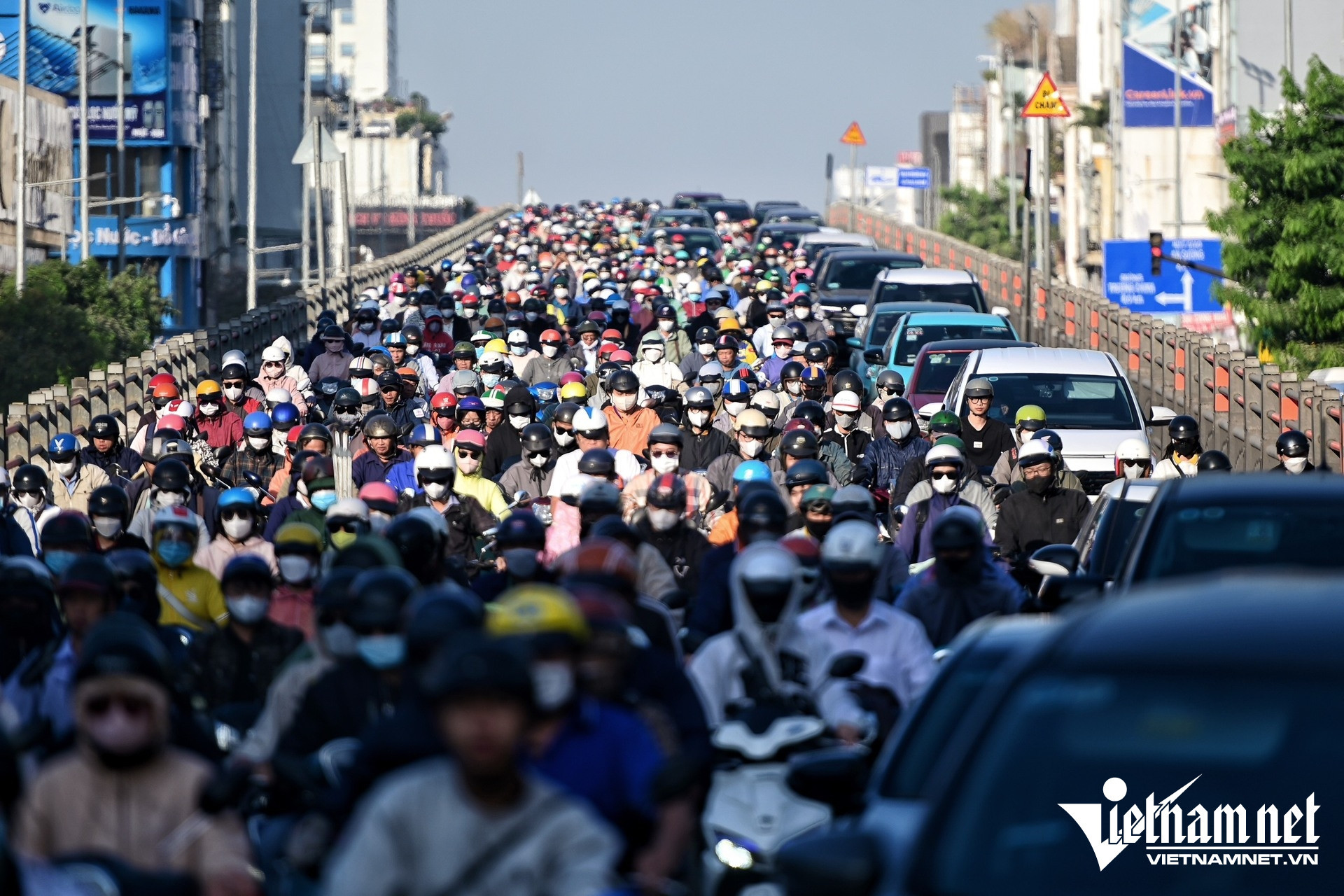
Speaking at the "People Ask, Authorities Answer" program on October 11, Tran Quang Lam, director of the Ho Chi Minh City Department of Construction, said the city had identified 28 locations frequently at risk of serious traffic congestion and was determined to resolve these bottlenecks by 2030.
"As a megacity, Ho Chi Minh City constantly faces the threat of traffic congestion. We aim to eliminate all 28 bottlenecks between now and 2030," Lam said.
According to the official, the city is implementing 98 projects to address congestion, including improvements to major intersections such as My Thuy, An Phu and Nguyen Van Linh - Nguyen Huu Tho, upgrades to National Highways 13 and 1, and the Nguyen Khoai and Binh Tien bridge and road projects.
Transport infrastructure accounts for approximately 70% of the city's total investment capital. Several smart parking facilities and large underground parking complexes are also expected to begin construction this year.
On regional connectivity, Lam described Ring Road 3 as a potential "golden goose" because of its role in linking provinces across southeastern Vietnam and supporting the development of an industrial belt.
Together with Ring Roads 2 and 4, National Highways 1, 13, 50 and 22, and the Ho Chi Minh City - Chon Thanh and Ho Chi Minh City - Moc Bai expressways, these routes will form the backbone of the region's transport infrastructure, with completion targeted for 2030.
With a current population of around 14 million, projected to reach 25 million over the next decade, Lam acknowledged that the city's existing infrastructure remains inadequate. He identified the metro system as a fundamental long-term solution.
The current master plan includes 28 metro lines spanning approximately 1,015 kilometers, with proposals to expand the network to 1,500 kilometers.
The city aims to complete around 255 kilometers of metro lines by 2030 and approximately 500 kilometers by 2035.
Regarding implementation mechanisms, Lam said National Assembly Resolution 188 allows Ho Chi Minh City and Hanoi to apply special procedures for metro development.
These include eliminating the preliminary investment policy approval stage, proceeding directly to feasibility studies and allowing direct contractor appointments to shorten project timelines.
In maritime transport, Ho Chi Minh City accounts for approximately 65% of Vietnam's total container throughput. With annual growth forecast at 5-6%, further expansion of port infrastructure is necessary.
Construction of the Can Gio International Transshipment Port is expected to begin this year, while the Cai Mep Ha Port project is undergoing the necessary procedures ahead of construction. The Cai Mep Ha Luu Port project is being prepared for a subsequent development phase.
In aviation, Tan Son Nhat International Airport currently handles approximately 42 million passengers annually, accounting for about 37% of Vietnam's air passenger market.
The airport has been expanded to accommodate up to 50 million passengers a year.
Plans for Con Dao Airport will also be revised to allow expansion, alongside efforts to strengthen connectivity with Long Thanh International Airport.
Lam expressed confidence that these ambitious targets were achievable, citing the new legal framework established under the Law on Urban Development.
Integrated transport planning essential to avoid fragmented investment

Speaking at the program, Nguyen Truong Nhat Phuong, vice chairwoman of the Ho Chi Minh City People's Council, stressed that developing a multimodal transport system requires more than building additional infrastructure.
She said different transport modes must be organized and connected in a coordinated manner, consistent with the city's master plan and long-term urban development strategy.
To make effective use of available resources, the city must identify clear priorities and avoid spreading investment too thinly.
Priority should be given to projects that remove major traffic bottlenecks, strengthen regional connectivity and improve access to seaports, airports, logistics centers and emerging economic growth areas.
Phuong also called for coordinated mobilization of public funding, private investment and land resources through transit-oriented development (TOD), which integrates urban development with public transport infrastructure.
Such investment mechanisms, she said, must comply with legal requirements while balancing the interests of the state, businesses and residents.
With the Law on Urban Development taking effect on October 1, Ho Chi Minh City has gained a stronger legal foundation for mobilizing resources to develop roads, railways, underground infrastructure and logistics facilities.
The municipal People's Council will work with the People's Committee to translate the new policies into concrete measures, oversee implementation and promptly address obstacles as they arise.
Phuoc Sang
.svg)
