 Vietnamnet.vn

 Podcast



On the afternoon of December 9, the city’s leadership, led by Party Secretary Tran Luu Quang, met with members of the science, technology, and innovation community to explore concrete steps toward this ambitious goal.
Seeking breakthroughs from Vietnam’s tech visionaries
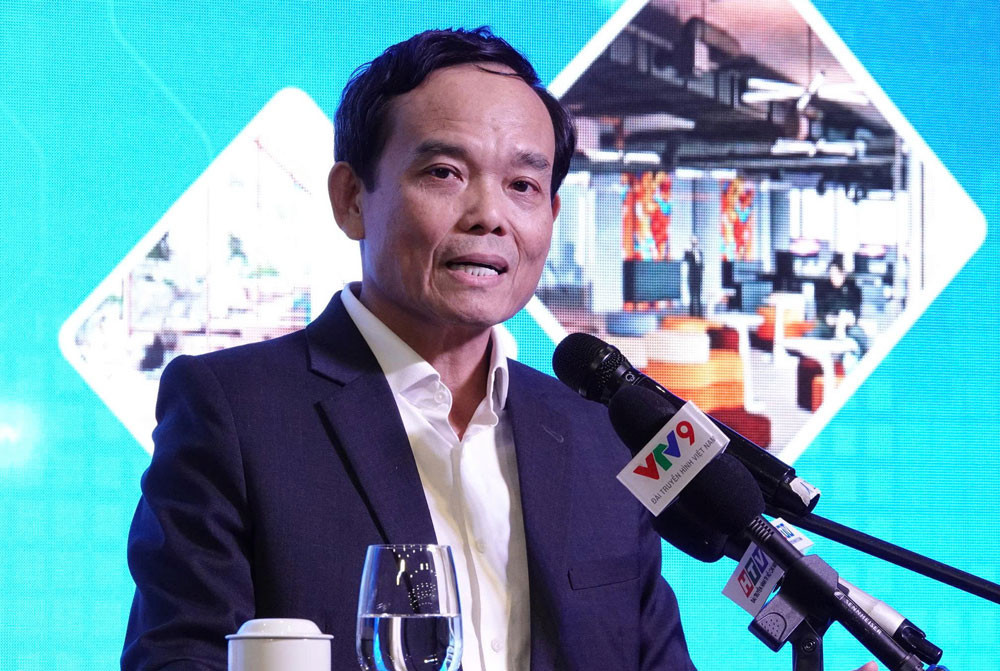
Opening the dialogue, Secretary Quang candidly shared his concerns and posed two fundamental questions to the community.
First, how can HCMC truly become the nation’s center for science, technology, and digital innovation - and sustain that leadership role?
Second, where should the city start, what should the priorities be, and how can it secure the necessary resources?
In response, FPT Chairman Truong Gia Binh presented insights from Japan, which is shifting strategic partnerships toward Southeast Asia - with Vietnam as the top priority, especially in the field of the low-altitude economy (LAE).
However, Binh pointed out that Vietnam currently lacks an institutional framework. "We don’t have regulations defining sandbox models, no standards or certificates of origin, and no permits - essentially, we lack everything," he said.
Despite these limitations, Binh proposed a bold idea: turning HCMC into the drone capital of Vietnam with a $10 billion UAV industry that could create one million jobs over the next decade.
Supporting this vision, Dr. Luong Viet Quoc, CEO of Real-time Robotics, shared how a “Made in Vietnam” drone stunned U.S. military officers at a Las Vegas tech exhibition - something even other tech powers had not achieved.
He affirmed that Vietnamese engineers can compete globally, noting that his R&D costs are just one-twentieth and manufacturing costs 30–40% lower than in the U.S. “There’s no reason we can’t compete fairly,” Quoc asserted.

On another front, Tran Kim Chung, Chairman of CT Group, proposed a new model of a “for-profit innovation center” powered by artificial intelligence, Web3, and blockchain. This concept departs from the conventional nonprofit startup incubator approach.
“All ideas, at every stage of development, could become digital assets. AI will help connect them with interested customers, automatically determine valuations, and facilitate transactions,” Chung explained.
He also suggested franchising this model to quickly scale it across the city, envisioning multiple profit-driven innovation centers throughout HCMC.
Contributing to this ecosystem vision, CMC Corporation Chairman Nguyen Trung Chinh emphasized the importance of data infrastructure. He shared that international partners are ready to increase investment in HCMC-based data centers from $1 billion to $5 billion - if the city commits to becoming an “AI hub” or “digital hub” for the region.
To support this, he proposed appointing a “chief architect” for each specialized field to tackle pressing urban challenges such as flooding, traffic congestion, and pollution through AI solutions.
Action plans grounded in practical needs

To realize these ambitions, human capital and intellectual collaboration will be key.
Professor Nguyen Thi Thanh Mai, Vice President of Vietnam National University HCMC, suggested that the city assign the university the role of coordinating knowledge across local institutions and research centers.
She emphasized the need for annual science and technology forums to convey the city’s innovation message to the world. As an example of effective academic-business collaboration, she revealed that just days before the event, her university secured six research projects worth over VND 20 billion (USD 820,000) with Dr. Quoc’s firm.
Listening intently and taking notes, Secretary Quang concluded by affirming that developing science and technology is not just vital for economic growth, but also crucial to solving urgent urban issues like traffic jams, flooding, pollution, and even the city's vision of a drug-free society.
"If we succeed in science and technology, it will help us tackle our current challenges using scientific tools," he remarked.
Specifically, Quang voiced strong support for the LAE sector and UAV production, calling them practical and achievable goals.
On policy, he pledged strong backing for sandbox models and financial incentives. For instance, HCMC would offer tax breaks and waive fees for any entity establishing venture capital funds in priority tech sectors.
To implement the plan, Quang assigned two agencies: the Department of Science and Technology will act as the lead coordinator, while the HCMC Institute for Development Studies will be in charge of policy proposals, incentives, timelines, and prioritization.
Closing the event, he issued a powerful call to action: "Let us dream big. Let's dream of transforming Ho Chi Minh City into a true innovation hub. And to make that dream real, we must begin with the smallest, most concrete actions - starting tomorrow."
What is the low-altitude economy (LAE)?
LAE refers to a newly emerging economic ecosystem centered around activities in low-altitude airspace (typically under 1,000–3,000 meters). It primarily leverages drone (UAV) technology, electric vertical takeoff and landing vehicles (eVTOL), and related systems for applications in agriculture, logistics, transport, surveillance, rescue, healthcare, and entertainment. LAE is poised to drive a new wave of digital transformation and economic growth.
Quoc Ngoc
.svg)
