 Vietnamnet.vn

 Podcast



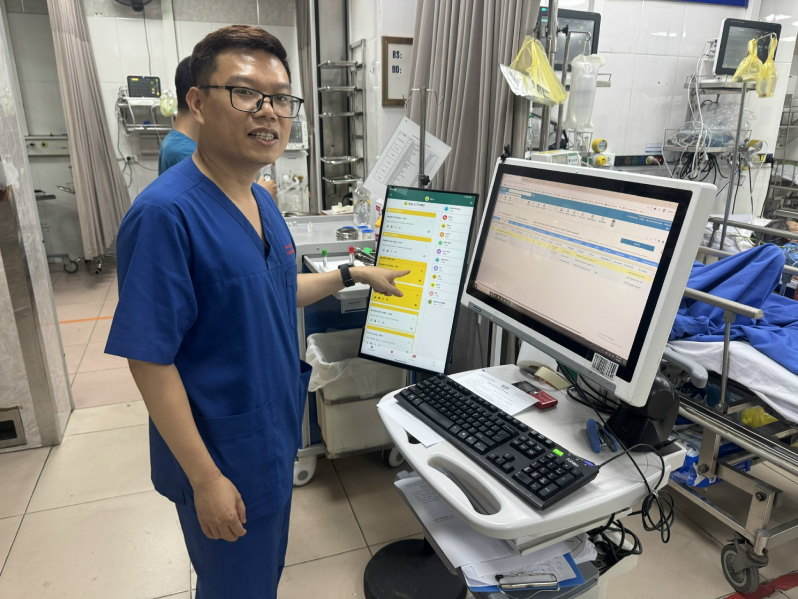
Dr Ngo Duc Hung, Deputy Director of the Emergency and Intensive Care Center, while guiding reporters on a tour, introduced a "home-grown" product that he built after many months of research: an emergency management software designed to fit the department's operational workflow.
At the reception area, nurses quickly assess vital signs, pain levels, blood pressure, and heart rate of patients, then enter the data into the system.
Within just a few seconds, the software will suggest the severity level using a color system (red, orange, yellow, green). After verification by medical staff, all information will sync onto the central screen and the treatment rows.
At the head of each hospital bed, there is a small slip printing basic information along with a QR code so that family members can track the patient's treatment status. Doctors call this the inquiry-settling QR.
Each emergency row has an electronic board displaying the patient list. Cases requiring urgent intervention will flash alerts through the system. Doctors issue orders on the software, and nurses receive notifications and execute them. Upon completion, nurses click the confirmation button so that the entire team knows the progress.
"Previously, the Emergency Department was very noisy. Doctors called nurses, nurses asked doctors back, wrote things down, and then ran to find each other. Now, all information appears on the screen, so the department is much quieter," Dr Hung said.
Bringing real-world workflows to digital space
With more than 20 years working in the emergency field, what concerned Dr Hung most was not the lack of equipment but the increasing pressure as the number of patients grew rapidly while human resources remained almost unchanged.
"The emergency department is a special place because patients enter continuously, with highly diverse illnesses ranging from internal medicine, surgery, and trauma to obstetrics and pediatrics. If the process is not good, it is very easy to fall into a state of overload and chaos," Dr Hung said.
Previously, patient classification was mainly performed manually using color cards hung at the head of the bed. Each color corresponded to a different priority level. This method helped with quick identification but still relied heavily on paperwork and the memory of medical staff.
"I wanted to bring the entire real-world workflow to the digital environment so that staff do not have to remember too many tasks at the same time. Most importantly, the software must be built by the emergency personnel themselves, not from the perspective of a programmer," Dr Hung said.
This idea had been nurtured by Dr Hung for many years. After coming to work at Hanoi Medical University Hospital, he spent about three months building the process, designing the interface, and an additional month cooperating with the information technology department to complete the software.
Initially, many staff members were hesitant because they were accustomed to the old way of doing things. However, after only one week of trialing, the entire department switched completely to using it. The efficiency was visible almost immediately.
"Many tasks increased efficiency by up to 10 times. Previously, with only about 90 to 95 patients, the department was already at risk of overloading, but now there are times we receive 150 patients simultaneously while everything remains under control," Dr Hung said.
In reality, nurses in the emergency department have to handle numerous tasks at the same time. If relying solely on paperwork or verbal orders, it is very easy to omit or confuse items, whereas just a small mistake can affect a patient's life.
One click replaces dozens of calls
Not only changing the way patients are classified, the emergency management software also alters the way doctors, nurses, and administrative staff coordinate.
Previously, after issuing orders, doctors had to often call nurses to remind them to administer medicine, take lab tests, or perform procedures. When patients were crowded, verbal communication easily caused confusion. Currently, all operations are executed on the system.
Doctors only need to click a button to issue an order, and nurses will receive the notification immediately. Upon completion, nurses confirm completion on the software, and doctors can track the progress in real time.
According to Dr Hung, the greatest value of the system is demonstrated in red-alert cases such as multiple trauma, cardiac arrest, or acute hemorrhagic shock.
"In emergency care, being slow by just a few minutes can be traded with the patient's life. When the process is digitalized, the mobilization of specialties occurs almost instantaneously," he emphasized.
Phuong Thuy
.svg)
