 Vietnamnet.vn

 Podcast



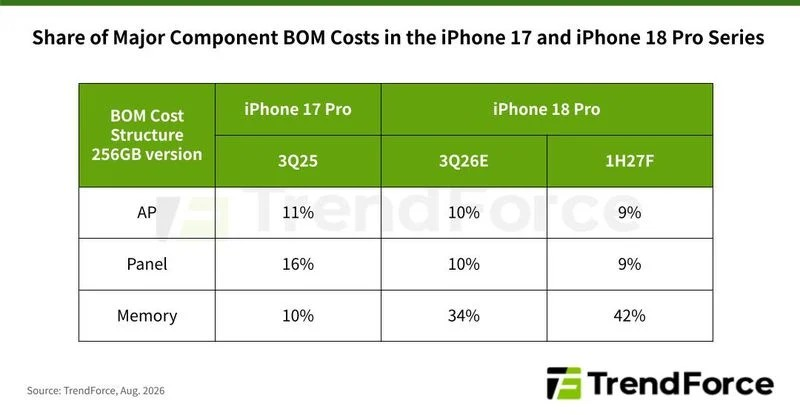
According to research firm TrendForce, the bill of materials (BOM) for the 256GB iPhone 18 Pro is expected to be around 38% higher than for the iPhone 17 Pro with the same storage capacity. The increase is being driven primarily by memory prices, which have risen five- to sevenfold since the beginning of 2025.
Memory is becoming one of the most expensive components in a smartphone.
For the 256GB iPhone Pro, memory accounted for only around 10% of total component costs a year ago.
TrendForce estimates that share will rise to around 34% in the third quarter of 2026 and could exceed 40% in the first half of 2027.
The shift is reshaping the iPhone's cost structure. In the past, the application processor (AP) and display panel were the two component categories that accounted for the largest shares.
As memory prices climb, however, each of these two components is forecast to account for only a single-digit percentage of total costs.
TrendForce believes Apple could choose to absorb some of the increase through a lower gross margin rather than passing the entire additional cost on to consumers.
The company has previously adopted this strategy with some recent MacBook models, helping limit price increases while maintaining sales volumes.
Apple could also adjust prices for older iPhone models when the new generation arrives.
Raising prices across the broader lineup would allow the company to spread some of the higher component costs rather than placing the entire burden on the iPhone 18.
Even so, pressure to raise prices is mounting. In June, Apple increased prices on several products, including the Mac, iPad, Apple TV, HomePod and Vision Pro, as memory costs rose. The iPhone lineup was not affected at the time.
Android manufacturers are expected to face even greater pressure. According to TrendForce, budget and mid-range smartphones operate on thinner profit margins, making it more difficult for manufacturers to absorb steep increases in component costs.
These companies may have to raise prices more aggressively than Apple, or even discontinue models that are no longer profitable.
TrendForce forecasts that global smartphone production will remain under downward pressure from the second half of 2026.
Apple is expected to unveil the iPhone 18 Pro, iPhone 18 Pro Max and its first foldable iPhone next month.
Du Lam
.svg)
