 Vietnamnet.vn

 Podcast



Concise and restrained in tone, the speech did more than summarize the final meeting of the term. It served as a strategic declaration-solidifying viewpoints, locking in principles of action, and outlining breakthrough directions for the five years ahead.
With Congress XIV on the horizon, this moment marks the final alignment of perspectives before Vietnam enters a more challenging and complex development phase-one that will demand far greater execution discipline than previous stages.
A new development era and Vietnam’s historic arc
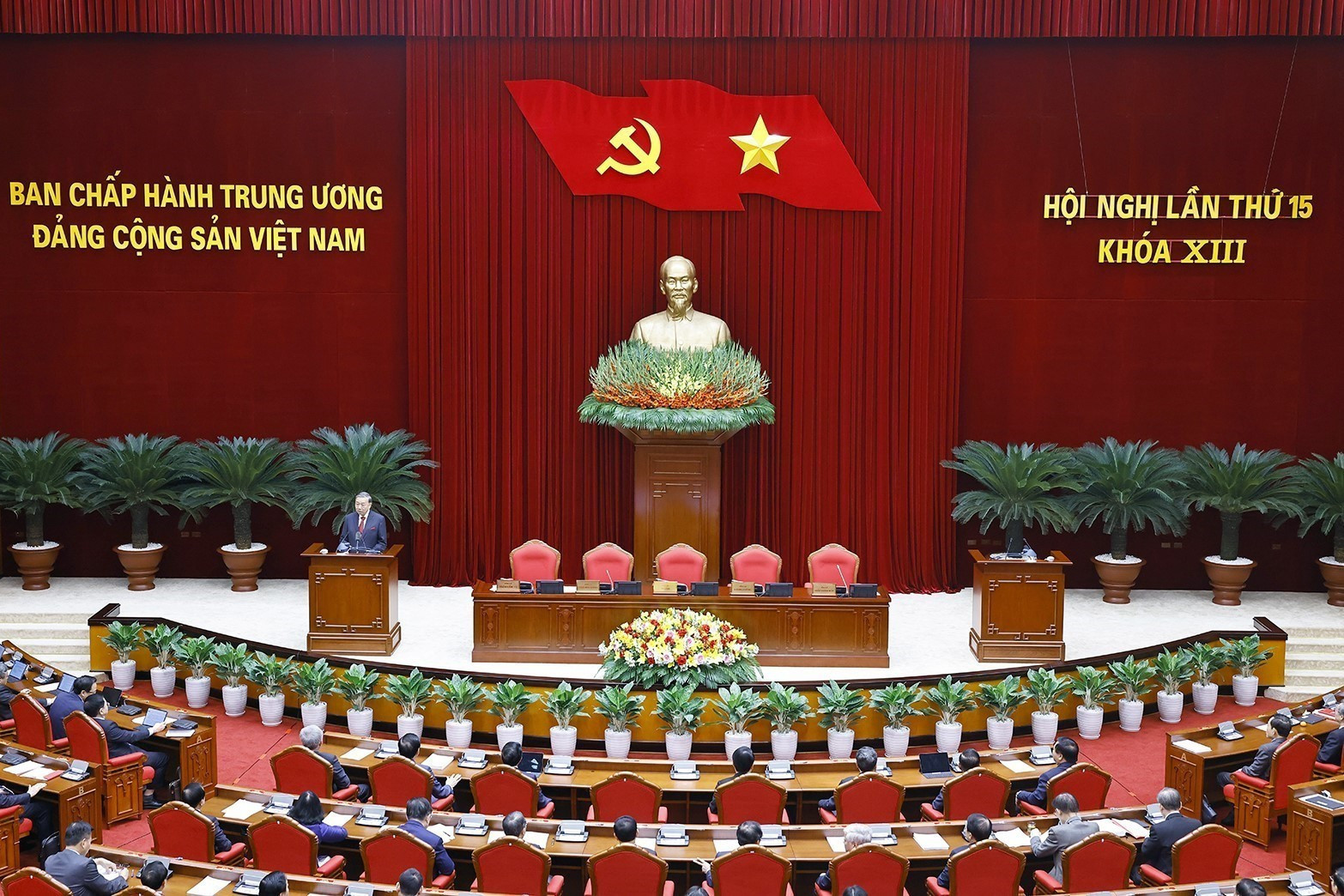
A core theme running through the General Secretary’s speech was the placement of the 15th Plenary Session and upcoming Congress XIV within the long historical arc of the nation.
Nearly 100 years of Party leadership, 40 years of Doi Moi reforms, and the ongoing commitment to the 1991 Political Platform-along with its 2011 revisions-were cited to reaffirm one essential point: Vietnam’s development path is a cumulative outcome of sustained effort, tested by real-world experience.
This message is crucial as reform enters more sensitive terrain.
Institutional overhauls, decentralization, growth model innovation, administrative restructuring, and resource reallocation are no longer merely technical tweaks-they touch entrenched interests, habits, and operational systems built over decades.
Affirming the correctness of the reform direction and the path toward socialism tailored to Vietnam’s conditions is a vital ideological anchor for future transformations.
Equally notable was the speech’s emphasis on unity and social consensus-factors deemed decisive to realizing the breakthroughs envisioned for the next stage.
Strategic autonomy in an uncertain world
The speech reaffirmed a key principle: sustaining strategic autonomy and national resilience in all circumstances.
This takeaway stems from the hard-earned experience of the 13th term, which saw external upheavals ranging from the pandemic and extreme weather events to geopolitical tensions, supply chain disruptions, and global economic shocks.
The lesson: Vietnam’s development trajectory cannot rely solely on external forces.
Deep integration remains a strategic choice, but without self-reliance, the nation risks vulnerability amid shifting global dynamics.
This principle will shape policy across the next term-from foreign capital flows, foundational industry development, and energy security to foreign affairs in a landscape of rising strategic competition.
Strategic autonomy does not mean isolation, but rather the ability to assert one’s position proactively within a realigned global order.
Three strategic breakthroughs for the new era
The speech’s most important focus was the Party’s adoption of three strategic breakthroughs to steer Vietnam’s upcoming development phase. The order of these breakthroughs reflects a marked shift in development thinking.
The first breakthrough is institutional reform-linked to decentralization, science and technology, innovation, and digital transformation.
Placing institutions first shows a mature recognition: if Vietnam fails to resolve institutional bottlenecks, no other resource-be it capital, labor, or technology-can be effectively mobilized.
Decentralization in this context is not mere administrative reform. It is essential for unleashing local innovation, shortening policy lags, and enabling new production and business models.
The second breakthrough involves restructuring and enhancing the quality of human capital, alongside bold reforms in personnel management.
The call to protect cadres who dare to think, act, and take responsibility sends a clear message: reform cannot succeed under a bureaucratic mindset fixated on safety.
This is the most difficult breakthrough-because it deals with people and systemic operations-but it is also the most decisive.
The third breakthrough is infrastructure development, especially in transport, digital, and energy systems.
Infrastructure here goes beyond public investment. It is the physical backbone for a new growth model and for achieving industrialization and modernization in the age of digital transformation and energy transition.
Six priorities and the execution test
While the three breakthroughs serve as strategic levers, the Party also identified six implementation priorities for the next term.
These range from Party-building and legal reform to developing a socialist-oriented market economy that better empowers the private sector, advancing science and technology, nurturing culture and human capital, and safeguarding national defense, security, and foreign policy.
What’s critical is the tight interconnection among these areas.
Private sector growth demands institutional reform. Science and technology need skilled human resources. Culture and people are seen not as auxiliary to development, but as its endogenous foundation.
This approach requires strong coordination capacity-and even more importantly, rigorous execution discipline within the apparatus.
That is both the biggest current bottleneck and the greatest test ahead.
The unified personnel vote outcome at the session underscores the priority placed on consensus and continuity, laying the groundwork for a term expected to face complex and sensitive decisions.
Congress XIV: A milestone for national progress
In closing, the General Secretary called Congress XIV a landmark political event for Vietnam.
But beyond formality, the real weight lies in the public’s expectations for this Congress: to launch a new development chapter with higher standards for growth quality and governance capacity.
The closing speech of the 15th Plenary set out very specific demands.
Vietnam’s development opportunities will only materialize if its strategic breakthroughs are fully realized-with discipline in execution and clear accountability at every level, in every sector, and by every individual in the system.
That is the defining challenge for Congress XIV-and for Vietnam’s next five years of development.
Tu Giang
.svg)
