 Vietnamnet.vn

 Podcast



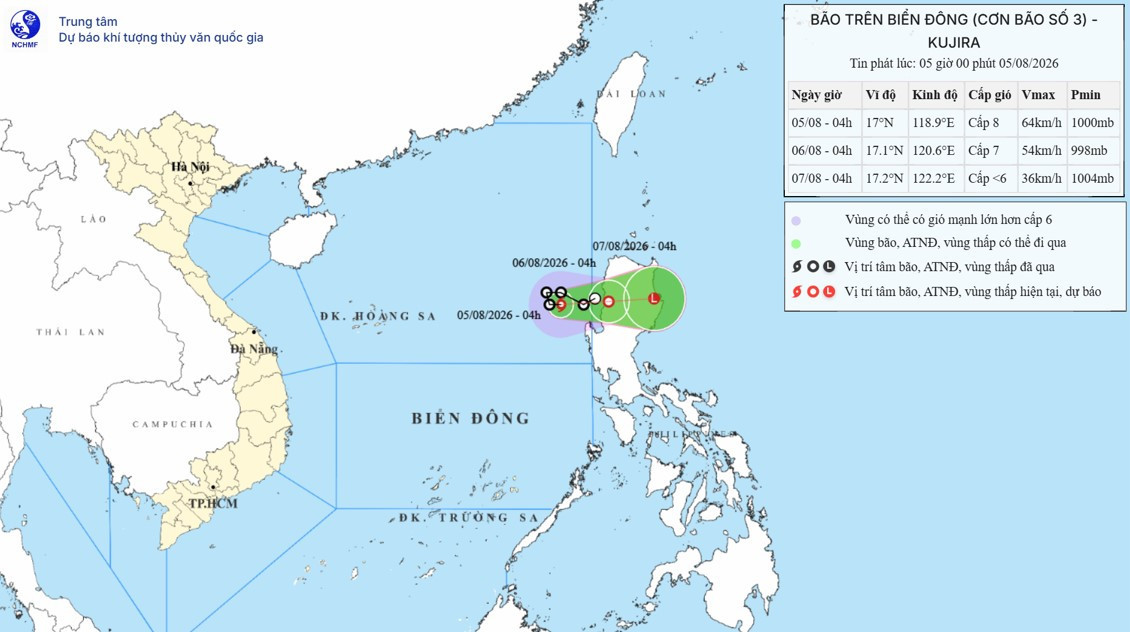
According to the Vietnam National Center for Hydro-Meteorological Forecasting (NCHMF), at 4 a.m. on August 5, the center of Tropical Storm Kujira was located over the southeastern waters of the northern East Sea.
Maximum sustained winds near the storm's center reached 62-74 km/h (39-46 mph), equivalent to Beaufort Force 8, with gusts up to Force 10. The storm was moving eastward at around 10 km/h.
Forecasts indicate that over the next 24 hours, the storm will move east-northeast at approximately 5-10 km/h.
By 4 a.m. on August 6, the storm's center is expected to be northwest of Luzon Island in the Philippines, where it is forecast to weaken into a tropical depression, with sustained winds of Force 7 and gusts up to Force 9.
During the following 24 hours, the system is expected to continue moving east-northeast at 5-10 km/h.
By 4 a.m. on August 7, the center is forecast to be northeast of Luzon before weakening further into a low-pressure area.
The storm is expected to generate Force 6-7 winds, with gusts reaching Force 9, across the southeastern waters of the northern East Sea. Areas near the storm's center could experience sustained Force 8 winds with gusts up to Force 10.
Wave heights are forecast to reach 2-4 meters, with rough sea conditions expected.
The weather agency warned that vessels operating in the affected waters could encounter thunderstorms, waterspouts, strong winds and high waves.
According to the NCHMF, Tropical Storm Kujira is not currently forecast to affect Vietnam's coastline or mainland.
In its 8 a.m. update on August 5, the forecasting center said the storm had shown very little movement during the previous three hours.
As of 7 a.m., the storm's center remained over the southeastern waters of the northern East Sea, with maximum sustained winds still at Force 8 (62-74 km/h) and gusts reaching Force 10. The storm was moving eastward at only 3-5 km/h, reflecting its unusually slow forward speed.
Bao Anh
.svg)
