 Vietnamnet.vn

 Podcast



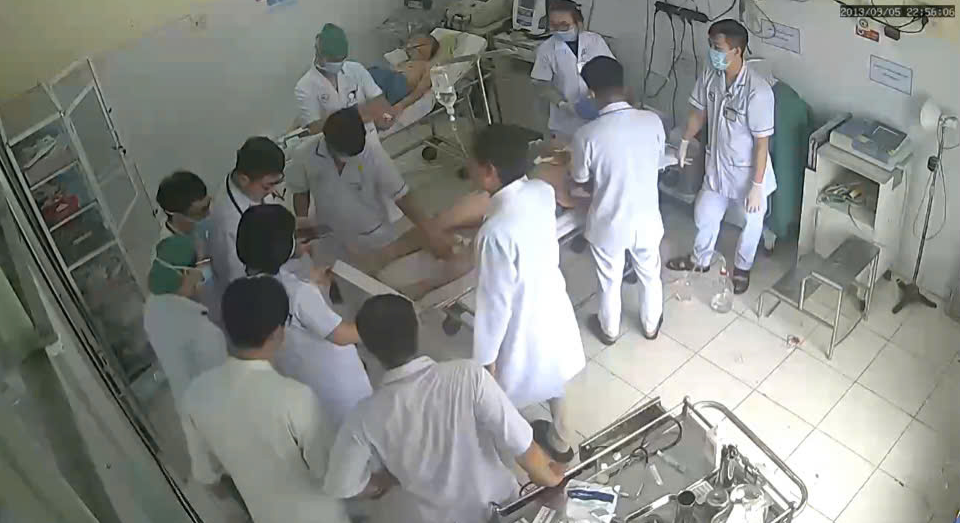
Anh, 40, from Le Ich Moc in Hai Phong, still cannot forget those brief minutes that turned him, a healthy man and family breadwinner, into a cardiac arrest patient with brain hypoxia and severe cervical spine injury. Doctors assessed his chance of survival at only 0.1 percent.
Earlier, a trip to Nha Trang in August 2025 had been a simple dream he cherished for years. After long days of hard work, he and his wife decided to take their three young children to a place tied to his youth. The first days were filled with joy and laughter, moments that seemed destined to become beautiful memories forever, until tragedy struck.
His wife, Hoang Thi Hoa, recalled that around noon on August 27 while the family was at a resort, she stepped away for a few minutes. When she returned, a panicked crowd had gathered. Seeing her husband motionless, his body turning blue and abdomen swollen with water, nearly broke her.
In panic, she could only cry out for help. Bystanders attempted first aid as each second felt unbearably long. By the time the ambulance arrived, his heart had stopped.
At the hospital, the battle intensified. Anh was diagnosed with cardiac arrest and water-filled lungs. CT scan results delivered another blow: a fractured cervical vertebra compressing the spinal cord, posing a risk of paralysis, along with brain damage from prolonged oxygen deprivation. Each diagnosis made hope more fragile.
Hoa still remembers the doctor’s words: “The chance of survival is nearly zero. Please prepare mentally - there are only a few hours left.”
In that moment, she did not fully understand the meaning of those words. She simply signed the papers, entrusting her fragile faith to the medical team and telling herself that her husband still had to live for the three children waiting for their father to return.
The 72 hours of therapeutic hypothermia to save brain tissue after cardiac arrest was the longest and heaviest period. It was the deciding boundary: either wake up or fall into a permanent coma, living in a vegetative state. Every machine beep in the ICU felt like the heartbeat of the entire family. Every time the loudspeaker called a patient’s name, Hoa’s heart skipped a beat, fearing that the familiar name would echo in the list of those with no more chances.
And a miracle happened. Nearly three days later, Anh opened his eyes. Without words or movement, he signaled life with tears.
His recovery did not end there. After emergency care, he was transferred to Cho Ray Hospital in HCMC for cervical spine surgery.
The following months were extremely difficult. He could not move his limbs, had to eat through a tube, and struggled to speak. Even the simplest human actions - moving a finger, swallowing a spoonful of porridge, or pronouncing a word - became challenges.
The miracle
Throughout those days, Anh was supported by his resilient wife and family. Gradually, small changes appeared: a slight finger movement, clearer eye contact, more distinct sounds. These small things, insignificant to others, were major milestones for him and his family, faint lights in a long, dark journey.
Seven months after the day, the man who once stood between life and death can stand up, take his first steps, eat on his own, and speak again.
Le Tran Anh Thi, Director of Khanh Hoa 115 Emergency Center, described the case as a miracle in emergency practice.
When the emergency team arrived, the patient was in deep coma, with SpO2 at only 10 percent and cardiac arrest. Doctors immediately performed CPR and activated the emergency response system.
Initially, doctors suspected internal causes such as stroke or heart attack, but witnesses said Anh had been sitting at the pool edge before suddenly falling face-first into the water.
Doctor Le Tran Anh Thi personally called the scene to understand how the fall occurred.
CT scans revealed multiple severe injuries, indicating the condition was not simply drowning.
Further investigation suggested he likely fell from a height before hitting the water, causing head, chest and cervical spine trauma, leading to spinal shock, coma, and secondary drowning.
Thi emphasized that the miracle came not only from medical expertise, but also from the unwavering support of his family and the patient’s own resilience during recovery.
Vo Thu
.svg)
