 Vietnamnet.vn

 Podcast



Nguyen Duy Hien, a 64-year-old farmer from Phu Phung commune in Vinh Long province, has been growing the exotic durian on a plot of nearly 7,000 square meters.
According to Hien, he discovered the unique durian variety by chance nine years ago. It featured golden yellow flesh, a smooth and creamy texture, mild aroma, and lacked the bitterness or toughness common in other types. He initially planted four trees, but only one survived. Leveraging his grafting expertise, he propagated seven more trees for trial cultivation.
"At first, I just wanted to see whether the tree could adapt to the climate and soil of the Mekong Delta. Seeing how healthy it grew, with minimal pests and high fruiting rates, I was motivated to expand the planting," Hien recalled.
Through careful observation and care, he noted that the tree flowers easily and requires cultivation techniques similar to popular varieties. During the rainy season, off-season flowering can be managed simply by covering the base with plastic.

Mr. Hien with his rare durian tree variety. Photo: T.X
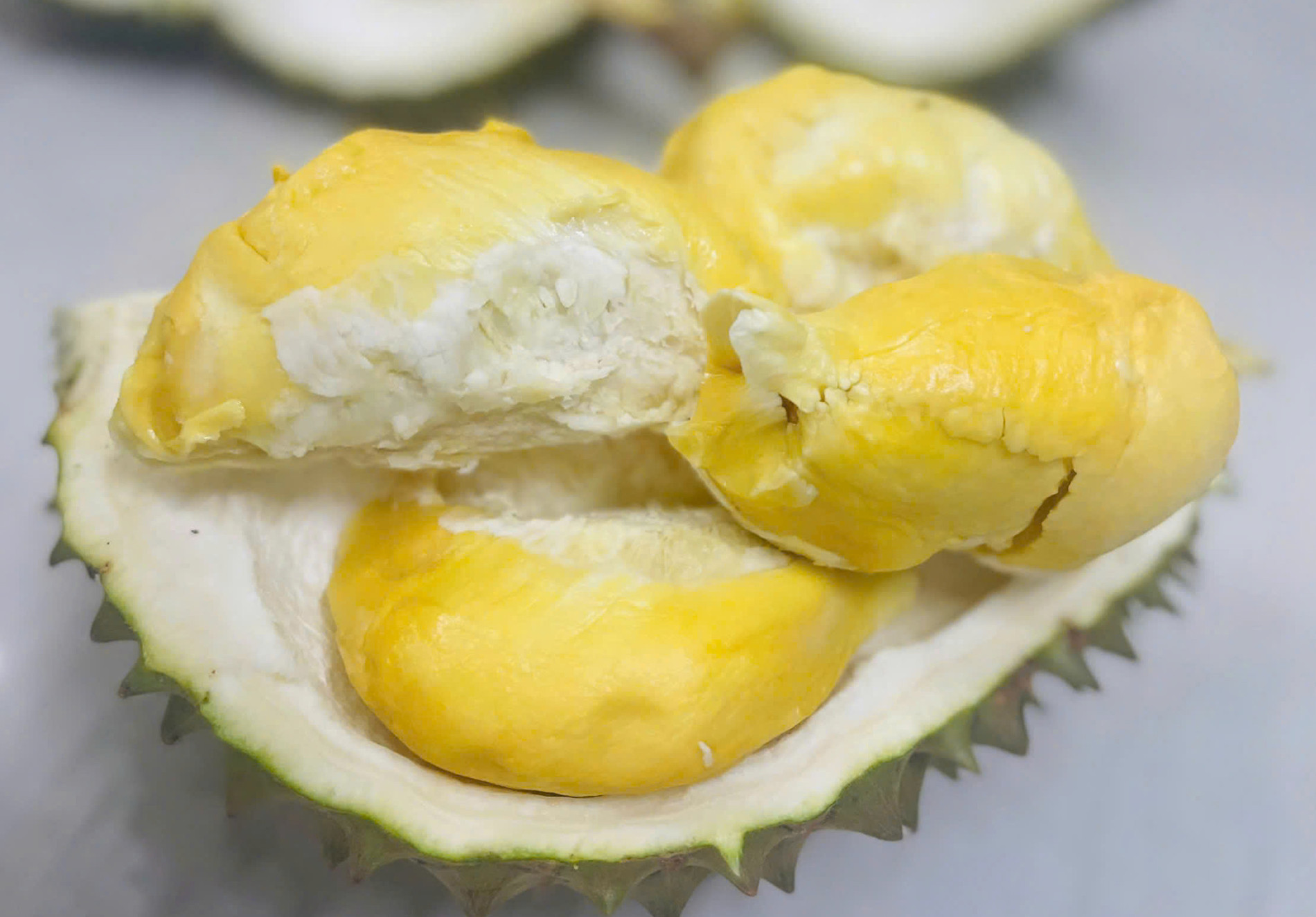
The early fruits from the tree had an elongated shape with a green-gray outer shell. After tasting the first harvest, Hien shared the fruit with neighbors and friends, who all praised its flavor.
The flesh of the fruit is bright yellow, dry yet soft like wax, with flat seeds and high sugar content, boasting a Brix level of 36.5 to 39.4 percent. According to Hien, each fruit weighs an average of 2 to 3 kilograms and retains its form well after ripening, without cracking or becoming mushy. It can be opened easily and naturally ripens 3 to 4 days after harvest without chemical treatment.
He named the new variety "Duy Hien DH.1" and has registered it as a mother plant. The time from flowering to harvest is approximately 90 days - much shorter than many other varieties.
Hien emphasized that the new durian is easy to manage for flowering and fruiting, making it suitable for cultivation not only in the Mekong Delta but also in the Central Highlands. In addition to commercial farming, he also provides seedlings to other farmers, aiming to build a high-value agricultural model.
The cultivation method of Duy Hien DH.1 is similar to that of popular durians in southern Vietnam. Farmers build raised beds 70–80 centimeters high to prevent flooding, and Hien regularly monitors plant growth to provide technical guidance to others.
Thanks to its superior quality, high sweetness, and compliance with “clean fruit” standards, the Duy Hien DH.1 durian fetches a retail price of up to 700,000 VND per kilogram (approximately $29). The seedlings are sold at 500,000 VND each (around $21).
Dr. Bui Thanh Liem, former Head of the Department of Agriculture and Rural Development in Cho Lach (now part of Vinh Long province), has sampled the variety and praised its dry, smooth, and chewy texture.
However, he noted that for broader adoption, the yield and economic efficiency of the variety must be further evaluated by agricultural authorities.
Hoai Thanh
.svg)
