 Vietnamnet.vn

 Podcast



The year 2025 is widely regarded as a watershed moment for Vietnam’s automotive industry, as the market not only rebounded strongly in scale but also underwent profound restructuring in market share, technology, production capacity and consumer trends.
More than a recovery in purchasing power, 2025 revealed deep internal shifts. Competition for market share intensified, product strategies were recalibrated and technological platforms were redefined, compelling automakers to adapt swiftly to increasingly pragmatic and demanding consumers.
Industry experts describe 2025 as not only commercially vibrant, but also strategically transformative, laying a firm foundation for even more significant changes in the years ahead.
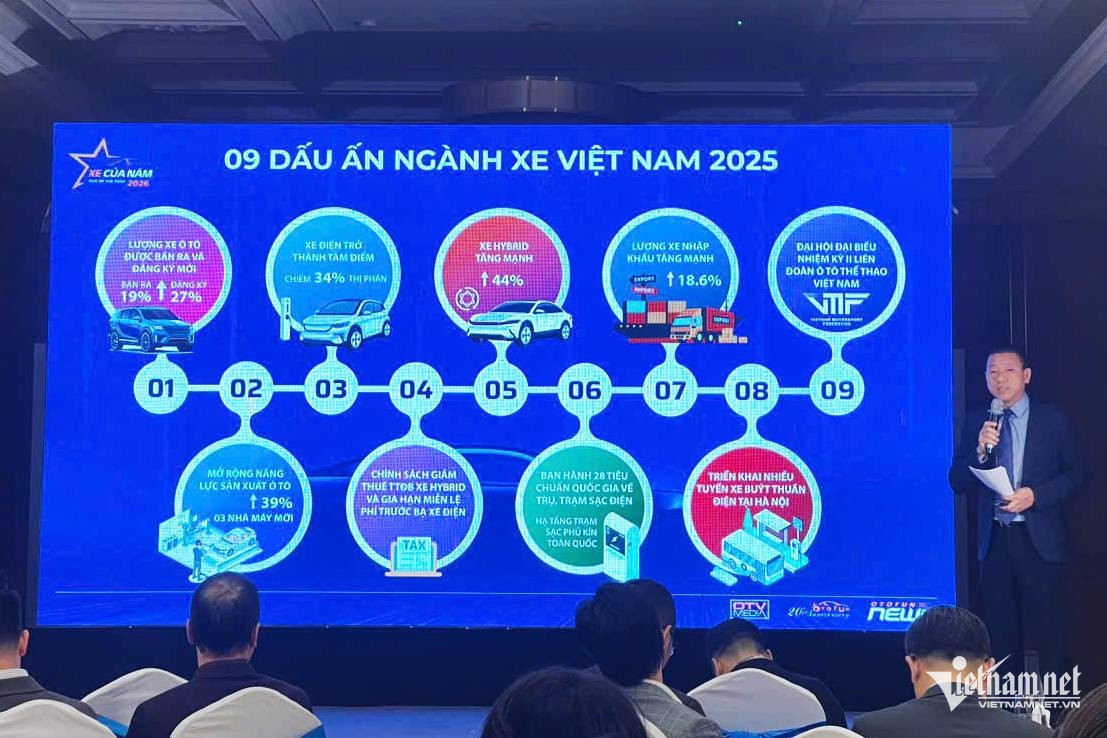
Based on research and analysis by Nguyen Dai Hoang, CEO of OTV Media and administrator of the Otofun forum, presented during the recent “Car of the Year 2026” program, VietNamNet reviews nine standout milestones of Vietnam’s automotive sector in 2025.
Record growth in car sales and new registrations
Vietnam’s auto market recorded historic growth in both sales and new registrations in 2025. More than 600,000 cars were sold nationwide, up 19 percent compared to 2024.
According to the Traffic Police Department, over 624,000 new cars were registered, a 27 percent increase and the highest level in many years, reflecting strong demand for private and service vehicles.
Meanwhile, more than 3.23 million motorcycles were newly registered in 2025, up 34.9 percent year on year, underscoring robust demand across the broader motor vehicle market.
Expansion of domestic production capacity
Data from the General Statistics Office show that approximately 484,500 automobiles were assembled in Vietnam in 2025, up 39 percent from the previous year.
The market also welcomed new production and assembly projects, including the VinFast plant in Ha Tinh, the Skoda factory in Quang Ninh and the Geleximco - Omoda & Jaecoo Vietnam joint venture plant in Hung Yen.
The addition of new facilities has strengthened domestic supply capacity and supported the industry’s localization roadmap.

Electric vehicles become the market’s focal point
For the first time in history, a Vietnamese automaker accounted for more than one third of total market share. VinFast sold 175,099 vehicles, equivalent to 34 percent market share, marking growth of up to 101 percent.
Electric vehicles and service fleets emerged as the primary growth drivers, signaling a clear shift in consumer behavior and market direction.
Green vehicle policies advance along a long-term roadmap
In 2025, the amended Special Consumption Tax Law was passed by the National Assembly. From January 1, 2026, hybrid vehicles, including both self-charging hybrids and plug-in hybrids, will be subject to a special consumption tax equal to 70 percent of that applied to comparable gasoline or diesel vehicles.
Although not yet implemented in 2025, this policy marks a significant preparatory step, creating momentum for stronger hybrid segment growth in the coming years.
Hybrid trend becomes more pronounced
In addition to electric vehicle growth exceeding 100 percent, hybrid models recorded sales of 14,171 units, up 44 percent year on year. The Vietnamese auto market is increasingly developing in depth, with clearer prioritization of energy-saving and low-emission solutions.

Foundational progress in EV charging infrastructure
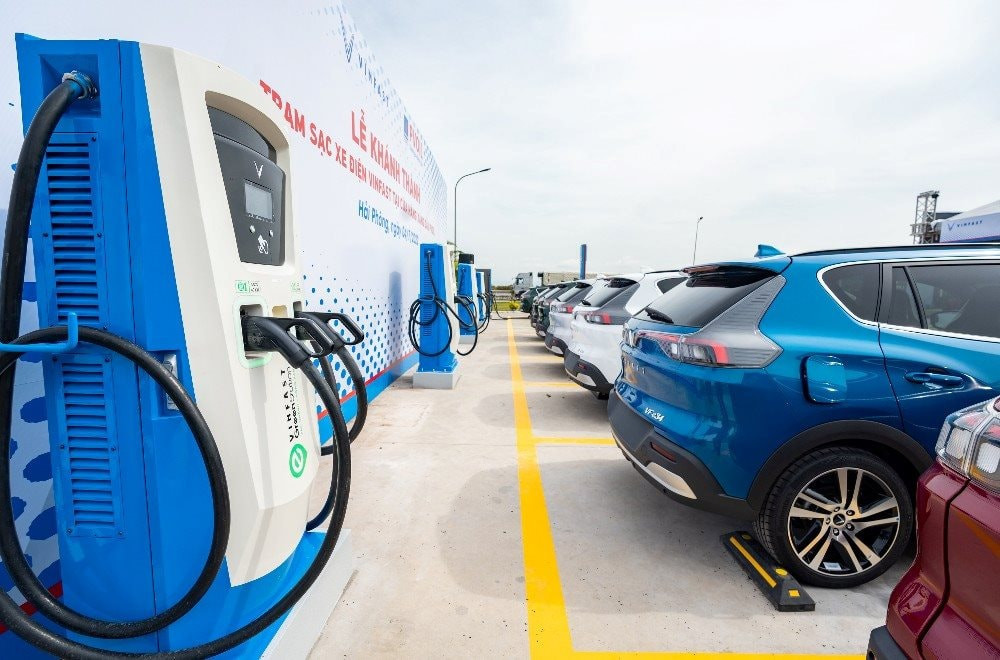
In 2025, 28 national TCVN standards for charging posts and stations were issued, establishing a unified technical framework for investment and operation. At the same time, the charging network continued to expand nationwide, helping remove one of the biggest barriers to EV adoption.
Strong growth in imported vehicles
According to the General Department of Customs, Vietnam imported 205,630 completely built-up cars in 2025, with total turnover of approximately US$4.74 billion, up 18.6 percent in volume and 31.1 percent in value compared to 2024.
Indonesia remained the largest exporter to Vietnam by volume, with 78,156 vehicles, followed by Thailand with 66,109 units, though at higher total value. Imports from China also surged to 47,895 vehicles, reflecting diversified supply sources and intensifying competition.
Electrification of public transport gains traction
Electrified public transport emerged as a notable highlight in 2025. In Hanoi and Ho Chi Minh City, numerous pure electric bus routes were put into operation, reducing urban noise and emissions while marking tangible progress in sustainable transport strategy.
These electric bus lines form an essential link between private electric mobility and the broader public transport system, paving the way for expansion to other major cities in the years ahead.
Automotive ecosystem expands into professional motorsport
The ninth milestone highlighted by the Otofun forum administrator relates to the broader automotive ecosystem.
In 2025, the second National Congress of the Vietnam Automobile Sports Federation took place, marking an important step in consolidating organization and promoting professional motorsport activities. This development contributes to strengthening automotive culture and elevating the stature of Vietnam’s auto industry.
The dynamic shifts of 2025 not only reflect the market’s growing maturity, but also establish an important basis for evaluating, honoring and shaping consumer trends in the years to come.
Hoang Hiep
.svg)
