 Vietnamnet.vn

 Podcast



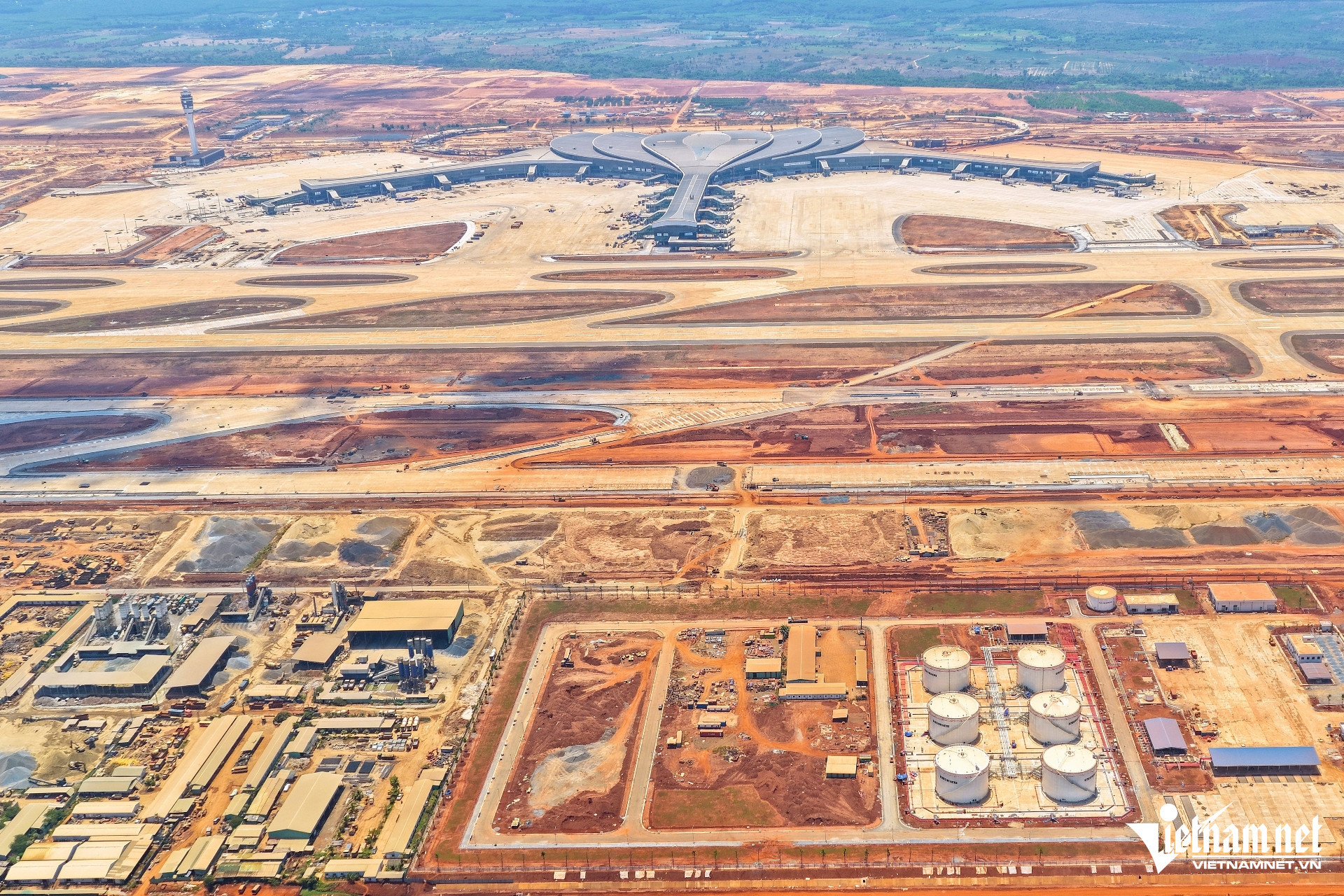
Towards the 10 percent economic growth target in 2026, Dong Nai is shaping two strategic development poles around Long Thanh Airport and along the Dong Nai River. These are new drivers helping expand the development space and enhance growth quality.
Budget collection
According to the Steering Committee for Economic Growth and State Budget Revenue of Dong Nai, several indicators in the early months of the year have not yet met the set scenario. The disbursement progress of public investment capital in some sectors remains slow, while certain revenue sources have not reached expectations.
In this context, the province has chosen a proactive approach to accelerate early on, instead of piling pressure onto the final months of the year. Departments, sectors, and localities have been requested to review every indicator, identifying shortages to formulate compensatory solutions within each quarter.
Truong Thi Huong Binh, Director of the Department of Finance of Dong Nai, said by the end of May, total state budget revenue in the area reached over VND49,300 billion, an increase of 30 percent over the same period last year, equaling 49 percent of the assigned estimate and about 33 percent of the full-year target.
This result demonstrates that the local economy continues to maintain positive growth momentum amid numerous difficulties. However, to obtain the 10 percent growth target, the province needs to continue exploiting new development drivers more effectively.
In addition to requirements regarding growth speed, Dong Nai aims to enhance growth quality. The city is accelerating the transformation of its industrial development model toward high-value manufacturing, prioritizing high technology, green industries, and environmentally friendly production to build a long-term economic foundation.
Positive signs have already emerged this year. Dong Nai's gross regional domestic product (GRDP) expanded 9.76 percent in the first quarter of 2026, placing it among the fastest-growing localities in Vietnam.
Industrial production rose by more than 13 percent, retail sales of goods and services increased by over 16 percent, and exports and investment inflows continued to improve.
However, achieving double-digit growth will require Dong Nai to move beyond its traditional growth drivers by expanding its development space and creating new growth poles.
New growth pole around Long Thanh Airport
In recent years, the area surrounding Long Thanh International Airport has become Dong Nai's newest major development zone. A number of transport infrastructure, industrial park, logistics and supporting service projects are being implemented at a rapid pace.
At the Long Duc 3 Industrial Park, land clearance and technical infrastructure construction are progressing quickly. The project covers an area of 244 hectares with total investment of nearly VND1.8 trillion.
Meanwhile, the Bau Can–Tan Hiep Industrial Park, with a total investment of nearly VND10.5 trillion, is gradually completing its infrastructure to welcome investors in high technology, electronics, semiconductors and logistics.
Together with Long Duc 3 and Bau Can–Tan Hiep, local authorities are also accelerating the Xuan Que–Song Nhan Industrial Park project, creating a large-scale industrial cluster around Long Thanh Airport.
Nguyen Tuan Anh, a representative of the investor developing Bau Can–Tan Hiep Industrial Park, said the company views the project not as an isolated industrial park but as part of the broader development ecosystem emerging around Long Thanh Airport.
"We can see tremendous opportunities from the region's expanding transport infrastructure and the emergence of a new hub for high-tech manufacturing and logistics. Preparing the infrastructure early will enable us to attract high-quality investment in the coming years," Tuan Anh said.
Long Thanh Airport is a key national aviation infrastructure project, and is expected to become a new international logistics and trade hub for the Southern region.
To exploit this advantage, connecting transport projects are being built, such as the Bien Hoa - Vung Tau, Ben Luc - Long Thành, and HCMC - Long Thanh - Dau Giay expressways, along with provincial roads connecting to the airport.
The new traffic routes will help shape a modern freight transport network, directly connecting Long Thanh Airport with the seaport system, industrial zones, and economic centers of the Southeast region.
This area is becoming a new growth pole for Dong Nai, where high-tech industries, logistics, commerce, and supporting services converge.
Hoang Anh
.svg)
