 Vietnamnet.vn

 Podcast



The third plenum of the 14th Party Central Committee concluded with a series of decisions of strategic importance to Vietnam’s development.
Yet beyond the resolutions adopted, one message stands out clearly: now that the state apparatus has been streamlined and the two-tier local government model has begun operating with stability, the focus of the new development phase must shift from formulating policies to putting them into practice, and from refining institutions to strengthening implementation capacity.
This is more than an adjustment in leadership methods. It represents an important shift in the thinking behind national governance.
The central government should not do localities’ jobs, provinces should not hold on to commune-level work

Experience over many years has shown that many sound policies and well-founded decisions have failed to produce the desired changes because implementation remains a “weak link.” Confronting that reality, Party General Secretary and State President To Lam has identified implementation capacity as the biggest bottleneck today.
In some places, authority has yet to be matched by responsibility; decentralization has not been accompanied by adequate resources, data, tools, personnel capacity and oversight mechanisms; and coordination remains fragmented in many areas. Correctly identifying the bottleneck also means identifying where a breakthrough is needed to translate the Party’s decisions into reality.
This assessment carries particular significance as Vietnam implements its two-tier local government model nationwide. After a period devoted to restructuring the organizational apparatus, the priority now is not to continue debating the model, but to make it work effectively. A streamlined apparatus can only deliver its full value when each level of government is given the appropriate authority, has sufficient capacity to act and is held fully accountable for the results of its responsibilities.
Decentralization and delegation of authority have therefore continued to be identified by the Party Central Committee as important drivers of innovation in national governance.
Under this new approach, however, decentralization is not simply the administrative transfer of tasks, much less a means of pushing responsibility down to lower levels. It means clearly defining the functions of each level of government so that each can focus on performing its own responsibilities as effectively as possible.
The message from the Party chief is clear: the central government should focus on strategic planning, institutional improvement, developing shared platforms, allocating major resources and overseeing implementation; provincial authorities should coordinate development, translate policies into concrete action and ensure that grassroots authorities have the conditions they need to operate; and commune-level authorities should become the frontline of public governance, directly serving people and businesses. The central government should not do the work of localities, while provincial authorities should not hold on to tasks that commune-level authorities are capable of handling effectively.
This is more than a division of responsibilities. It represents a new way of organizing state power. When the central government devotes more time to strategic planning and institutional development, local authorities gain greater room to take the initiative in implementation, while commune-level administrations can truly become the place where issues arising from everyday life are addressed.
When each level performs its proper role, the result will be a more seamless, flexible and effective governance system.
Notably, alongside the requirement that higher levels should not “do the work” of lower ones, the Party chief also emphasized their responsibility to ensure that lower-level authorities have the conditions necessary to carry out their duties. If commune-level authorities lack sufficient powers, personnel, finances, data, tools or guidance, provincial authorities must proactively address those shortcomings rather than allow work to pile up.
This underscores an important principle: decentralization does not mean loosening management. Delegating authority must go hand in hand with ensuring that the conditions are in place for that authority to be exercised effectively.
More broadly, this is precisely what is required to build a development-enabling public administration. Enabling development does not mean doing the work of the market or local governments. It means creating the institutions, resources and environment that allow different actors to exercise initiative and creativity.
Higher levels should neither hold on to the work of lower levels nor stand aside when lower-level authorities encounter difficulties. Their responsibility is to provide support and guidance, conduct oversight and promptly remove obstacles that arise during implementation.
If decentralization is the necessary condition, implementation capacity is the sufficient condition for policies to deliver results. That is why the third plenum introduced an important new requirement: implementation capacity must be built into every policy decision from the outset.
Every task must clearly identify the lead agency, the person accountable, the conditions required for implementation, the completion deadline and the expected output. Tasks should not be assigned before the conditions for implementation have been clearly established; authority should not be decentralized without oversight mechanisms; and accountability should not be blurred under the guise of coordination.
This marks an important transition from process-based administration to results-based governance. What people and businesses care about is not how many meetings are held or how many documents are issued, but whether administrative procedures become easier, whether processing times are shortened, whether the investment environment becomes more conducive to business and whether the quality of public services improves.
One notable feature of this Central Committee plenum, therefore, is the requirement that tangible results and the satisfaction of people and businesses become the primary basis for evaluating organizations and officials, particularly those in leadership positions.
At the same time, inspection and supervision must increasingly rely on data, tangible outputs and actual performance. Authorities should promptly recognize those that perform well, protect officials who dare to think differently, take action and assume responsibility for the common good, while strictly addressing those who avoid responsibility, pass the buck, perform half-heartedly or focus on appearances rather than substance.
Establishing a new approach to governance
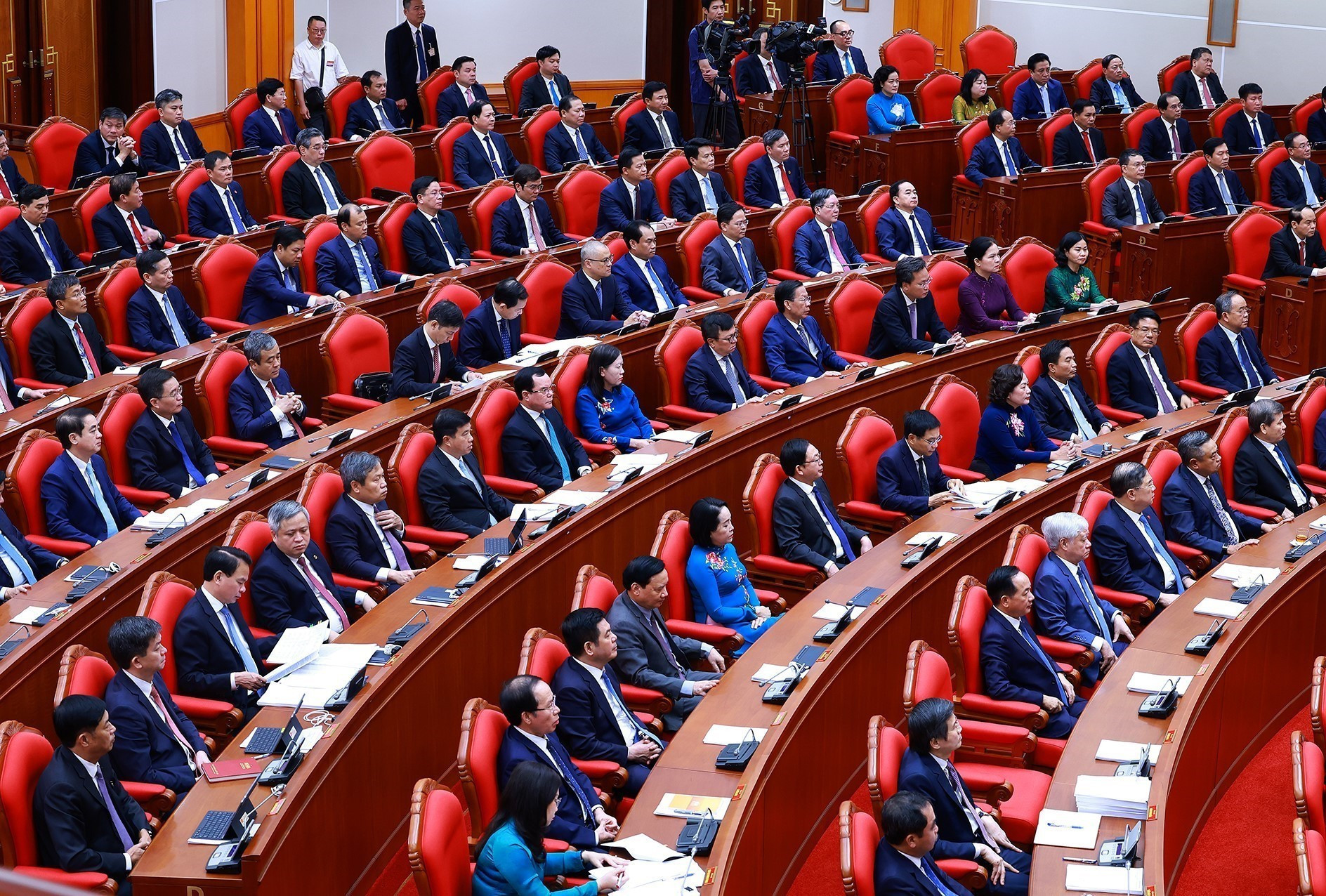
The defining feature of the third plenum lies not only in its continued push for decentralization and delegation of authority, but also in the establishment of a new approach to governance: every policy decision must be tied to the capacity to implement it; every power must come with corresponding responsibility; and every result must ultimately be measured by how effectively it serves the people and contributes to the country’s development. This is the standard now being set for the entire political system.
The journey from resolutions to everyday life always demands strong political determination. But determination becomes reality only when it is translated into concrete action programs, officials willing to take responsibility, smoothly functioning mechanisms and results that can be verified in practice.
That is also why the Party chief has called for the speed at which resolutions are issued to be matched by the speed of implementation, and for political determination to be transformed into substantive change.
The message from the third plenum, therefore, is directed not only at policymaking bodies. It is also a requirement for every level of government, every agency and every official and civil servant throughout the system.
When the central government concentrates on strategy, local authorities proactively enable development, commune-level administrations truly become the foundation of public governance, and every policy is judged by its real-world results, the strength of the state apparatus will no longer lie in the number of documents it produces, but in the tangible improvements it brings to people’s lives.
That is the deeper meaning of the principle of “decentralization to enable, implementation to develop” set out by the third plenum of the 14th Party Central Committee.
Dr. Dinh Van Minh
Former Director of the Legal Affairs Department, Government Inspectorate
.svg)
