 Vietnamnet.vn

 Podcast



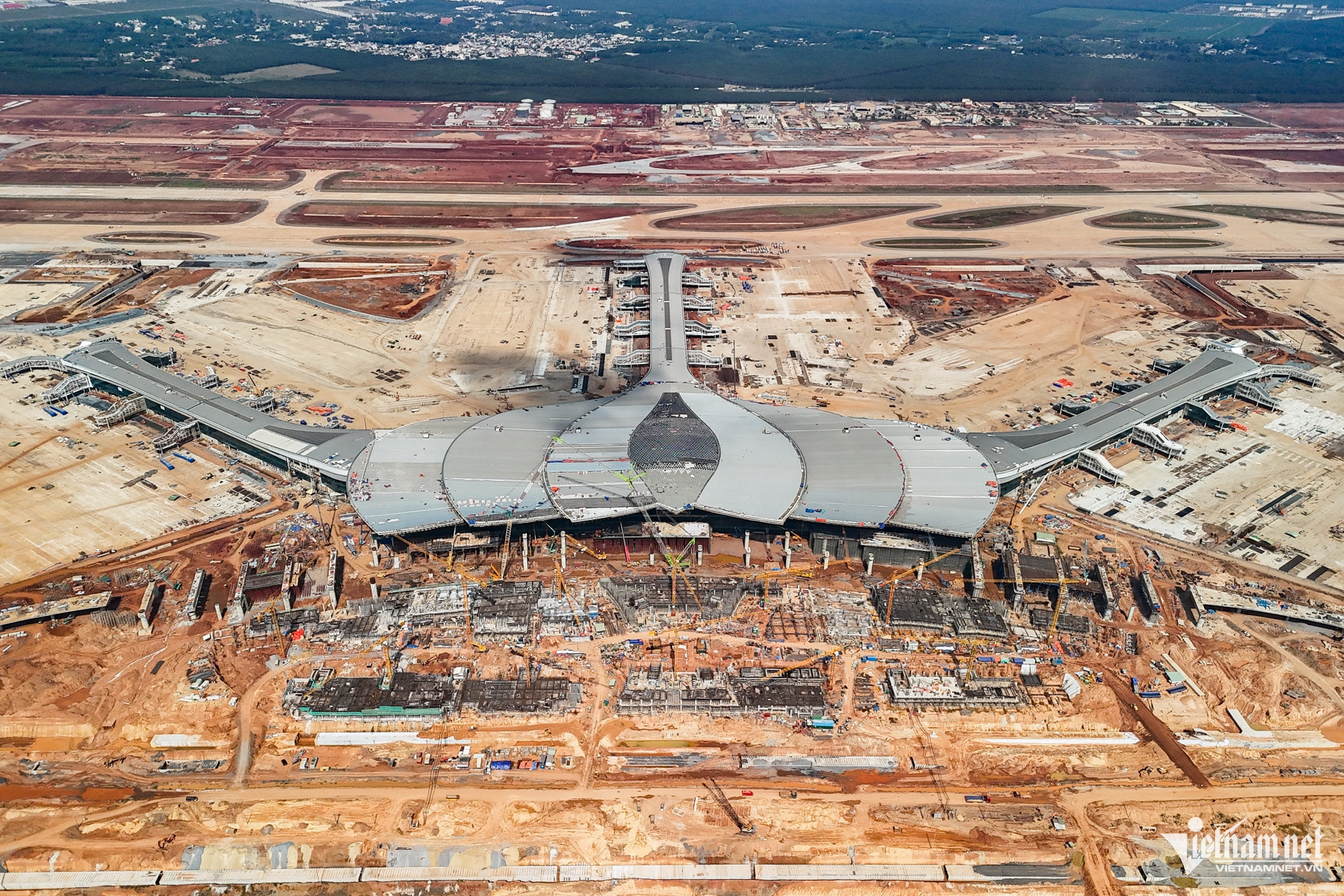
Lam cited the Long Thanh Airport project as a practical example of shortcomings in the operations of SOEs when he delivered a directive speech at the national conference to implement the Politburo’s Resolution 79 (on developing the state economy) and Resolution 80 (on cultural development) on February 25.
Lam emphasized that the state economy must truly occupy the strategic heights of the national economy, hold the leading role, and become the national anchor in the new era. This must be proven by the capacity to lead, efficiency, and substantial contributions to macroeconomic stability and the country's medium- and long-term development.
Questions that demand answers
The Party Chief has legitimate grounds to raise concerns about public investment projects in general and the Long Thanh international airport project in particular. He noted that “it seems SOEs are not calculating based on economic accounting principles, but are mainly thinking about disbursement.”
The story of Long Thanh airport shared by the general secretary has truly captured public attention. A comparison was made: Long Thanh airport is being invested with $16 billion for a capacity of 100 million passengers (equivalent to about $150 per passenger), while the figure in Malaysia or Singapore is just “about ten billion”.
Meanwhile, questions such as "Can it outperform Malaysia and Singapore?", "How long will it take to recover capital for the State?", and "How much does this airport contribute to the country's economic growth each year?" are “uncalculable."
In comparison with many large airports in the region and the world, such as Daxing Airport (Beijing) with seven runways and a capacity of 100 million passengers/year with an investment of about $11.5 billion; or Istanbul Airport (Turkey) with four runways, a capacity of 90 million passengers, and capital of about $12 billion; it can be seen that at $16 billion, Long Thanh Airport is among the highest-cost airports in the world.
The General Secretary's questions are not only a warning about the waste of national resources but also demonstrate a determination to rectify and re-establish order in economic accounting for large State projects and works, ensuring efficiency, capital recovery, and clear contributions to the country's sustainable development.
The Long Thanh International Airport project was approved by the 13th National Assembly on June 25, 2015, at its 9th session. In the context of Tan Son Nhat Airport being overloaded, the construction of Long Thanh Airport is expected to become an international aviation transfer "hub" for the region, capable of competing with major airports like Changi (Singapore) and Suvarnabhumi (Thailand), significantly reducing pressure on Tan Son Nhat and creating a century-defining boost for the economy of the Southern Key Economic Zone and the entire country.
The project is also expected to contribute 3-5 percent to Vietnam's GDP by creating a complete airport economic ecosystem, including high-tech industrial parks, logistics, trade, services, and tourism, attracting high-quality FDI and creating tens of thousands of direct and indirect jobs.
Leaders of the Airports Corporation of Vietnam (ACV) once committed to recovering capital after 14 years of operation, or even earlier, if 80-85 percent of international passengers and 10-15 percent of domestic passengers from Tan Son Nhat (about 15-16 million passengers/year) move to Long Thanh immediately after the airport goes into operation as expected.
The problem of using $16 billion
However, these figures can only be realized when the infrastructure connecting Long Thanh Airport with HCMC is invested at the same time with metro lines, high-speed railways, and inter-regional highways.
Conversely, if the connecting infrastructure development delays by another 5-7 years, every minute of passenger waiting and every hour of cargo truck congestion will silently erode economic benefits. The waste then becomes the loss of potential profit if that $16 billion were invested in other more practical fields.
Now, the story is no longer about a 2-hour or 30-minute travel time from the center of HCMC to Long Thanh Airport or about construction techniques, but about the responsibility to use national resources in the most transparent, economical, and efficient way.
According to the General Secretary, when questions about the efficiency of the mega-project Long Thanh Airport cannot be answered by the investor, "this may lead to waste, negativity, and even potential loss."
Therefore, the Long Thanh story is not a private matter of ACV or a project management group, but a problem of using $16 billion in the context of the country talking much about the "era of rising up."
Van Thieng
.svg)
