 Vietnamnet.vn

 Podcast



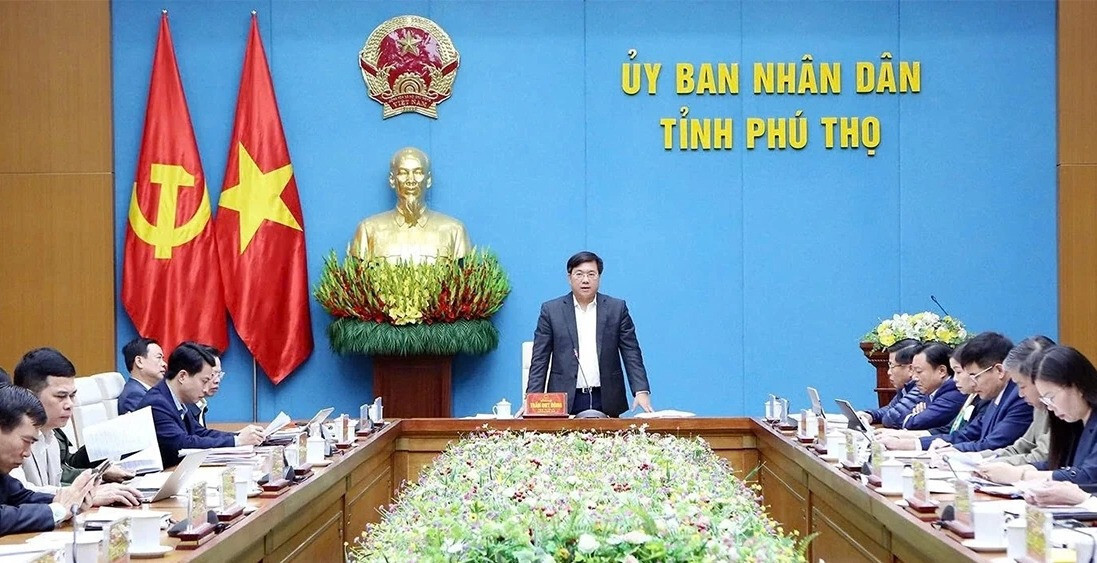
Shortening the roadmap by 14 months to “clean up” 1,331 legal documents and accepting fiscal pressure to apply higher social welfare standards province-wide was Phu Tho’s strategy of “upward harmonization” to eliminate regional disparities following the administrative merger last year.
The policy of reorganizing provincial-level administrative units represents a strategic breakthrough aimed at expanding development space and optimizing national resources.
The 2025 operational reality in Phu Tho, the merged entity of Vinh Phuc, Phu Tho and Hoa Binh, has provided important information. With an economy valued at approximately $16 billion and a smoothly functioning administrative apparatus, Phu Tho stands as tangible evidence supporting the soundness of this decision.
When the National Assembly’s resolution on merging the three provinces of Vinh Phuc, Phu Tho and Hoa Binh officially took effect, the new provincial government immediately faced a complex legal reality: the parallel existence of three separate systems of normative legal documents, each with different economic-technical norms and policy mechanisms.
For the same management content, each former locality applied its own standards, creating invisible barriers to the operation of the new administrative structure.
According to the Phu Tho Department of Justice, a total of 1,331 legal normative documents required review and handling, including 391 resolutions of the former provincial People’s Councils, 913 decisions, and 27 directives issued by the People’s Committees of the three former provinces.
Under the National Assembly’s resolution, merged localities were allowed a transition period until February 2027 to complete synchronization. However, the Standing Committee of the Phu Tho Provincial Party Committee and the provincial People’s Committee opted to shorten the timeline by 14 months, completing the review, repeal and issuance of a unified legal framework within 2025 so that it could take effect uniformly from January 1, 2026.
Provincial People’s Committee Chair Tran Duy Dong explained that the decision stemmed from practical necessity: “The most important objective of the merger is unity. If healthcare, education and fee policies differ, people will naturally feel concerned.”
To achieve that goal, the provincial administration operated at high intensity: 10 thematic meetings of the People’s Committee and four special sessions of the People’s Council were held consecutively.
The result was the repeal of 488 overlapping documents and the issuance of 235 new ones. Completing the heavy workload 14 months ahead of schedule was commended by the Ministry of Justice as a model of review progress among localities undergoing administrative restructuring. More importantly, it helped Phu Tho avoid a “one province, two mechanisms” situation during its first fiscal year.
Addressing disparities
Following the document cleanup is the challenge of policy substance. The greatest challenge in unifying mechanisms and policies was the large gap in social security benefits among the three former localities.
Review data revealed clear differences in fiscal capacity. Dong noted: “Previously, Vinh Phuc had strong revenue sources, so its social welfare was often set at 1.2 to 1.3 times the minimum level prescribed by the central government. Hoa Binh, due to limited resources, could only offer about 80 percent.”
So, the question is which level should be the common standard? Lowering Vinh Phuc's support or taking the average would be safe for budget balancing but would cause negative reactions from residents enjoying the high levels. Conversely, raising the entire province's support to the highest level (Vinh Phuc's) would create social consensus but place great pressure on recurrent expenditures.
Phu Tho chose the second option, called the "upward synchronization" strategy. The province decided to apply the most superior policies regarding healthcare, education, and support to all citizens, including difficult areas in former Hoa Binh and Phu Tho.
This decision served as a vital lever for stabilizing the population. Ensuring all residents benefited early from high-quality policies created public consensus for the new administrative model.
The "march" of 651 cadres to communes
Alongside institutional perfection, the province restructured the apparatus to operate a two-level local government model starting July 1, 2025. The complete abolition of the district level (the intermediary) posed a challenge to law enforcement capacity at the commune level as workload surged at the grassroots.
To solve this, Phu Tho implemented a mechanical personnel transfer plan. According to the Provincial People's Committee, 651 cadres, civil servants, and public employees from provincial agencies and former district-level units were seconded or mobilized to work at communes and wards.
This was a technical solution to bring those with professional expertise and management mindsets from higher levels down to reinforce the front lines. Additionally, the province added 74 Vice Chairmen of Commune People's Committees to key areas to strengthen leadership capacity.
Doan Bong
.svg)
