 Vietnamnet.vn

 Podcast



On finance and credit policies, the city proposed exemptions or reductions in land-use fees and land rental payments during the first five or ten years of projects. It also suggested reductions in land taxes over the same period and lending rates that would be 2-3 percentage points lower than prevailing commercial bank rates.
The city further requested permission to allow flexible conversion among resettlement housing, social housing and rental housing to prevent waste of existing housing stock.
Duoc also noted that of the 838 projects under municipal authority included in a task force database for resolving bottlenecks, roughly half have been largely addressed while solutions have been identified for the remainder. For stalled projects under central government authority, he asked the Prime Minister to direct ministries and agencies to help remove obstacles.
"With its position as a special urban center and the country's economic locomotive, Ho Chi Minh City fully understands its responsibility to the central government and to people nationwide," Duoc said.
The city, he added, would continue promoting its tradition of dynamism, creativity, solidarity and accountability while striving to achieve double-digit growth in 2026 and throughout the 2026-2030 period.
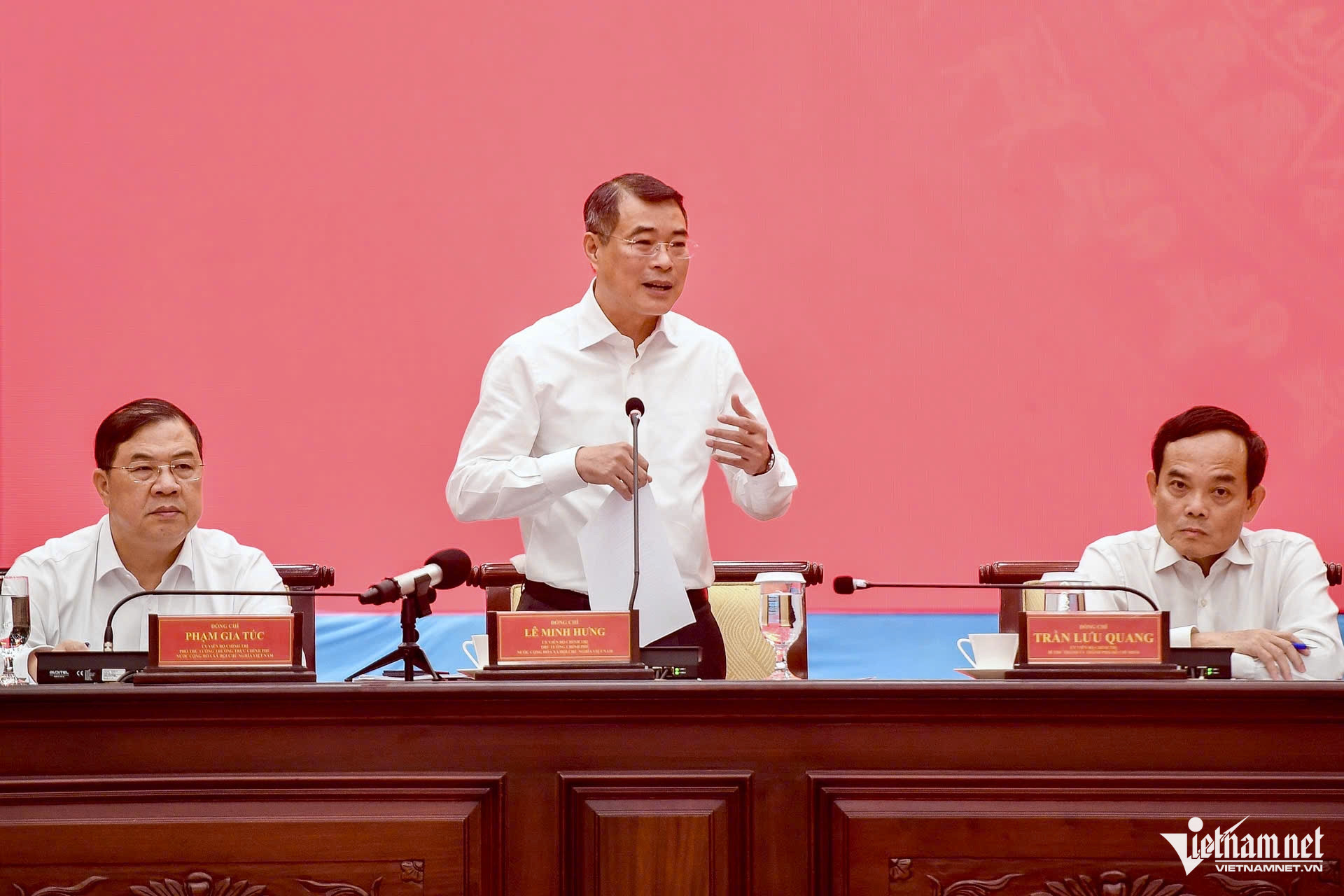
At the meeting, deputy prime ministers and ministry leaders also listened directly to the city's concerns and worked with local authorities on potential solutions.
Special Urban Law to be submitted to parliament
In his concluding remarks, Prime Minister Hung acknowledged Ho Chi Minh City's positive performance during the first five months of the year.
The city's first-quarter GRDP expanded 8.27% year-on-year, the highest first-quarter growth rate in five years. Budget revenue exceeded 50% of the annual target and increased by nearly 25%.
The Prime Minister also highlighted strong investment figures. Foreign direct investment reached more than USD 6.6 billion, up 106.25%. Nearly 24,000 new businesses were established, an increase of around 30%, while more than 9,600 companies resumed operations. Total social investment exceeded VND141 trillion (USD 5.4 billion), up nearly 11%.
He further praised the city's progress in resolving a large number of long-delayed projects, unlocking more than VND200 trillion (USD 7.7 billion) in investment and over 17,000 hectares of land.
Despite these achievements, the Prime Minister pointed to several shortcomings.
He said innovative thinking among city leaders had not yet been consistently transmitted to departments, agencies and grassroots administrations.
"If we can spread that mindset throughout all levels and sectors, the city's results will be much stronger in the coming period," he said.
The Prime Minister also noted that while first-quarter GRDP growth was solid, it remained below the city's own target scenario of 10.5-11%. Industrial production and construction grew about 7.7% against a target of 9.26%, while services expanded 8.9%, below the 11.1% goal.
Public investment disbursement remained slow, reaching only about 18% of the annual plan, compared with the national average of 21.6%. The city ranked 23rd among 34 provinces and centrally governed cities. Implementation of special mechanisms approved by the National Assembly also remained limited.
According to the Prime Minister, Ho Chi Minh City has yet to achieve major breakthroughs in science, technology and innovation, while hesitation and fear of responsibility still exist among some officials.
Six priorities for the city
The Prime Minister said Ho Chi Minh City is currently in a highly favorable position and should help shape a new national development model. He stressed that Vietnam's double-digit growth ambition depends heavily on major growth centers, including Ho Chi Minh City.
He outlined six major priorities for the city.
First, review growth scenarios for the remainder of the year and assign specific responsibilities to agencies, local authorities and businesses, particularly in industry, construction, trade and services, which account for the largest shares of the city's economy.
Second, accelerate public investment disbursement. The Prime Minister said the government is prepared to prioritize resources and mechanisms if the city proposes projects that strengthen its role as a national growth engine, provided that implementation schedules, quality standards and investment efficiency are guaranteed.
He also instructed the city to speed up key projects, including Ring Road 3, the An Phu interchange, the My Thuy interchange and National Highway 50 upgrades. Construction should begin as soon as possible on major projects such as Metro Line 2 connecting Ben Thanh and Thu Thiem, the Can Gio sea bridge, Cai Mep Ha Port, the Thu Thiem-Long Thanh railway and Thu Thiem 4 Bridge.
Most notably, he revealed that he and the city Party secretary had agreed on a plan to remove all remaining obstacles and ensure the completion of the VND10 trillion flood control project this year.
Third, finalize the draft Special Urban Law for submission to the National Assembly during its thematic session in August. The Prime Minister described it as the first time the central government has allowed the city to design its own policy framework and urged close coordination with ministries to ensure bold, synchronized and practical policies, particularly in finance, land management and infrastructure.
Fourth, rapidly complete the city's master plan while reviewing and updating urban, rural, zoning and grassroots-level planning frameworks.
Fifth, prioritize the development of state-owned rental housing, which has been identified as a strategic objective. The city was encouraged to propose new mechanisms and practical solutions not yet covered by existing regulations. Initially, state capital should be used, while longer-term policies should mobilize private-sector resources.
The Prime Minister added that the Ministry of Finance and the State Bank of Vietnam had been tasked with proposing financial mechanisms in July, including bond issuance and long-term refinancing solutions with reasonable interest rates to attract private investment into rental social housing.
Sixth, conduct a one-year review of the two-tier local government model, identify unreasonable decentralization arrangements and reassess the capabilities of grassroots officials. He also announced that the central government would establish specialized review teams to evaluate personnel across ministries, agencies and localities, with reassignment measures to be completed no later than the third quarter.
Regarding the city's recommendations, the Prime Minister instructed ministries and agencies to work closely with Ho Chi Minh City, proactively address issues within their authority and promptly report matters requiring higher-level decisions.
He also assigned the city government to coordinate with ministries in reviewing and proposing solutions for the most effective use of publicly owned land and buildings, excluding defense and security assets, and submit a report to the government within June.
"The government is committed to standing alongside the city and directing ministries and agencies to work closely with Ho Chi Minh City to resolve immediate obstacles and improve policies for the development of both the city and the country," the Prime Minister said.
Phuoc Sang - Nguyen Hue
.svg)
