 Vietnamnet.vn

 Podcast



During rush hour on Nguyen Trai Street, the full weight of Hanoi’s urban pressure was on display.
Motorbikes, bicycles, cars and crowded buses stretched into long lines, each squeezing through narrow gaps just to move forward. Along a relatively short stretch of road, no fewer than seven universities and academies stand side by side. Each hosts tens of thousands of students, and at certain hours, they all spill into the streets at once, merging with commuter flows from the outskirts into the city center.
Nguyen Trai is far from the only example. In the Ho Tung Mau - Xuan Thuy - Cau Giay area, another university cluster operates with institutions such as the University of Commerce, Vietnam National University, and the Academy of Journalism and Communication.
To the south, streets like Giai Phong, Tran Dai Nghia, Le Thanh Nghi and Dai Co Viet - already narrow - must absorb massive waves of motorbikes heading toward university gates during class hours. The end of lectures often coincides with peak congestion across entire districts.
Against this backdrop, Hanoi is drafting its Capital Master Plan for 2021-2030, with a vision stretching up to 100 years - an ambitious framework expected to reorganize the city’s development space, from infrastructure and population to knowledge hubs.
Within this plan, relocating universities with limited land and substandard facilities out of the inner city is identified as a key direction - a way for Hanoi to reconfigure its own living space.
A long-standing policy
Looking back at earlier master plans, this is not a new idea.
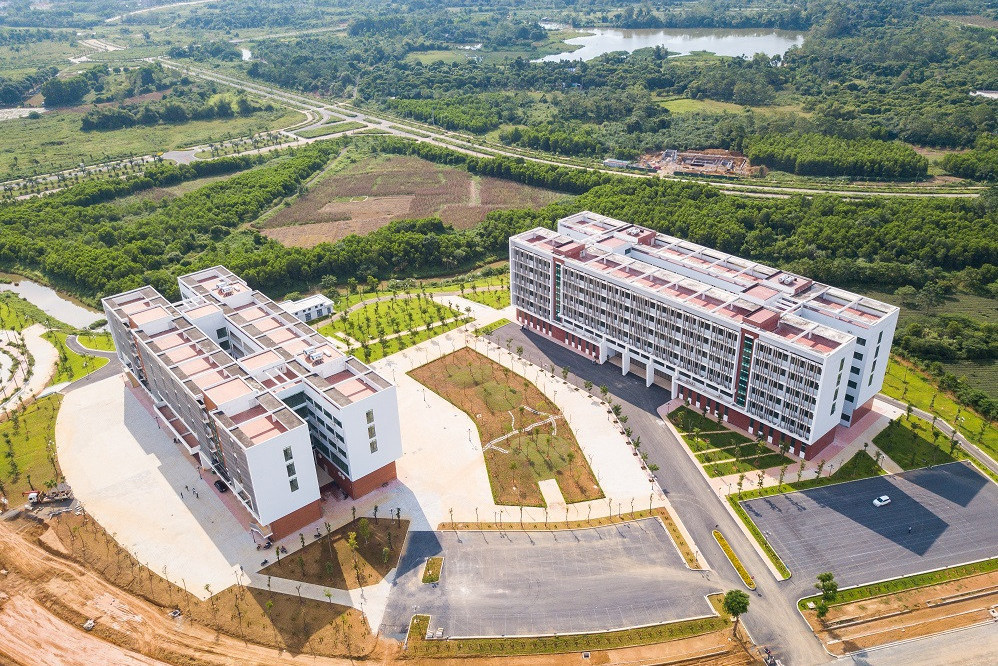
As early as 2007 and again in 2011, Hanoi proposed reducing the number of students in the inner city to around 30,000 while developing university clusters in Hoa Lac, Soc Son, Son Tay and Gia Lam. A list of institutions slated for relocation, including more than a dozen universities, was even outlined.
Yet after more than a decade, little has changed. Aside from a few partial relocations, most universities remain in the inner city, continuing to expand within already constrained campuses.
Cost is an obvious barrier. Building a university campus involves more than lecture halls - it requires an entire ecosystem, including dormitories, libraries, laboratories and supporting urban infrastructure.
More fundamentally, for years the relocation policy has existed more as a guideline than a binding requirement. It lacks a clear roadmap, enforcement mechanisms, defined responsibilities and, crucially, strong institutional support.
Accumulated pressure can no longer be ignored
While relocation has stalled, student numbers have steadily increased. Hanoi now hosts around 650,000 to 700,000 students, most concentrated in the inner city. Placed within an already overloaded infrastructure system, this creates significant pressure.
A simple observation illustrates the point: during summer breaks, when students leave, many streets around universities become noticeably less congested. This suggests that university clusters are not only educational spaces but also major generators of urban traffic.
Some universities currently provide only a few square meters per student, far below the minimum standard of 25 square meters. Overcrowded learning environments, limited practical facilities and insufficient research infrastructure not only affect education quality but also indicate that the “inner-city university” model has reached its limits.
Universities are no longer just an issue for the education sector - they directly shape how the city functions every day.
A university, in its full sense, extends beyond lecture halls. It creates an entire surrounding ecosystem - from rental housing and food services to part-time jobs for students.
For many students, studying in the inner city is not only about attending classes but also about finding work to support themselves. For lecturers, especially those settled in central areas, commuting tens of kilometers daily is far from a minor adjustment.
The question, therefore, is whether the new locations can offer conditions that allow both students and faculty to truly settle. Without a convincing answer, relocation will inevitably face resistance from those most affected.
The solution: move from intent to action
First, the universities that need to relocate must be clearly identified, along with a concrete timeline. Once deadlines are set and responsibilities assigned to specific agencies, the policy will no longer remain a mere recommendation.
But even with a roadmap, progress will stall if destination areas are not ready. Hoa Lac offers a clear example. Planned as a large-scale university zone spanning thousands of hectares near a high-tech park, it has struggled for years due to weak connectivity and limited supporting services.
If students still have to travel dozens of kilometers by motorbike, and if campuses lack housing, job opportunities and a functioning urban environment, universities will find little incentive to leave the center.
Transport, therefore, becomes a decisive factor. Only when students can take a metro line from the inner city and arrive near their lecture halls will a 30km distance truly feel shorter.
Financing is another unavoidable challenge. No university can independently mobilize the thousands of billions of VND needed to build a complete campus. Without a strong financial mechanism - where the State provides initial capital and direction, while businesses participate in infrastructure and service development - relocation plans will struggle to advance.
And ultimately, the issue comes down to people. A lecturer who has lived in the inner city for decades will not easily move without access to housing, schools for their children, and a comparable living environment. A student, likewise, will not choose a place where opportunities for part-time work are nearly nonexistent.
The hardest question lies in the land left behind
Perhaps the most difficult question lies beyond relocation itself: how will inner-city university land be used afterward?
Many campuses occupy some of Hanoi’s most valuable locations. From a market perspective, these sites hold immense value.
If converted into real estate projects, the city could generate significant short-term revenue. But the cost may be continued strain on infrastructure, while much-needed public space remains limited.
Alternatively, if this land is repurposed for parks, schools, creative spaces or research centers, the benefits may not be immediate but would be far more sustainable.
At its core, this is a clear choice: prioritize short-term gains or accept slower returns in exchange for long-term value.
Hanoi can continue expanding outward with new urban areas, but the spaces within its core cannot be recreated once lost.
One day, if Nguyen Trai or Giai Phong no longer sees tens of thousands of students pouring into the streets at the same hour, that may be when people truly recognize how a planning decision quietly reshaped the city. And perhaps then, Hanoi will no longer feel like a vast parking lot.
Tu Giang
.svg)
