 Vietnamnet.vn

 Podcast



Why, in a developing society like Vietnam, has reading yet to become a widespread habit? A series by Pham Quang Vinh offers a different lens: reading is not merely an individual choice, but the outcome of an ecosystem - where policy, education, the market, and social values collectively shape behavior.
VietNamNet presents this series as an open forum, inviting diverse perspectives from readers, policymakers, educators, and publishing professionals: How can a reading society be cultivated in the context of a knowledge-based economy?
A childhood shaped by books
I was almost six when my father taught me to read. As my birthday approached, he took me to Cau Bung, to a small bookstore by the roadside. I no longer remember the books I chose, but I still remember the low-tiled house - what we would now call a modest one-story home - and the feeling of stepping inside, standing before shelves of books, as if entering another world, separate from the dusty road outside.
My father bought me many books, not only on birthdays. I remember that at the age of seven, he bought me The Temple in the Sea, Tsiolkovsky Tells Stories, and another book whose author I no longer recall, only its title - The Older Brother and the Youngest Brother, a story about young soldiers. It was in that not particularly famous book that I encountered a sentence that has stayed with me ever since: “Thu trung huu kim ngoc” [1] - within books are treasures of gold and jade.
The line was spoken by an older soldier to a younger one, while recounting rural stories and recalling a teacher’s words. It was not a formal lesson, just a line from a story. Yet it has stayed with me all my life.
As a child, I read everything I could find. When I was young, it was simply whatever books came into my hands. As I grew older, curiosity led me to broader and more challenging reading. Looking back, I realize that many important lessons did not come from school, but from those unplanned encounters with books.
But if “books hold treasures” once guided a child’s growth, the question today is whether it still holds true in modern Vietnamese society. Or more broadly: is the issue that Vietnamese people are “reluctant to read,” or that society no longer creates strong enough reasons for them to read?
Reading, I believe, is not primarily an individual choice. It is the result of how a society defines the value of knowledge, understanding, and reading itself.
Reading as a product of social structure
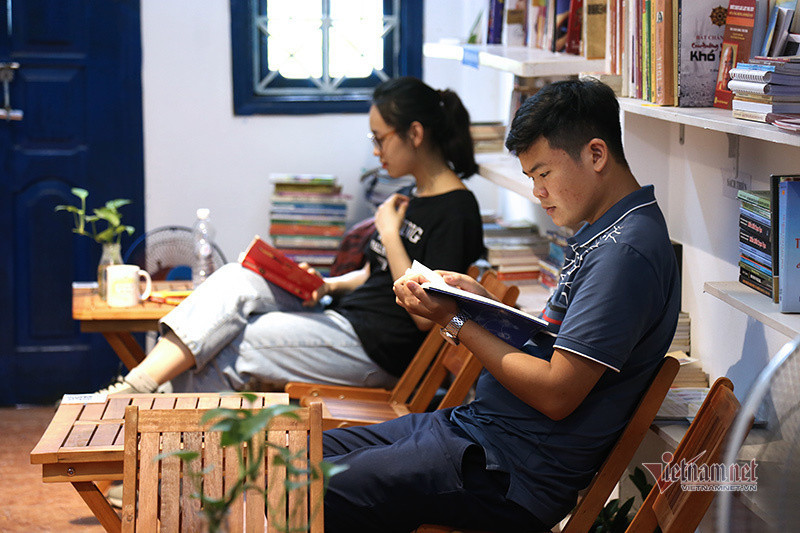
Reading is not merely a personal habit - it is shaped by social structures.
Looking at the world, we can see that reading habits are often the product of environments that make reading necessary. Societies where people read more are not simply those with more diligent readers, but those where structures compel reading.
In Japan, for example, people spend significant “idle time” commuting on public transport - waiting for trains, riding them - and this context fosters the habit of reading during transit. Seeing others read reinforces the behavior. They do not necessarily read because they love books more, but because their daily environment creates opportunities for reading.
According to the World Intellectual Property Organization, in 2023, Japan published 68,429 titles, including 66,885 commercial books and 1,544 educational titles. Commercial books accounted for 97.7% of the total. That same year, Japanese readers spent US$9.315 billion on books, of which US$8.7 billion went to commercial titles.
This can also be explained by a highly competitive intellectual environment, where children are taught from an early age that reading is part of life. When children look around and see adults reading, it becomes a natural prompt for them to pick up a book.
In South Korea, another Asian country, intense academic competition has created a strong reading ecosystem - from textbooks to skills-based and academic books. In 2023, the publishing market reached US$6.654 billion, with US$3.39 billion in commercial books and US$3.26 billion in educational titles.
In Western countries such as the US and across Europe, the presence of a developed publishing industry, universities, research institutions, and a culture of debate has made reading habits more sustainable. In 2023, Americans spent US$26.150 billion on books, including US$17.360 billion for commercial books and US$8.79 billion for educational titles. Comparable figures include France at US$2.9 billion, and Germany at US$9.945 billion.
In these societies, reading is not considered a noble act. It is simply a tool for survival in knowledge-based environments.
Why Vietnam reads less
Structurally, modern Vietnamese society does not strongly support reading habits.
Urban life is fast-paced. Although people spend time commuting, it is often on personal vehicles, which do not allow for reading. Society tends to value power and money more than knowledge, and advancement often depends less on intellectual capability and more on relationships.
When knowledge and understanding are not highly valued, reading habits inevitably decline. This, in turn, affects younger generations, who may not see reading as important.
Some people read mainly for short-term purposes rather than deep engagement. Others may regard reading as a refined activity and distance themselves from society. In both cases, reading does not become a shared cultural norm.
To some extent, the structure of Vietnamese society today does not support the formation and maintenance of reading habits.
[1] The phrase “Thu trung huu kim ngoc” is a simplified rendering of a classical Chinese idiom: “Within books are beauties with jade-like faces, within books are houses of gold,” believed to date back to the Song dynasty, encouraging the pursuit of learning.
Pham Quang Vinh
.svg)
