 Vietnamnet.vn

 Podcast



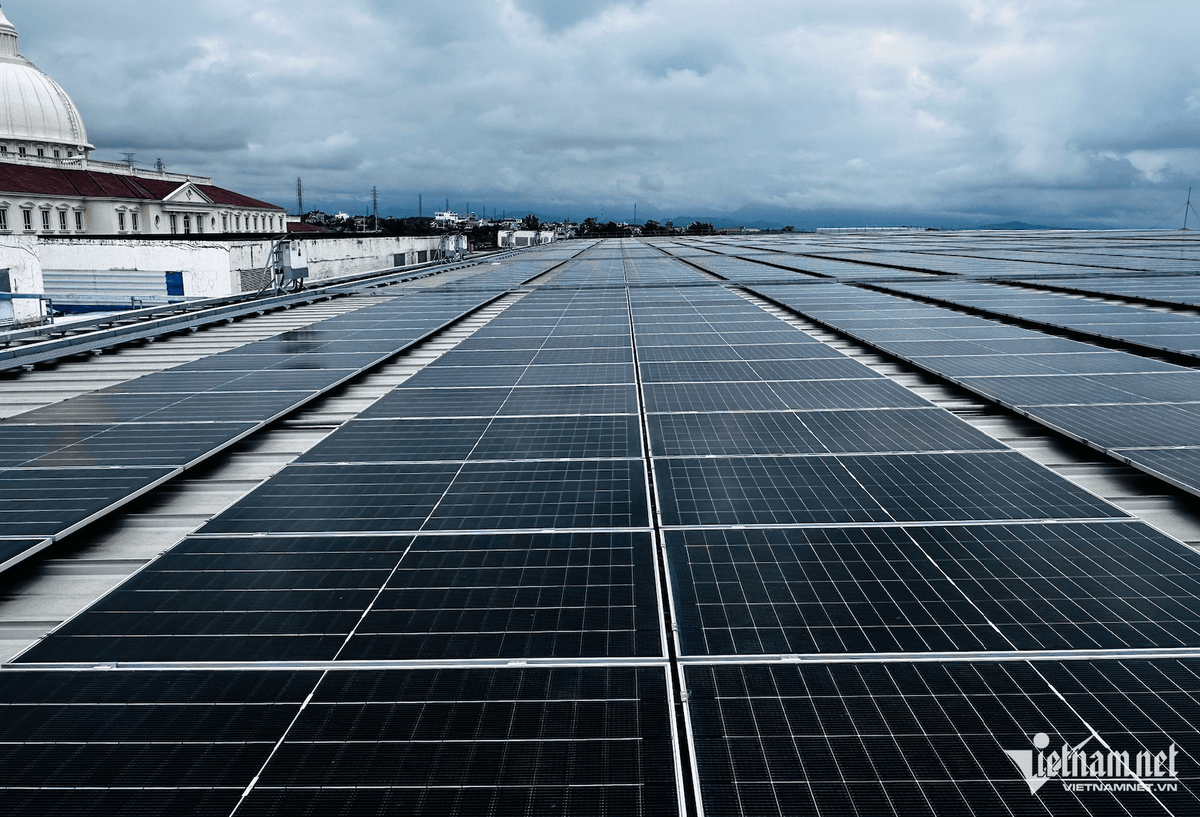
Leading some businessmen to visit a rooftop solar system, Pham Xuan Gioi, power manager at Ngan Long Science and Technology (Hai Yen Industrial Zone, Quang Ninh), noted that it had been installed last September, and that thousands of solar panels noe cover the roofs of five manufacturing workshops.
The Ngan Long company specializes in manufacturing yarn for domestic and export markets, employing over 2,000 workers. Numerous international partners frequently send delegations to inspect the factory, paying close attention to energy usage, power-saving efficiency, and emission reduction solutions.
Gioi said that rooftop solar power not only helps the company slash electricity costs significantly, but also accelerates its green transition to meet increasingly stringent export market standards. The company spent VND150 billion to install a rooftop solar system with a capacity of nearly 20 MW.
Before installing solar power, the company's monthly electricity costs were VND40-60 billion. The solar system has satisfied 8-10 percent of the factory's total power demand, generating average monthly savings of VND5-6 billion. During months with favorable weather conditions, savings have reached VND6-7 billion.
The company plans to continue surveying the potential for rooftop solar installations on warehouses and dormitory buildings. However, the specific scale of expansion will depend on the power grid's reception capacity and agreement with the local power utility, Gioi noted.
Similarly, in Hai Ha Industrial Zone (Quang Ninh), a self-produced, self-consuming rooftop solar system was installed on four workshops and two warehouses belonging to Ngan Ha Technology Engineering.
Ngan Ha’s Ca Van Cuong said the company's solar power system has a capacity of 20.47 MW. As a result, the enterprise saves between VND5.6 billion and VND6.3 billion in electricity costs each month.
"Even with rooftop solar power, the company still has to pay VND75- 84 billion per month to buy grid electricity to meet production needs," he said. The enterprise plans to install additional rooftop solar systems on its remaining workshops.
A representative from Hai Ha Industrial Zone noted that the investment in rooftop solar aims not only to reduce electricity expenses, but also to satisfy increasingly strict demands from international buyers.
The majority of enterprises in the industrial zone serve as suppliers to partners in Europe and North America, markets that are tightening criteria in sustainability, renewable energy, and supply chain decarbonization.
Accordingly, not only manufacturing enterprises but also industrial park infrastructure developers are accelerating the deployment of green energy projects to meet market requirements and boost competitiveness.
More households install solar power
In Quang Ninh Province, over 550 customers have installed rooftop solar power. In the Hai Ha area alone, 139 customers had installed and commissioned their systems by late June 2026.
Dong Tien Dung, a representative of Hai Ha Power, said the unit recently coordinated with local authorities to survey, educate, and advise residents, schools, and medical centers on installing rooftop solar systems.
Emphasizing that rooftop solar power is demonstrating strong efficiency, Dung noted that households consuming around 800 to 1,200 kWh per month see an estimated payback period of 5 to 5.5 years. Households with higher electricity demands, particularly those consuming substantial power during daytime hours, can achieve faster cost recovery.
Most households install rooftop solar systems ranging from 6 to 12 kWp in capacity, paired with energy storage units of around 16 to 20 kWh. Households combining residential living with commercial operations opt for systems ranging from 30 to 45 kWp, or even up to 50 kWp.
The People's Committee of Quang Ninh Province plans for rooftop solar power installations across public educational institutions statewide as soon as possible. Additionally, provincial authorities have had ongoing surveys to create installation plans for public headquarters of provincial agencies and medical facilities, aiming for swift execution.
Experts cautioned that investment efficiency for rooftop solar varies across regions and customer groups. Northern Vietnam in particular exhibits pronounced seasonality, with solar power output in winter falling significantly lower than in summer.
Therefore, prior to investing, customers must carefully calculate their power needs, on-site consumption capacity, and financial return across the project's entire lifecycle.
In the long run, Battery Energy Storage Systems (BESS) are expected to raise on-site electricity utilization rates, reduce grid feed-in volumes, and enable load shifting across usage hours.
Tam An
.svg)
