 Vietnamnet.vn

 Podcast



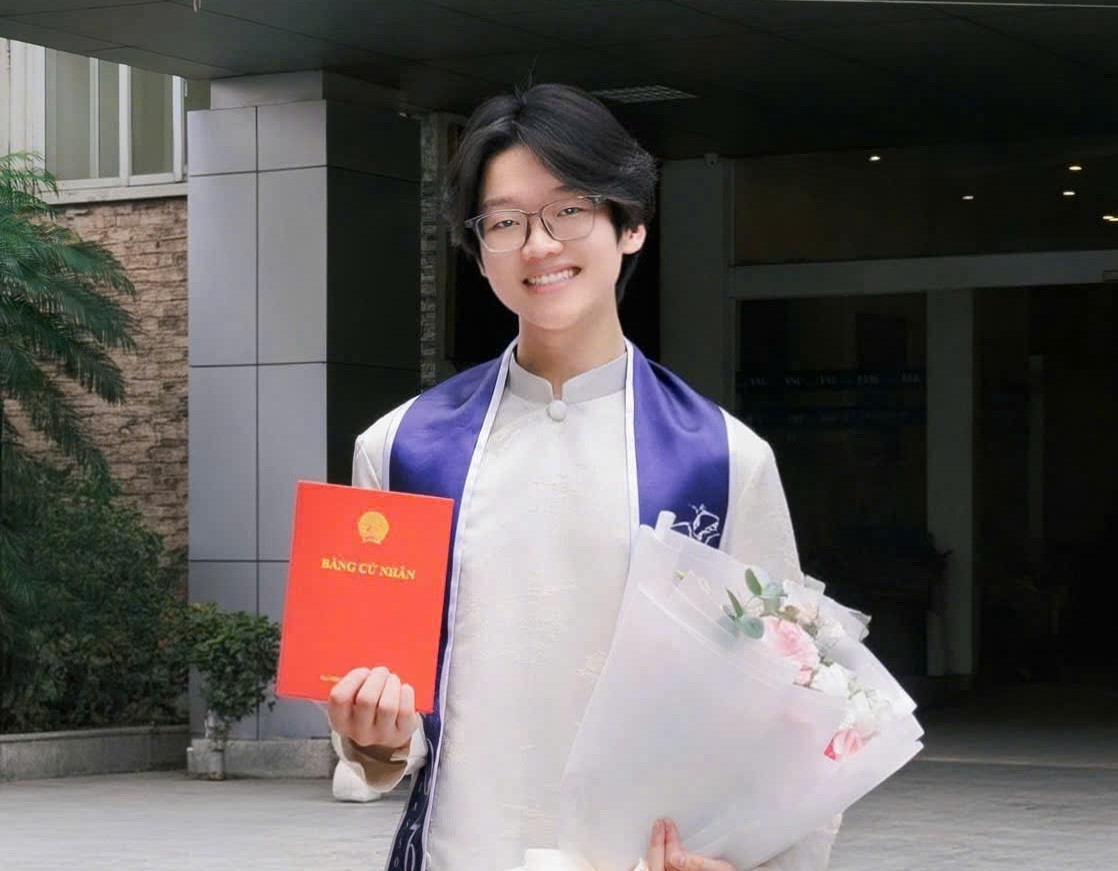
Thanh, from Phu Tho Province, recently graduated as valedictorian of the Business and Technology Management program and salutatorian of the School of Business and Management under Vietnam National University, Hanoi.
Speaking on behalf of the graduating class at the commencement ceremony, Thanh said he had never imagined standing on that stage when he first enrolled. Looking back, he realized that "as long as you keep moving forward, every step brings you closer to your dreams."
"There are already many traditional business majors, but a program that teaches how to leverage technology to manage businesses in the digital era is still quite new. That was what attracted me," he said.
Coming from a modest-income family, Thanh set a goal of earning scholarships from his first year to help ease his family's financial burden. Throughout university, he balanced his studies with scientific research, student activities, academic competitions and internships.
Thanh was the lead author of two research papers on environmental, social and governance (ESG) issues in the banking and finance sector. One received the Best Research Paper award at the CIEMB 2025 International Conference, while the other was presented at the ICECH 2026 International Conference.
The research topic was initially suggested by his academic supervisor. As he delved deeper, Thanh realized that sustainable development was not only academically meaningful but also highly relevant to business practice.
"Data on sustainable development in Vietnam remain quite limited. I wanted to develop a measurement approach tailored to Vietnam's language and business context so the research could have practical value," he said.
For his first quantitative research project, Thanh independently collected commercial banks' reports from 2010 to 2024, built a Vietnamese ESG keyword database and programmed a data-processing tool to measure the extent of sustainability disclosures.
"From the literature review and programming to consulting experts, running econometric models and analyzing the results, I completed almost everything myself. Along the way, I had to teach myself econometrics and data analytics," he said.
His academic achievements also earned him the opportunity to represent Vietnam at the Regen Asia Summit 2025 and the Asian Undergraduate Symposium at the National University of Singapore.
Working alongside students from different countries changed his perspective on scholarship.
"I used to think academic excellence meant mastering knowledge and getting high grades. After those experiences, I realized knowledge only becomes meaningful when you ask questions, connect it with real-world issues and exchange ideas with people who have different perspectives," Thanh said.
Lessons from startup journey
Alongside research, Thanh also explored entrepreneurship. After noticing that existing payment methods often required too many steps, he and his teammates developed a contactless payment solution using near-field communication (NFC) technology to simplify transactions.
The project won second prize at Innovation Ignition 2024 and later advanced to the investment pitching round of Shark Tank Vietnam Season 7.
Standing before the investors, however, Thanh realized the significant gap between an innovative technology and a commercially viable business.
"The sharks didn't just want to know how the product worked. They asked about customers, revenue, operating costs and why the market actually needed the solution," he recalled.
Although the project was never commercialized, the Shark Tank experience reshaped his understanding of innovation.
"I realized technology is only a tool. What's truly important is identifying the right problem, understanding the people you want to serve and creating a solution that can be implemented in the real world."
To gain practical experience, Thanh also completed internships at businesses, where he discovered how different real-world work was from classroom learning.
"In class, problems usually come with complete data and relatively clear answers. In a company, even defining the problem can be difficult. A good solution isn't just technically sound, it also has to fit the organization's processes, available resources, legal requirements and the needs of multiple stakeholders," he said.
"Over the next five to 10 years, I hope to become a business leader with a strong foundation in technology and data. I want to contribute to technology projects that genuinely solve problems, improve processes and create better user experiences," Thanh said.
Thuy Nga
.svg)
