 Vietnamnet.vn

 Podcast


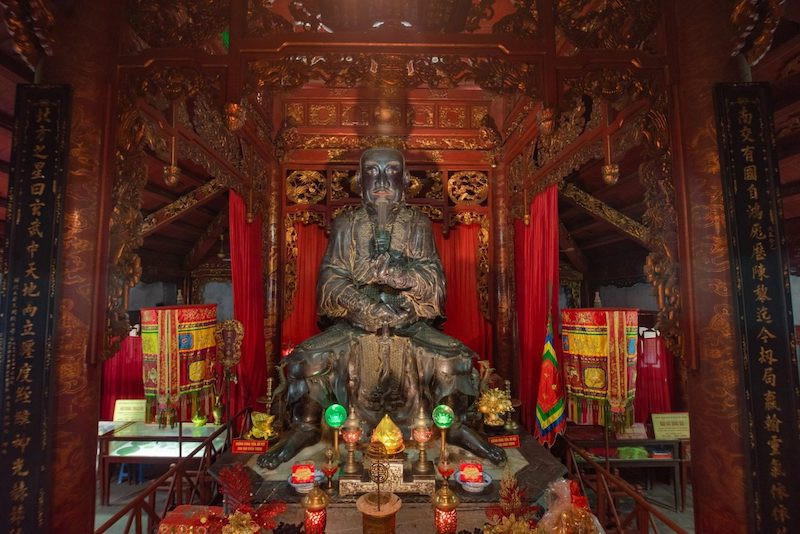
Evidence of Taoism's early presence extends beyond legends and oral traditions.
Research based on historical Han-Nom documents indicates that by the end of approximately 1,000 years of Chinese rule, the Red River Delta had as many as 21 Taoist religious establishments.
During the Ly and Tran dynasties, Taoist divine hierarchies such as the Three Pure Ones (Tam Thanh), Four Sovereigns (Tu Ngu) and Thunder God (Loi Cong) featured prominently in religious practices.
Vietnam also developed administrative structures associated with Taoist religious activities, reflecting local characteristics.
However, the Vietnamese did not adopt Taoism exactly as it existed in China.
Quach Thi Thu Hien, a researcher at the Vietnam Institute of Literature, explained that Taoism in Vietnam developed through a distinctive process of selection and adaptation.
"Vietnamese Taoism is highly complex because it encompasses not only the Taoist traditions of the ethnic Vietnamese but also those of the Dao and Cao Lan ethnic communities," she said. "Two outstanding characteristics of Taoism among the Vietnamese are its selective approach and strong tendency toward religious integration."
Rather than adopting the entire Taoist pantheon, Vietnamese communities concentrated on deities that suited their spiritual needs.
"The Vietnamese mainly focused on the Three Pure Ones, the Four Sovereigns and the Thunder God. Other deities received less attention," Hien said.
This selective approach allowed Taoism to evolve in ways that reflected local cultural and religious traditions.
Taoism's integration with Vietnamese folk beliefs
Taoism's influence in Vietnam extended well beyond temples and formal religious institutions.
Over time, Taoist beliefs became intertwined with folk religion, Mother Goddess worship and other indigenous spiritual practices.
The process of localization also introduced Vietnamese historical and legendary figures into Taoist religious traditions.
Among them was Pham Hong Son Chan Nhan, while King Le Thanh Tong was also regarded as a Taoist deity in certain traditions.
Such developments demonstrate how Taoism was transformed rather than simply transplanted into Vietnamese society.
Bich Cau Taoist Temple offers another example of this religious and cultural interaction.
During the 18th century, the temple became an important intellectual and cultural center near the Temple of Literature in Hanoi.
It attracted scholars, intellectuals, Confucian literati and Buddhist followers.
The presence of people from different religious and philosophical backgrounds illustrates how the boundaries between Taoism, Confucianism and Buddhism were often fluid in Vietnamese society.
Religious affiliation did not always require exclusive adherence to a single tradition.
Instead, individuals and communities could draw upon different belief systems according to their spiritual and social needs.
Why are so few major Taoist temples visible today?
The apparent scarcity of prominent Taoist monuments raises a question: If Taoism once flourished in Vietnam, why are so few major religious sites associated with it still widely recognized?
Hien argued that the answer requires looking beyond Hanoi and examining Taoism's historical presence across the country.
She pointed to Dong Thien Ton in Hoa Lu, where sacred figures have been worshipped since ancient times, and Thong Thanh Quan in Bach Hac, which historical accounts date to the Tang dynasty.
Worship of Van Xuong De Quan, the Taoist deity associated with literature and scholarly achievement, was also once widespread.
According to Hien, Vietnam's religious landscape before the 10th century was not dominated entirely by any single religious or philosophical tradition.
This environment allowed communities to adopt different systems of thought, provided they met local spiritual needs and could coexist with indigenous beliefs.
"No system of thought entering Vietnam has remained entirely unchanged. Each has undergone transformations to adapt and become part of the country's indigenous cultural life," she said.
Nguyen Dinh Hung, a researcher at the Institute of Philosophy, agreed that Taoism's historical significance should not be assessed solely by the number of surviving monuments.
Historical records indicate that Chinese Taoist practitioners traveled to Vietnam from the 10th century onward and that administrative bodies overseeing Taoist communities existed.
Archaeological discoveries have also revealed evidence associated with the worship of Huyen Thien at Dong Thien Ton.
Another example is Sai Temple on the outskirts of Hanoi, where Huyen Thien Tran Vu is worshipped.
The temple was previously believed to date to the Le dynasty, but archaeological evidence suggests it may have existed as early as the Tran dynasty.
Together, these findings indicate that Taoism once occupied an important place in Vietnamese spiritual life, even if many of its original institutions are no longer prominent.
A religion that survived by adapting
Pham Van Hung, a researcher at Vietnam Education Publishing House, offered another explanation for Taoism's distinctive development.
He suggested that Vietnamese communities generally adopted Taoism in a relatively moderate and flexible manner.
Rather than making an exclusive choice between Buddhism, Taoism and Confucianism, people could embrace elements of all three traditions.
In some cases, followers even worshipped figures associated with all three belief systems.
This approach helped reduce religious confrontation and encouraged different traditions to coexist.
However, it also made it more difficult for individual religions and philosophical schools to develop into highly structured, independent institutions.
As a result, Taoism in Vietnam did not necessarily emerge as a dominant organized religion comparable to Buddhism.
Instead, its influence became embedded in local customs, rituals, deity worship and broader cultural practices.
The relative scarcity of distinctly Taoist temples today therefore tells only part of the story.
Taoism's institutional presence may have diminished, but elements of its spiritual heritage remain woven into Vietnamese religious life.
Its history illustrates a broader feature of Vietnamese culture: the ability to selectively absorb outside influences, adapt them to local circumstances and integrate them with existing traditions.
Rather than remaining a separate religious system in its original form, Taoism became part of Vietnam's evolving spiritual identity.
Binh Minh

