 Vietnamnet.vn

 Podcast



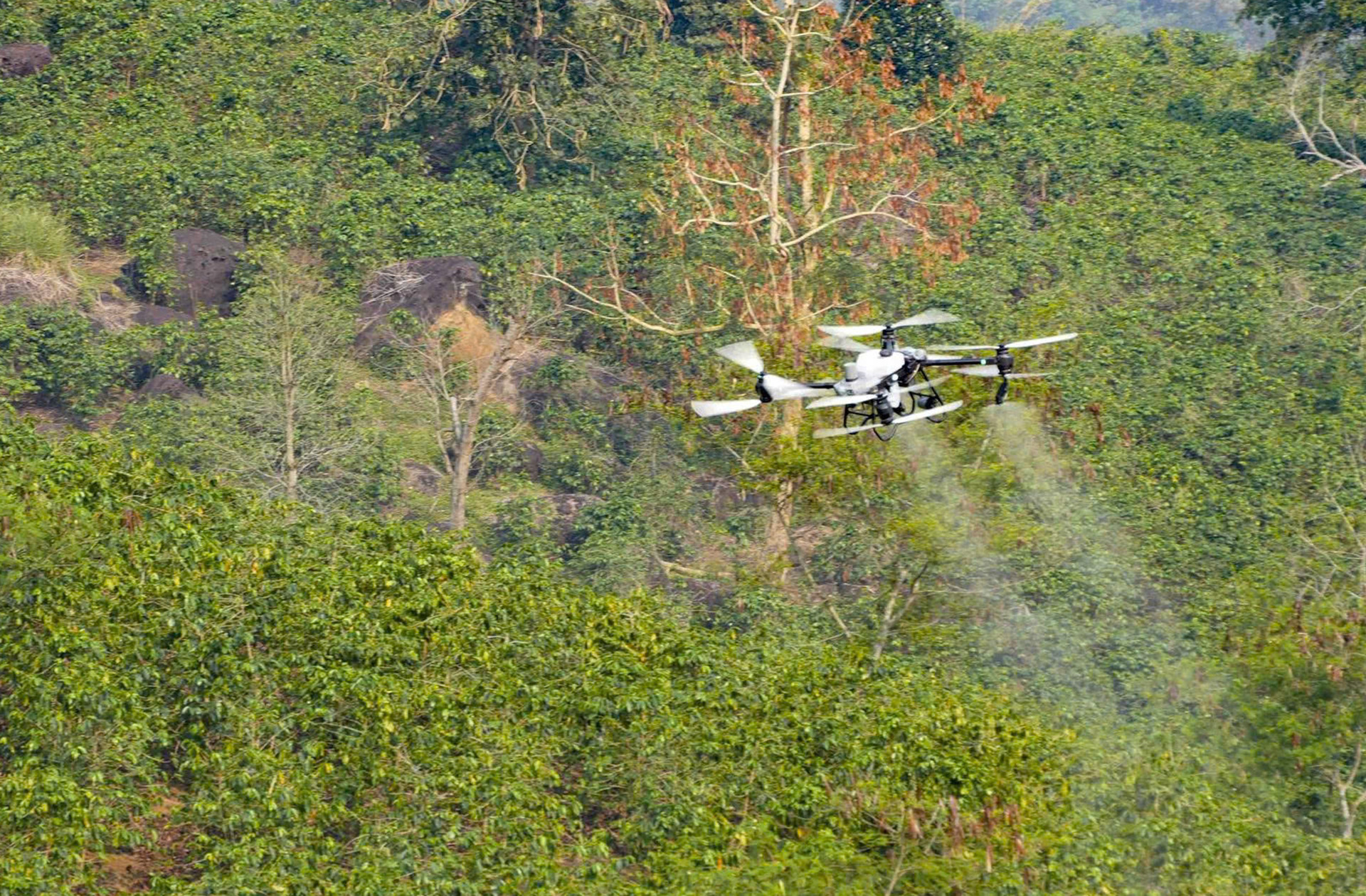
At the 2026 Dien Bien Investment Promotion Conference, Deputy Minister of Science and Technology Bui Hoang Phuong noted that Dien Bien's difficulties, such as fragmented terrain and long distances between residential areas and economic centers, can fully become new development spaces if solved by technology.
Dien Bien is one of the first localities to register for a controlled trial model of the low-altitude economy and low-altitude airspace with the Ministry of Science and Technology (MST). This is not just a new economic model but also a policy test to refine the institutional framework for national science, technology, innovation, and digital transformation.
The leading role is assigned to major tech corporations. “The participation of large groups and companies like Sun Group, Vingroup, and FPT will play a leading role in forming the ecosystem, creating a powerful ripple effect across the province,” Phuong noted.
New tech markets
It is no coincidence that Dien Bien was chosen as a testing ground. With 70 percent of its cultivated area consisting of steep slopes, making mechanization difficult, labor costs high, and logistics expensive, the province gathers nearly all the "bottlenecks" that UAV technology can intervene in.
Nguyen Van Khoa, CEO of FPT and Chair of the Vietnam Low-Altitude Economic Alliance (LEAP), said that FPT and other alliance members are aiming to build low-altitude economic models suitable for highlands, mountains, and border areas.
According to FPT's calculations, applying UAVs in agriculture can reduce pesticide spraying time from four hours to just 10 minutes per hectare; increase seeding and fertilizing productivity to 40-64 hectares per day; and reduce agricultural logistics costs by about 40 percent.
More significantly, across over 51,000 hectares of key crops such as rice, coffee, macadamia, and Shan Tuyet tea, the UAV model is expected to help reduce cultivation costs by 15-20 percent, save 62 million cubic meters of water annually, and add about VND2,630 billion to the province's GRDP.
This shows that UAVs are no longer simply “flying devices,” but are becoming a new infrastructure platform for agricultural and logistics economies in difficult regions.
Tech firms enter ‘soft infrastructure’ race
What differentiates this wave is that Vietnamese technology companies are not following the traditional model of selling standalone devices. Instead, they are building entire ecosystems that include management software, data systems, workforce training, logistics operations and pilot policy frameworks.
FPT has proposed two cooperation directions for Dien Bien: establishing linkage models among mountainous provinces with similar conditions to scale up the low-altitude economy, while selecting several “priority challenges” to deal with first, particularly in agriculture and logistics.
Alongside this is a human resource development strategy. According to FPT, students in Dien Bien could gain early exposure to UAVs, data and automation from the secondary school level to prepare for the future digital economy.
This signals that Vietnamese technology companies are shifting from the role of “solution providers” to builders of foundational capabilities for localities, similar to how many global technology giants created ecosystems around AI, cloud computing and electric vehicles.
The Government’s inclusion of UAVs in the list of strategic technology products under Decision 21/2026/QD-TTg has opened a new race for Vietnamese technology enterprises.
As AI, data and automation continue reshaping industries, the “low-altitude economy” could become a new strategic market for domestic technology groups.
Instead of competing solely in software or traditional IT outsourcing, Vietnamese companies are entering fields tied to physical infrastructure, airspace, logistics and smart agriculture.
If successful in Dien Bien, the model could become a “sandbox” for many other mountainous provinces while creating a sufficiently large domestic UAV market to promote the research, production and commercialization of “Make in Vietnam” unmanned aerial technology.
Thai Khang
.svg)
