 Vietnamnet.vn

 Podcast



Ha Nam

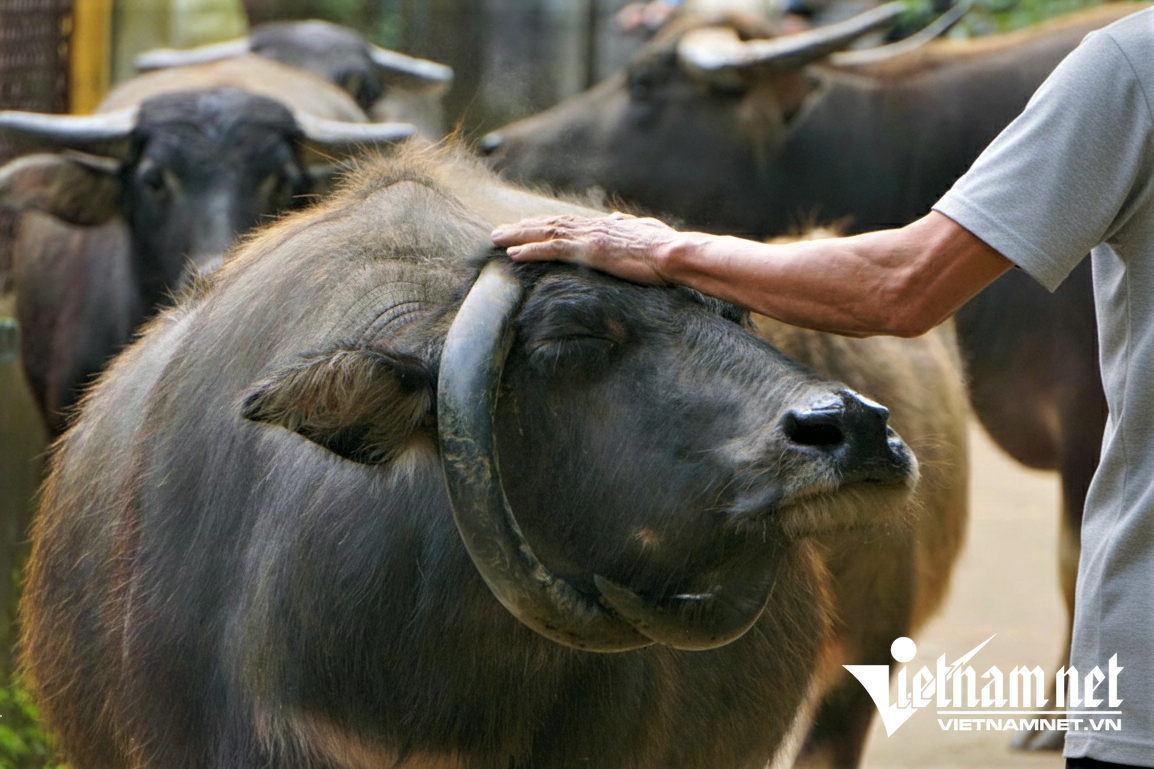
A female buffalo in Da Nang has captured public curiosity for its unique backward-curving horns that resemble a large necklace wrapped around its head and neck.
The animal belongs to 67-year-old Vo Truong, a longtime resident of Trung Chanh Hamlet, Tam My Commune, Da Nang City.
Unlike most buffalo, whose horns grow outward and upward, this buffalo’s horns begin near the temples, curve downward, and gradually close into a symmetrical circle around its head. From a side view, they appear like an oversized neckpiece, giving the animal an unusually striking profile.
Truong says his family has raised this buffalo for nearly 20 years, mainly for plowing and breeding. He recalls that from the time its horns began to grow, they showed an unusual curvature. Over the years, the horns naturally formed a closed circle without any human interference.
“She’s gentle, strong, and has been a good breeder,” Truong shared. “She’s already given birth to ten calves and is currently pregnant again. Thanks to her, we’ve had a steady source of income to support our family.”
Despite its mother’s rare feature, none of her calves inherited the same horn shape; all have developed normal horns.
“In nature, buffalo horns are typically a form of defense and a symbol of strength,” Truong explained. “But with her horns growing backward, maybe she understands her limits - she’s very tame and never gets aggressive with others. She just quietly eats grass, looks after her calves, and listens to her owner,” he added with a smile.
The buffalo remains in excellent health, eats well, moves freely, and is still strong enough to work the fields. Her unique horns do not hinder her daily activities or labor performance.
Among the four buffalo currently in the family’s pen, only this one has the backward-curving horns, making her a frequent subject of fascination. Locals and passersby often stop by to take photos and admire her unusual look.
While the family has received high offers from livestock traders eager to buy the animal, Truong insists he has no intention of selling.
“She’s been with us for so many years. I still take her out to graze every day, care for her, and she’s become part of the family,” he said.
Truong shared that the buffalo’s offspring can sell for $600–800 each. Over time, this has allowed his family to gradually improve their quality of life - building a new house and buying transportation.
“In the countryside, buffalo truly are the foundation of our livelihood,” he reflected. “Thanks to her, we’ve been able to reach a stable place in life.”
Recently, images of the buffalo with its “necklace” horns have gone viral on social media, attracting even more attention. But to Truong, the animal is not a trophy or a curiosity - it’s a faithful companion that has quietly witnessed and contributed to decades of his family’s rural journey.



.svg)
