 Vietnamnet.vn

 Podcast



According to Ms. Mỉa, each Muong brocade product is a story, a profound cultural message. Photo: Bình Minh
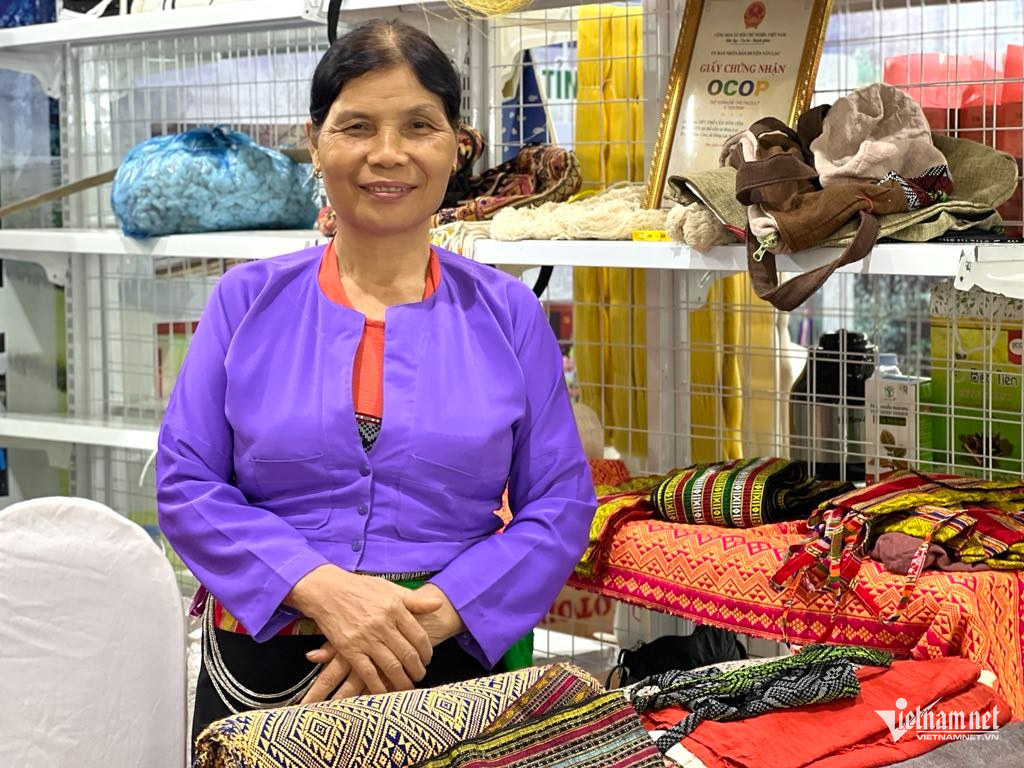
At over 60 years old, Bui Thi Huong from Com Hamlet (Tan Lac, Phu Tho) is one of the few people still dedicated to preserving the traditional Muong brocade weaving craft.
We met her at an OCOP (one commune one product) fair in Hanoi, showcasing regional specialties. She was selling goods while bringing along tools like a cotton roller and loom to demonstrate the traditional handmade process of creating brocade fabric.
“No one knows when this craft began; we only know it was passed down from our ancestors, generation after generation,” Huong shared.
The process to produce brocade is highly intricate. The Muong grow their own cotton for raw materials, and after about six months, the cotton is harvested and dried.
Next comes preprocessing, when the Muong use hand tools to separate seeds. The cotton is “beaten” to fluff it up and rolled into small clumps called “con” for easier spinning.
“On average, one kilogram of cotton yields only about 300 grams of usable fiber, and it can only be processed on sunny days; rain halts the work,” Huong noted.
From these fluffed cotton clumps, artisans spin them into threads and wind them into skeins.
Before weaving, the threads are washed and soaked in water for about a week to become soft and durable. Threads are divided into warp and weft. For warp threads, to ensure strength and durability during weaving, the Muong cook rice into a paste to starch the threads, then wind them into skeins, thread them through, and set them on the loom. Weft threads, however, are only washed to remain soft before being woven.
To dye the threads, the Muong use natural materials: black from indigo plants, yellow from turmeric, and sky blue from non-fuzzy ‘dac’ (Arenga palm) plants.
On traditional handlooms, warp and weft threads are woven together to create brocade fabric with intricate patterns.
“Our ancestors left us about 50 pattern designs, like lozenges, hearts, duck eggs, ducks, flowers, leaves, and mountain peaks, all tied to nature. Each product tells a story and carries a profound cultural message,” Huong said with pride..
Cultural symbol of the Muong
The traditional brocade weaving craft is considered a cultural symbol, a unique hallmark of the Muong.
Bui Thi Mia, Deputy Director of the Dong Lai Commune Brocade Weaving Cooperative, said in the past the Muong distinguished social classes through patterns on the skirt’s waistband.
There were three classes in Muong’s society in the past. ‘Lang’ was the highest-ranking nobility, overseeing entire Muong regions. ‘Au’ assisted ‘Lang’, managing tasks and serving as aides. ‘Nooc’ were the poor commoners.
For the ‘Lang’, waistband patterns were elaborate and symbolic of power, featuring sacred animals like dragons, phoenixes, and peacocks. Weaving these patterns required advanced skills, time, and effort. The waistbands were typically woven with expensive silk threads in vibrant colors (red, yellow, green) with high color durability.
For the ‘Au’, waistband patterns often depicted fruits like ‘en’ fruits or cloudberries.
For commoners, waistband patterns were simpler, often leaf motifs, easier to weave, using affordable cotton threads in black, white, or green.
According to Mia, weaving a complete piece of fabric, especially with traditional patterns, requires artisans to meticulously count each thread and form each motif. A slight misstep can distort the entire pattern. Patience is essential.
Preserving the craft against challenges
Proud of a traditional craft rich in cultural identity, Huong and Mia harbor growing concerns. The once-thriving craft village now has only about 50 households still practicing, mostly middle-aged. The risk of the craft fading is evident.
Mia began learning brocade weaving at 12, taught by her mother and grandmother. After nearly 50 years dedicated to the craft, she feels pained that “at this age, I see the younger generation struggling to carry on. It’s such a pity.”
Huong added “This craft is laborious and doesn’t bring much income. I mainly rely on farming; a year of weaving might only earn a few million VND. Young people today don’t want to learn. We encourage them, but they prefer salaried jobs at companies.”
In 2023, those committed to preserving the Muong’s traditional brocade weaving established the Dong Lai Commune Brocade Weaving Cooperative (previously under Tan Lac District, Hoa Binh Province, now part of Tan Lac, Phu Tho after a merger).
Binh Minh
.svg)
