 Vietnamnet.vn

 Podcast



It was a sobering message: the window of opportunity will not remain open indefinitely. If we hesitate, we may reach our centennial as a nation unprepared and too late.
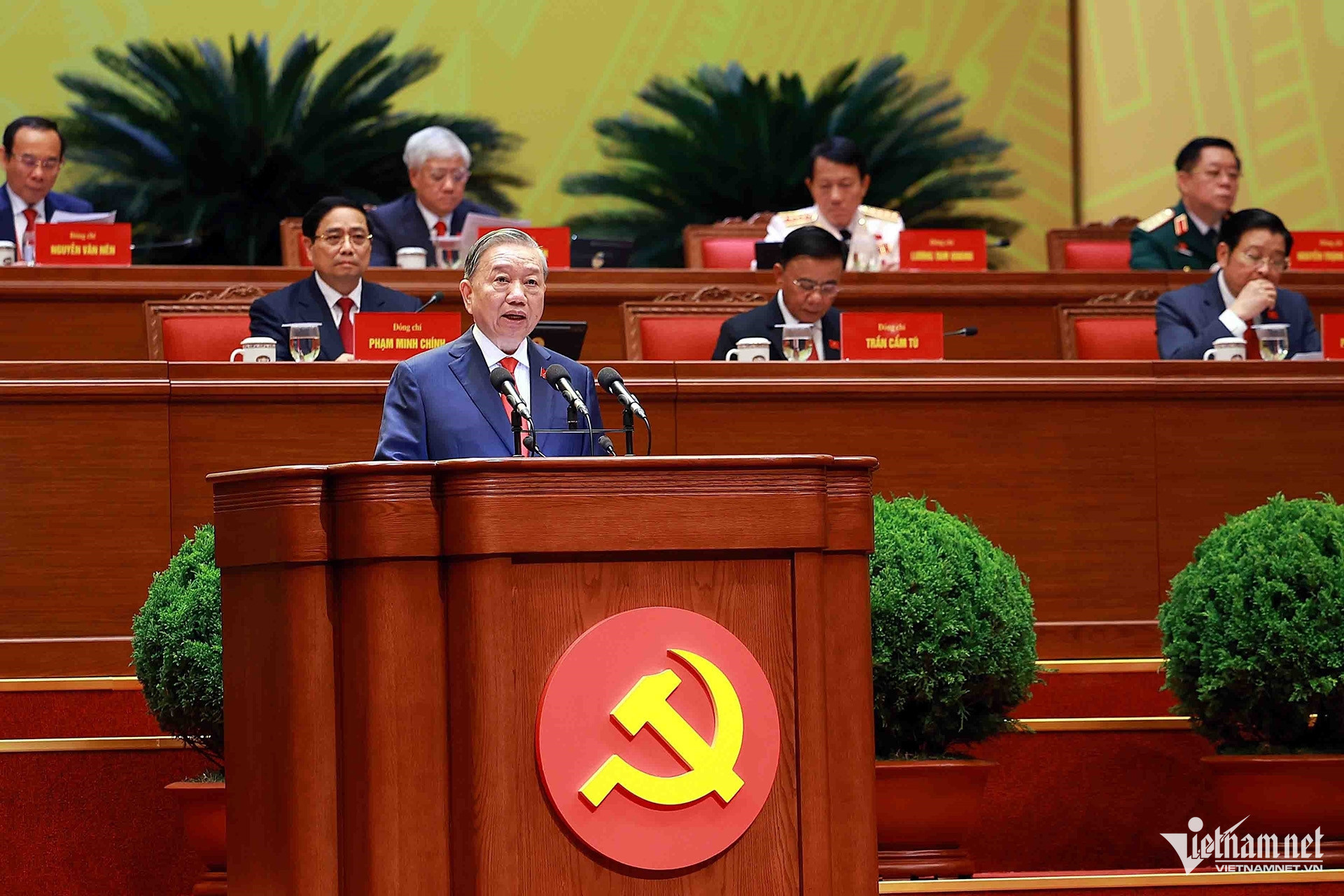
In his address presenting the draft documents at the Congress's opening session, General Secretary To Lam outlined a clear imperative: face the truth, assess realities with honesty, reform thinking, perfect institutions, strengthen national governance - and act decisively, boldly, and effectively.
In essence, the demands of development for the coming period have been articulated with clarity and urgency.
Ambitious goals, elevated aspirations
The documents propose an average annual GDP growth rate of 10% during 2026–2030, aiming for a per capita GDP of $8,500 by 2030. This is not just a statistic - it is a declaration of pace and ambition.
But the General Secretary was equally frank: even sound policies can remain “on paper” if implementation is slow, misaligned, or ineffective.
The message is unmistakable: high growth is not merely an economic challenge - it is first and foremost a test of organization, discipline, and execution. The higher the goal, the higher the demands for open institutions, scientific governance, and strict accountability.
Institutions must pave the way for development
Placing institutional reform and the rule-of-law socialist state at the forefront, the General Secretary emphasized one core metric: execution.
His directives were precise - dismantle the “ask-give” mechanism, drastically streamline administrative procedures, achieve full digitalization and data integration. Reform should be measured by the time and cost it saves citizens and businesses.
He called for legal and implementation discipline to end the all-too-familiar ailments of governance: laws that obstruct rather than enable, top-level urgency met with ground-level inertia, excessive talk with limited action, and policies well-conceived but poorly executed.
The essence of his message: institutions are not ends in themselves. They must operate, deliver, and actively enable the country’s development goals.
A new model for growth
Vietnam must transition to a new growth model - one built on knowledge, digital, green, and circular economies.
The old formula - resource extraction, cheap labor, and capital-intensive expansion - has run its course.
The General Secretary insisted that growth quality must now be measured by productivity, efficiency, innovation, and full-cost accounting. The economy must move up the value chain, with strategic growth hubs and logistics centers, and develop into high-end financial, tourism, and service hubs.
The roles of different economic sectors were also clarified: state-owned enterprises must continue to stabilize the macroeconomy and provide strategic orientation. But private enterprise, as the most dynamic driver, must be protected in its rights to property and free business, within a fair and competitive environment.
Put simply, growth engines only function when institutions allow them to.
Science, technology, innovation: the central force of development
The General Secretary affirmed that science, technology, innovation, and digital transformation are the driving forces of national progress. But he also cautioned: technological breakthroughs require more than ambition - they begin with people and sound mechanisms.
The draft documents call for concrete actions: attracting and empowering talent, assessing performance by outcomes, flexible financial policies, public-private collaboration, and strategic commissioning of scientific research aligned with development needs.
Digital transformation is not just a tech initiative - it is a means to raise productivity, reduce social costs, and improve governance.
The message is clear: technology becomes a true driver only when it generates real-world value, embedded in the right institutional framework.
A foundation for sustainable development
One of the speech’s central themes was the human-centric approach to development. Culture and people are seen as both spiritual foundation and intrinsic drivers of progress.
The General Secretary called for fostering cultural values and a healthy social environment; strengthening education, healthcare, and social welfare; and ensuring that growth is tied to equity, justice, and environmental sustainability. These are not “soft elements” of development - they are conditions without which growth can collapse upon itself.
Speak less, do more, deliver fully
If institutions are the roads, then officials are the drivers.
The documents refer to cadre work as the “core of the core” - placing emphasis on selecting the right people, assigning the right tasks, and measuring outcomes by performance, impact, and public trust. There must be mechanisms for upward mobility, accountability, and protection for those who dare to act for the common good.
The General Secretary gave a pointed instruction: speak less, do more, and see things through.
Every goal must be backed by measurable indicators, clear timelines, and designated responsibility. Rigorous inspection and supervision must follow. Those who deliver should be rewarded; those who delay or evade must be held accountable.
“The people are the root” – the highest benchmark for policy
At the heart of the entire speech was one enduring principle: “The people are the root.”
The people are the center, the subject, the purpose, and the metric of development. Public trust is not earned through rhetoric, but through the effectiveness of institutions, fairness in opportunity, protection of rights, and responsiveness to legitimate concerns.
The General Secretary posed some of the most profound questions in simple terms: Does this decision benefit the people? Will it enhance trust? Will it improve lives?
If not, he said, it must be improved.
A covenant with the future
The 14th Party Congress has been defined as a Congress of trust and aspiration, of breakthroughs and action.
But the true value of its declarations lies in what follows: each month, each quarter, each year must deliver visible progress that the people can feel, believe in, and rally behind.
A 10% growth target is not a slogan - it is a solemn commitment. A contract with the future.
It demands that institutions genuinely pave the way, that discipline is enforced, responsibility is clear, and results are measured in the real lives of citizens.
This Congress is taking place at a time when the “clock of history” is striking crucial hours - on the approach to 2030, the 100th anniversary of the Party’s founding.
“Never has our dream of a democratic, prosperous, civilized, and happy Vietnam felt so close,” the General Secretary said. “But never have we also faced such intense challenges, such fierce demands, such competitive pressures as we do now.”
Tu Giang
.svg)
