 Vietnamnet.vn

 Podcast



As the 2026 Lunar New Year approaches, syrup kilns in Lam Thanh village, Kim Tan commune, Thanh Hoa province, are ablaze around the clock.
The air is thick with the scent of boiling sugarcane, the crackle of firewood, and the bustle of villagers working from dawn to midnight to meet the seasonal surge in demand.

Villagers in Lam Thanh work late into the night boiling syrup ahead of Tet. Photo: Le Duong
With the end of the sugarcane harvest, families gather at the kilns for what has become a traditional three-month production sprint. It’s a race against time - and orders.
“We've had nights where the whole family stays up to tend the fire, and at sunrise we start pressing more cane. It's exhausting, but with so many Tet orders, we can't stop,” said Do Thi Nhan, a veteran syrup maker whose family has passed the craft down for generations.
In the fire-lit glow of the kilns, syrup churns in giant iron pots. Villagers press cane into juice, skim impurities, and slowly boil it for hours until it thickens into a golden-brown syrup - smooth, fragrant, and ready for bottling.
A labor of love and experience
“It takes strength, but also skill,” Nhan explained. “Too much fire and the syrup burns. Too little, and it won’t thicken properly. You have to stir constantly, keep an eye on the flame, and feel the texture.”
This year, Nhan’s family expects to produce around 10 tons of syrup. With prices ranging from 14,000 to 16,000 VND per kilogram (about $0.57–$0.65), the season’s earnings could reach $6,500. After deducting expenses for raw cane, firewood, and labor, the family expects to net about $4,000 in profit.
And they’re not alone.
A village in full production mode

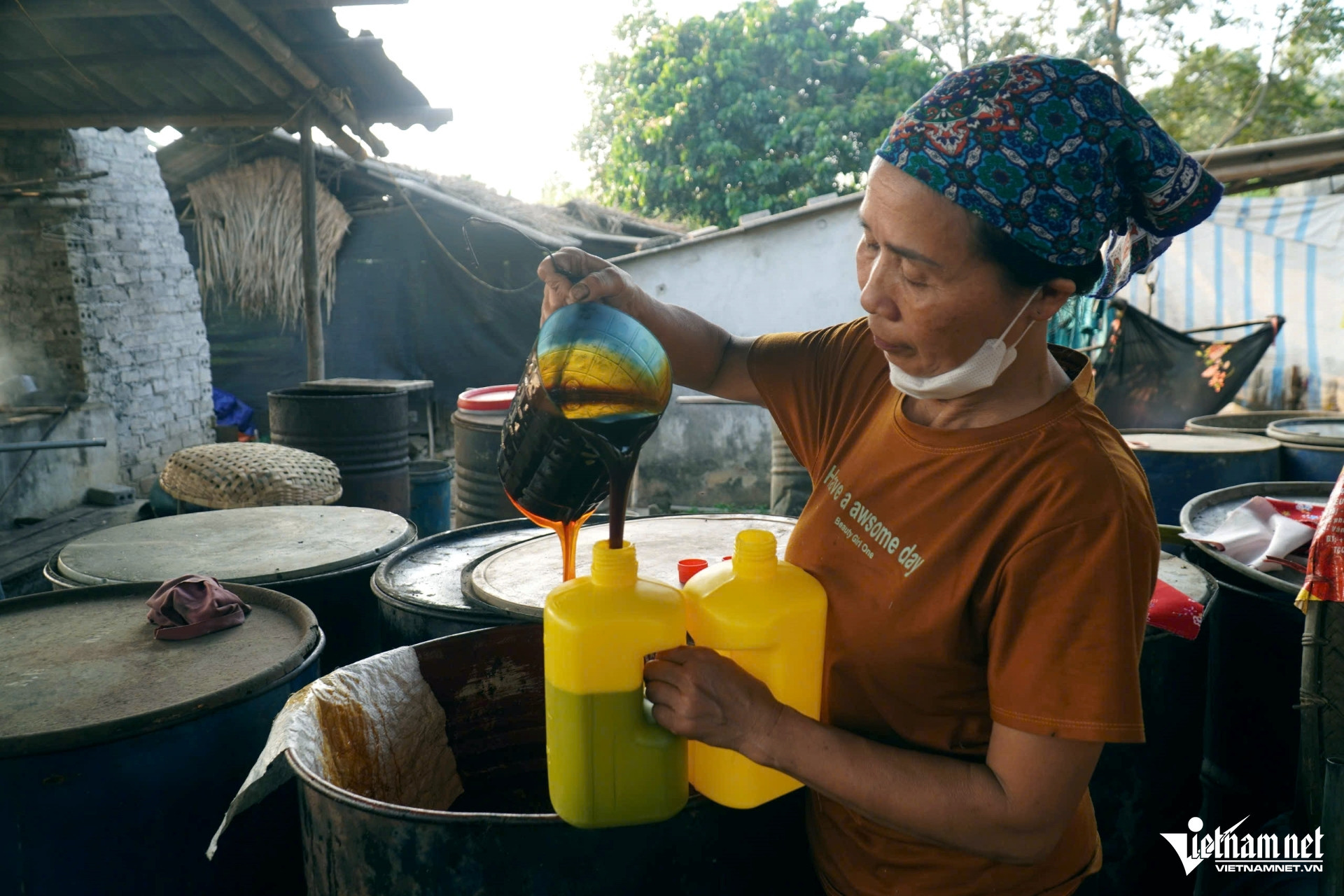
Do Thi Nhan pours freshly made syrup into cans for delivery. Photo: Le Duong

In Lam Thanh, nearly every household is in motion. At the kiln of Dinh Van Trung’s family, more than 300 tons of raw sugarcane are pressed each season, yielding 30 tons of syrup.
This year, demand is even stronger, especially from loyal buyers in and beyond Thanh Hoa. Trung’s family has had to press late into the night to keep up.
Despite the workload, Trung is proud that his family and village still follow the traditional syrup-making method - an artisanal process unchanged for generations. The cane is harvested, pressed for juice, filtered, and slowly boiled in large pots over wood fires. Once it reaches the right consistency and rich amber color, the syrup is cooled and bottled.
Boosting income and preserving tradition
According to local officials, Lam Thanh now has over 20 active syrup kilns. Each typically uses around 100–120 tons of sugarcane and generates seasonal income of roughly $8,000.
This traditional craft not only provides a vital outlet for local sugarcane farmers but also creates jobs and boosts household incomes during the slower agricultural months.
In the final days before Tet, the kilns glow late into the night, a familiar and comforting sight. More than just a seasonal business, syrup-making in Lam Thanh is a celebration of craft, community, and culture - preserved and passed down, one pot at a time.
Le Duong
.svg)
