 Vietnamnet.vn

 Podcast



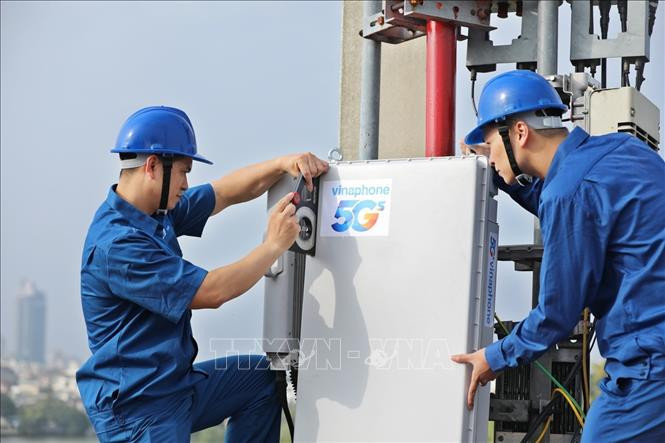
On September 9, National Auction Partnership Company No. 5 held an auction for spectrum in the 900–915MHz and 945–960MHz bands.
Earlier, Vietnam’s Ministry of Science and Technology had announced the auction plan for the 900MHz spectrum, setting a starting price of more than $40 million for each block and a 15-year licence term.
The 900MHz spectrum was divided into three paired blocks - C3-C3’, C4-C4’ and C5-C5’ - each with 2x5MHz of bandwidth. Specifically, the three blocks cover 900–905/945–950MHz, 905–910/950–955MHz and 910–915/955–960MHz, respectively.
VNPT won the C3-C3’ paired block with a bid of nearly $40.9 million. Viettel secured C4-C4’ for nearly $40.9 million, while Vietnamobile won the C5-C5’ paired block for nearly $40.8 million.
The results indicate that spectrum auctions are no longer the “life-or-death” contests among mobile operators that were seen in previous auctions for the 2,600MHz and 700MHz bands.
The competition was particularly intense for the 2,600MHz band, where Viettel had to pay more than $285 million to secure what was considered prime spectrum.
In terms of value, of course, the 900MHz band does not match the 700MHz or 2,600MHz spectrum. The 900MHz frequencies currently used for 2G networks will be repurposed by operators for 4G and 5G services.
For VNPT and Viettel, the 900MHz spectrum represents additional capacity following two previous successful auctions for spectrum allocated to 4G and 5G.
For Vietnamobile, however, securing the spectrum is critical to building out its 4G and 5G networks in the coming years. Within 12 months of receiving its spectrum licence, Vietnamobile will be required to put its 4G and 5G networks into operation.
The 900MHz band has enough capacity to serve four mobile operators. One spectrum block is currently reserved for national defence and security purposes. This means that part of the 900MHz spectrum could potentially be allocated for use by an operator suited to those requirements.
Thai Khang
.svg)
