 Vietnamnet.vn

 Podcast



Which type of tax poses the greatest risk to Vietnamese wooden furniture?
The greatest risk to Vietnamese wood and other major export industries is Section 301. Anti-dumping or countervailing measures usually only apply to specific products or enterprises. In contrast, Section 301 can be applied to an entire industry or even the whole export economy.
Notably, this time the US is focusing on 16 countries with large trade surpluses, meaning they are "striking selectively." Vietnam is at the top of this group.
Prior to that, the 301 tool was mainly for negotiation pressure, but it now has a more pragmatic and fiscal tone: they need revenue and "quick cash."
Vietnam's difficulty is a large trade surplus but limited "trade-off" room. Bluntly, this is a game where the rules are being rewritten, and we are not the ones writing them.
Vifores and Vietnamese wood enterprises see this as an "ambush from all sides." With support from the Trade Remedies Authority (Ministry of Industry and Trade), the association and enterprises have submitted responses and will participate in hearings, but in reality there are not many “cards” in hand.
The US side has clearly shown its intention to accelerate the Section 301 process, even using other legal tools to impose tariffs, possibly even higher, to offset losses from previously rejected retaliatory tariffs.
Why are Vietnam wood exports to the US so large?
In 2024, the US imported furniture from about 35 countries with total value $21.8 billion. Vietnam alone accounted for about $8.5 billion, equivalent to nearly 40 percent of the US market. In addition, Vietnam also exported nearly $1 billion of other wood products and about $500 million of forest-derived products.
No enterprise wants to “put too many eggs in one basket”. However, large exports to the US are not only the choice of Vietnam enterprises but the result of two-way interaction, especially from US market demand and US consumers, mainly the middle class.
Since 2018, the US – China trade conflict has escalated strongly. The US needs “friend-shoring” supply sources, and Vietnam is one of the few countries that can respond quickly under the “China+1” model.
On the other hand, US consumers, especially the middle class, prefer Vietnam wood products because of reasonable price, good quality, compliance with timber trade regulations and stable delivery capacity.
More importantly, the Vietnam – US wood trade is a mutually beneficial relationship. Vietnam needs a large and stable market; while the US side – from importers, distributors to consumers – all benefit, even more than Vietnam enterprises.
Any disruption, whether due to “natural” or “man-made” causes, will harm both sides and the entire supply chain.
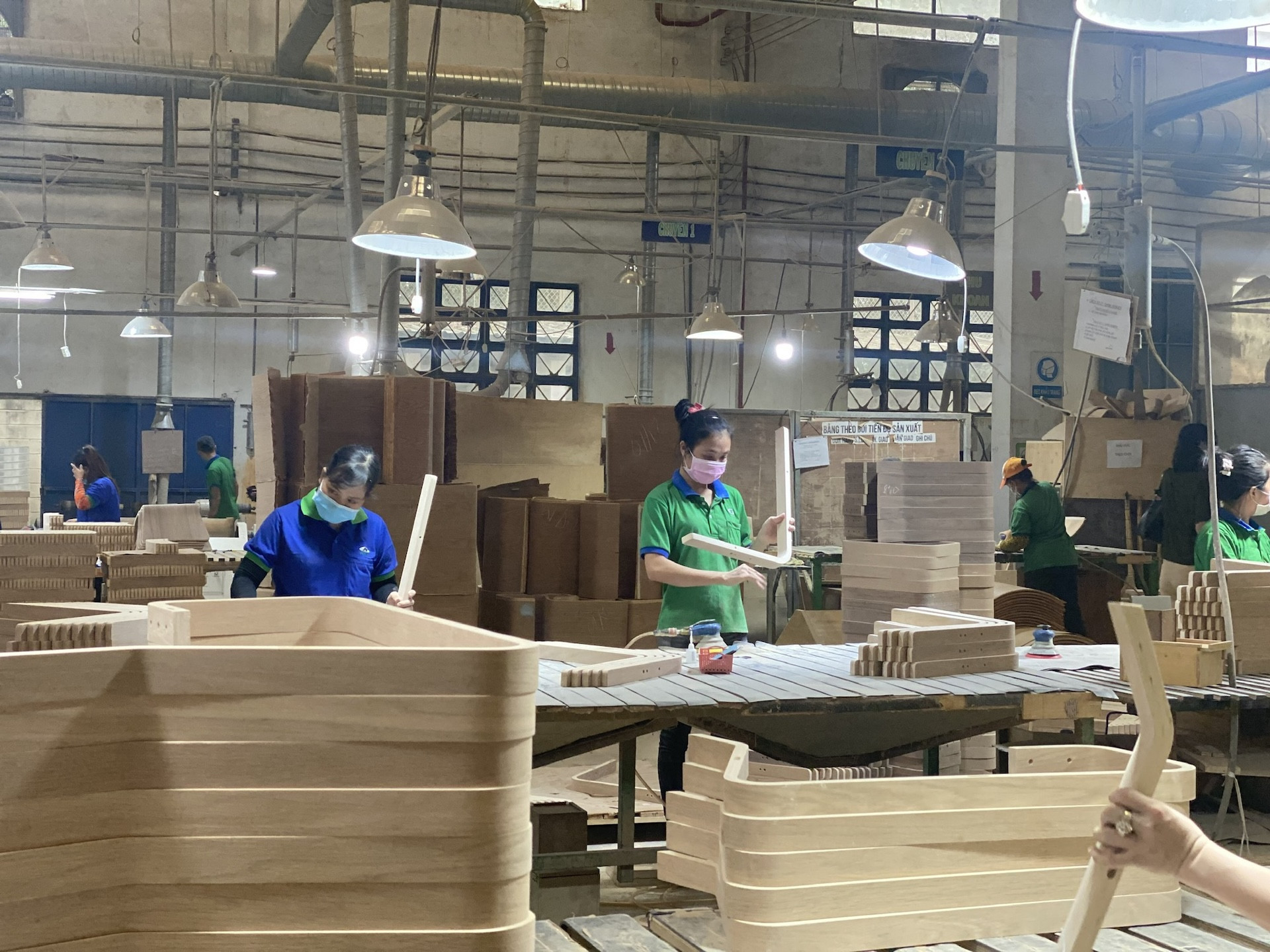
For the Vietnam wood sector, the core factor creating competitiveness is still people – human resources. Vietnam wood entrepreneurs are generally dynamic, resilient and flexible, able to seize opportunities. Vietnamese workers are diligent, skillful and meticulous, the qualities necessary for a labor-intensive industry that mainly “takes labor as profit”.
The friendly and practical imprint of “made in Vietnam” wood products, carrying to some extent the Vietnam culture and spirit, has become a part of the living and working spaces of many Americans.
Can Vietnam enterprises increase imports from the US to balance trade?
This trend has been happening. In 2024, Vietnam imported $325 million of timber from the US; by 2025 it increased to about $600 million, nearly doubling.
Types of wood such as oak, ash, beech, cherry are imported from the US to Vietnam, processed by Vietnam workers into products like kitchen cabinets, living room furniture, vanities, bedroom and office furniture, then exported back to the US.
This is the natural logic of global supply chains, where each party maximizes its comparative advantage.
In the long term, if the US truly wants to bring the wood industry back domestically (home-shoring), Vietnam enterprises can invest directly in the US, hire Vietnamese to work there, and use the abundant US timber to produce furniture in the US and supply to US consumers.
I have to clarify that although imports from the US have increased strongly, the trade surplus is still very large. But in the total value of $1.8 – $2.0 billion of logs and sawn wood that Vietnam imports annually from nearly 100 countries, the $600 million imported from the US is significant, accounting for one third.
Ultimately, at this moment, no technical solution can fully "resolve" a structural issue. If we don't want to fall into the trap where more processing leads to more irrational barriers, Vietnamese wood enterprises must participate deeper in the value chain, perhaps right in the major markets.
Tu Giang - Lan Anh
.svg)
