 Vietnamnet.vn

 Podcast



The new space for Vietnamese enterprises will be visible on restarted construction sites, in projects resolved to completion, in technologies mastered by Vietnamese hands and in concrete decisions taken at every level of government.
From drones to digital identity
The story begins with a phone call early on the morning of November 20, 2025. A friend had lost contact with relatives in a deeply flooded area. Luong Viet Quoc, CEO of RTR Technology, did not wait. He and his colleagues loaded relief supplies and four drones onto a vehicle, coordinating with local authorities while redrawing routes on digital maps amid landslides and blocked bridges.
By the afternoon of November 22, RTR’s Hera drone reached an isolated kindergarten where seven children and eleven adults were stranded. The drone transmitted live images to the command center, guiding ground forces to approach safely.
This story marks an important shift: drones manufactured by Vietnamese engineers are entering life-saving missions, disaster response and rescue operations with technology, initiative and a spirit of action.

Flood rescue operations using Hera drones during heavy rains across parts of the Central and Central Highlands regions in late 2025 were markedly different from before. These drones cut through wind and rain, delivering supplies to places beyond the reach of conventional rescue vehicles.
On another front, also related to security, another Vietnamese private enterprise has moved into the very core of institutional infrastructure: chip-based citizen identification cards, digital identity and data sovereignty.
For nearly two decades, Nguyen Trong Khang, Chairman of MK Group, has built capabilities in secure card manufacturing, biometric matching solutions and digital identity authentication systems serving tens of millions of citizens.
At one point, MK Group proudly reported producing tens of millions of chip-based citizen ID cards. These cards are not merely administrative documents. They are the foundation of a digital state - now mastered to a high degree by a Vietnamese private enterprise.
If RTR’s story shows that private firms can help safeguard lives in the most perilous moments, MK Group’s story shows that they can help build the digital nervous system of a modern state.
In both examples, private enterprises are not peripheral service providers or subcontractors. They have become co-actors in some of the most sensitive domains.
When this has already happened, the question is no longer what the private sector can do, but how far institutions will allow it to go - and under what frameworks of accountability and oversight.
The space that RTR, MK Group and many other private enterprises are entering reveals opportunities opening in unprecedented ways. But that is only half the story. The other half lies in the systemic barriers still holding the private sector back.
Awakening a sector that generates over 50% of GDP
The private sector contributes more than 50% of GDP, over 80% of employment and nearly one-third of export turnover. Yet its internal structure remains thin and vulnerable.
On average, there is only one enterprise for every ten citizens. Nearly 20 provinces have fewer than three enterprises per 1,000 inhabitants. Only around 40% of enterprises are profitable, and among micro enterprises the rate falls below 30%.
An economy aspiring to double-digit growth cannot feel secure when most businesses operate on a small scale, lacking capital, data, markets and a truly reliable legal framework for long-term investment.
The biggest bottleneck does not lie in entrepreneurial will, but in institutions and procedures. Enterprises must still seek licenses under fixed business classifications. New models risk suspension because they are “not yet regulated.” Escalating land costs render many production projects unviable. Most small and medium enterprises have almost no access to long-term capital or advanced technology.
A new space for private enterprise therefore also means dismantling systemic barriers - where the mindset of “not daring to sign” or “passing it upward to be safe” remains common, and where overlapping procedures force projects to endure a decade of paperwork before implementation.
These barriers are gradually being addressed through the Politburo’s quartet of resolutions, reflecting a coherent development mindset: modern law as foundation, technology as engine, international integration as market space and the private sector as the central driving force of a new growth model.
In a working session with the business community on Resolution 68, Prime Minister Pham Minh Chinh stated: “The Party has directed, the Government is united, the National Assembly agrees, the people support - we only discuss how to act, not how to retreat.”
This statement clearly positions the private economy. Nearly one million enterprises and more than five million business households are no longer merely encouraged actors. They are pillars upon which all high-growth objectives must rest.
The quartet of resolutions, along with expert recommendations, conveys a shared vision: the State cannot act as both referee and player; private enterprises cannot remain excluded from strategic sectors; and institutions cannot call for innovation while maintaining a jungle of procedures that restrains initiative.
Beyond technology and manufacturing, the new space for private enterprise also lies in strategic infrastructure: the North-South high-speed railway, nuclear power plants, the Red River landscape axis, metro lines, expressways and seaports.
Projects that shape the nation’s development space are now being designed so that private firms can participate as co-investors, co-creators and risk-sharing partners.
An economy seeking double-digit growth cannot rely solely on fiscal and monetary tools. It requires a new layer of physical infrastructure and urban-industrial space in which private enterprise is explicitly invited and enabled to participate.
Unlocking what has been left dormant
A significant portion of the new space lies in what has long been dormant. In July 2025, at a national conference on resolving stalled projects, authorities cited 2,981 suspended projects with an estimated total investment of US$235 billion and about 347,000 hectares of related land.
These projects represent housing, urban infrastructure, logistics, industrial zones, jobs and future fiscal revenues. Yet they remain frozen due to unresolved violations, shifting legal frameworks, overlapping documentation and, above all, fear of responsibility.
Prime Minister Pham Minh Chinh emphasized: “Where clarity exists, act there; resolve each issue fully; do not let mistakes compound.” But any policy, no matter how timely or correct, remains merely text unless it penetrates the level of implementation.
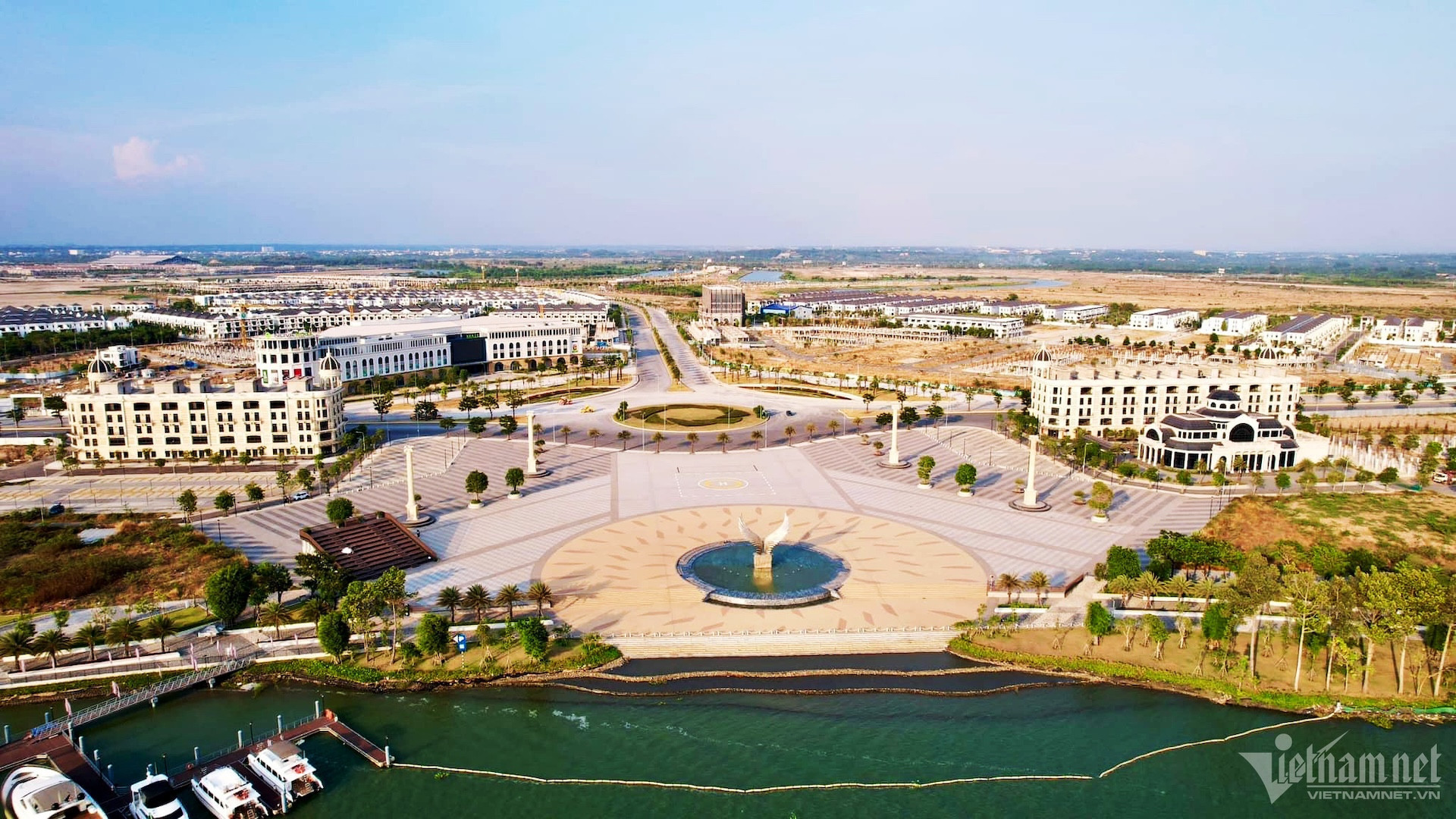
Aqua City in Dong Nai offers a telling example of how institutions only matter when they are applied.
After a prolonged period of legal entanglements and institutional hesitation, Dong Nai adopted a different approach: provincial leaders assumed direct responsibility, established an inter-agency task force, consolidated all obstacles under one focal point, conducted periodic reviews and resolved issues decisively.
When leaders are willing to stand at the forefront within the bounds of law, officials feel secure enough to propose solutions. When departments sit together to resolve issues, procedures no longer circle year after year.
The successful handling of Aqua City sends a clear message: if institutions operate properly, resources frozen for years can be released within months. If such approaches are replicated, 2,981 stalled projects could become a catalogue of opportunities for private enterprise and supply-side growth.
Ultimately, products such as Hera drones, chip-based citizen ID cards, Aqua City and many other goods and services will generate unprecedented growth impulses once institutional barriers are dismantled.
All of this converges on one central question: are we truly ready to entrust and safeguard the role of the private economy as the “most important driver” as we ourselves have defined it?
If the answer is yes, then the new space for Vietnamese enterprises will appear on restarted construction sites, in projects resolved to completion, in technologies mastered by Vietnamese hands and in concrete decisions taken at every level of government.
At that point, double-digit growth and a Vietnam entering a new development era will become the natural outcome of a clear institutional choice: to recognize, treat and protect the private economy in accordance with the role we have already assigned to it.
Tu Giang
.svg)
