 Vietnamnet.vn

 Podcast



General Secretary and State President To Lam has called for a comprehensive review of whether additional commune and ward mergers are necessary, based on assessments of population size, geographic area, infrastructure capacity and the quality of local government personnel.
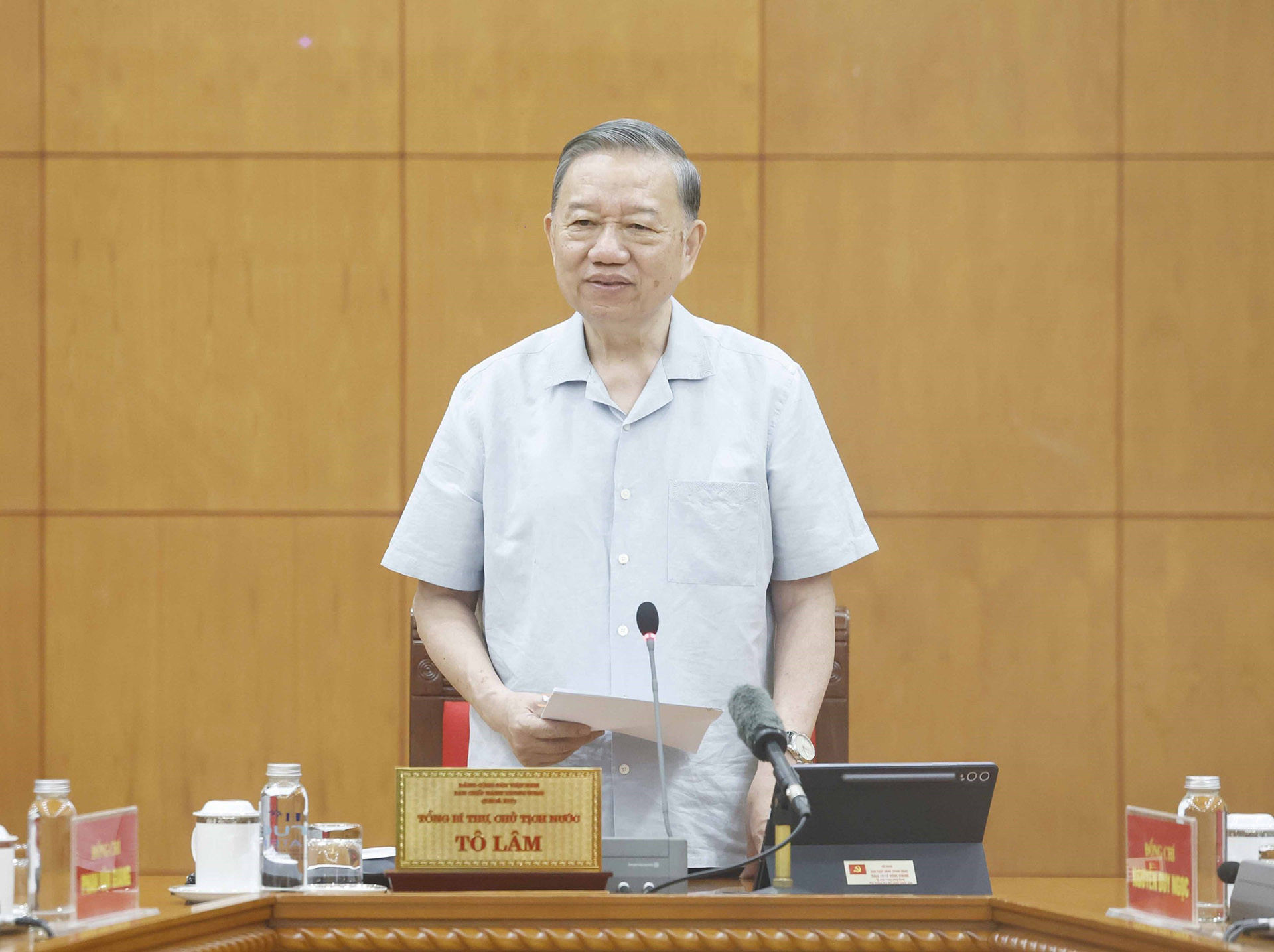
The Party Central Office has released the conclusions of To Lam following a working session with the Central Steering Committee responsible for reviewing one year of operation under Vietnam's new political organizational model and three-tier government structure.
According to the review, the political system has completed a substantial volume of work over the past year, successfully restructuring the administrative apparatus within a relatively short period.
A draft report prepared for the review highlights significant achievements in implementing the new organizational framework and the three-tier local government model, while also identifying key bottlenecks and institutional constraints that need to be addressed to ensure more effective and efficient governance.
Governance quality remains uneven
Despite initial successes, To Lam noted that many issues still require further consideration, revision and adjustment.
While the organizational structure has been streamlined, the quality of governance remains uneven across different localities. The number of administrative units and organizational focal points has been reduced, but management effectiveness has not always met expectations.
In addition, although greater authority has been delegated to local governments, resources, institutional capacity and implementation tools have not always kept pace with the demands of the new development stage.
To Lam approved the draft review report for submission to the Politburo, which is scheduled to discuss the matter on June 26.
He assigned the Party Central Committee's Organization Commission to work with the Party Central Office to incorporate feedback from the meeting and finalize the report for circulation to Politburo members.
The Organization Commission will also coordinate with the Government Party Committee, the National Assembly Party Committee, the Party Committee of the Vietnam Fatherland Front and mass organizations, the Party Committee of Central Party Agencies, the Central Military Commission, the Central Public Security Party Committee, central Party commissions and provincial and municipal Party organizations to complete preparations for a nationwide review conference scheduled for July 1.
Careful assessment of emerging risks
To Lam called for a thorough assessment of the consistency, transparency and effectiveness of Vietnam's current legal framework, particularly laws governing local government operations in areas such as science and technology, innovation, digital transformation, land management, natural resources, forestry, finance, budgeting and decentralization.
He also requested a detailed evaluation of implementation capacity at the commune level, particularly in sectors including land administration, construction, finance, justice, industry and trade, agriculture, environmental management and social services.
The assessment should take into account staffing levels, the availability of specialized personnel and the alignment of job positions with practical governance requirements.
The Party chief further emphasized the need to identify shortcomings arising from applying a uniform governance model to localities with significantly different levels of development, administrative capacity, geographic conditions and infrastructure.
Special attention should be paid to differences between major urban centers and rural or mountainous areas, as well as disparities in digital infrastructure and technological readiness.
Authorities were also instructed to examine whether decentralization policies are adequately supported by financial resources, personnel and budget allocations, particularly at the commune and ward levels.
To Lam suggested that future reviews should also examine the operation of Vietnam's national defense and public security systems within the two-tier local government model.
In addition, he called for a detailed assessment of judicial institutions following the transition to a regional structure, including the closure of three high-level courts, three high-level procuracies and district-level courts and procuracies.
Further mergers may be considered
The General Secretary and State President requested an additional review of the effectiveness, autonomy and operational suitability of public service units following administrative restructuring.
He also directed authorities to assess whether further mergers of communes and wards may be necessary after reviewing criteria related to land area, population, infrastructure, personnel capacity and future development needs.
According to To Lam, any additional restructuring should aim to strengthen the advantages of larger administrative units while promoting digital transformation and improving the effectiveness of state management.
He also proposed studying the establishment of special urban administrative units capable of serving as development hubs and coordinating infrastructure, public services and key economic zones.
Warning of potential challenges
The Party Chief and State President urged authorities to identify and evaluate potential risks associated with the ongoing reforms and develop timely corrective measures.
Among the concerns highlighted were the possibility that administrative restructuring could focus primarily on reducing the number of agencies rather than improving service quality and governance capacity.
Other risks include widening disparities in public service quality between major urban areas and remote regions, as well as between localities with strong digital capabilities and those that remain underdeveloped.
To Lam also warned of growing pressure on grassroots officials, who may face increasingly heavy workloads and greater responsibility, potentially leading to risk-averse behavior and administrative delays.
Another concern is that residents may have to travel farther and spend more time accessing public services if service centers are not organized and distributed appropriately.
The review is expected to provide the foundation for future decisions on Vietnam's administrative reform agenda as the country seeks to modernize governance, strengthen local government performance and accelerate digital transformation nationwide.
Tran Thuong
.svg)
