 Vietnamnet.vn

 Podcast


According to the latest report from the Vietnam Automobile Manufacturers' Association (VAMA), October vehicle sales totaled 28,957 units, covering VAMA members and completely built-up (CBU) vehicle imports by non-member companies.
The reported figures included 20,715 passenger vehicles, 9,698 commercial vehicles and 544 special-purpose vehicles. Compared with September, passenger vehicle sales fell 16%, commercial vehicles declined 22% and special-purpose vehicles dropped 14%.
Among VAMA members alone, October sales reached 22,806 vehicles, down 13% month on month and 28% compared with the same period in 2025.
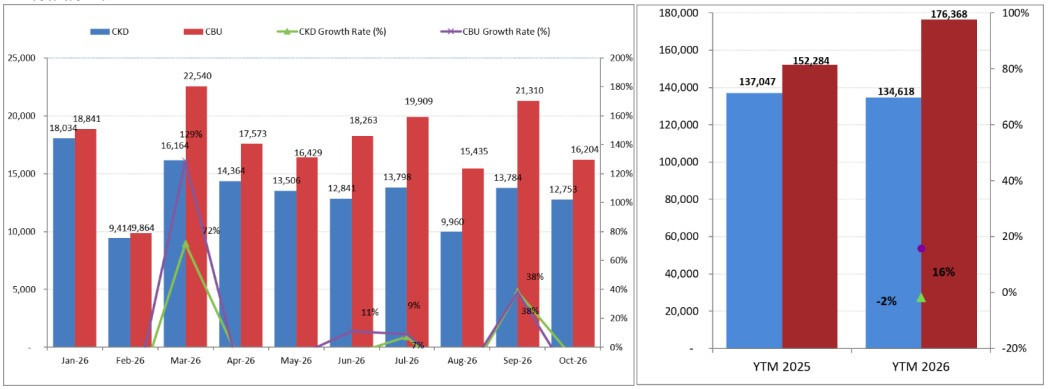
By origin, sales of domestically assembled vehicles totaled 12,753 units in October, a 7% decline from the previous month. Meanwhile, sales of imported CBU vehicles reached 16,204 units, plunging 24%.
Vietnam auto sales remain higher for the first 10 months
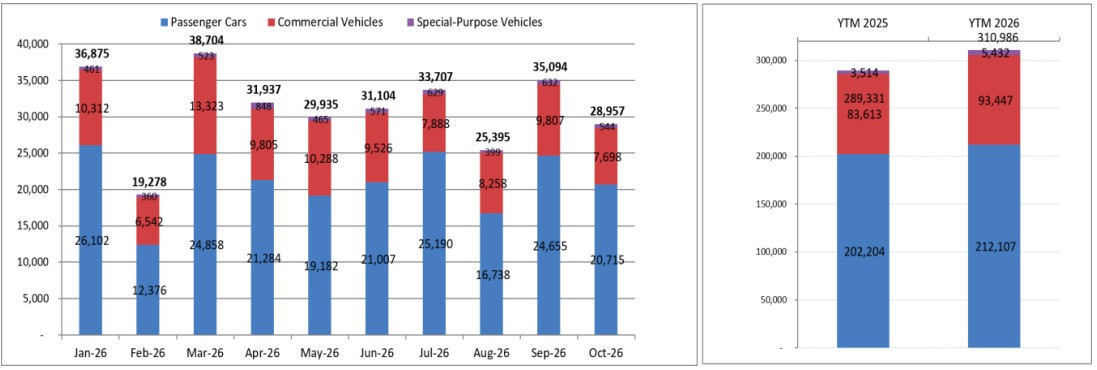
Despite the sharp October slowdown, Vietnam auto sales for the first 10 months of 2026 reached 310,986 vehicles, up 7% from the same period last year.
Passenger vehicle sales increased 5%, commercial vehicle sales rose 12%, while special-purpose vehicle sales surged 55%.
VAMA data also showed contrasting trends between domestically assembled and imported vehicles. Cumulative sales of locally assembled vehicles fell 2% year on year during the January-October period, while imported CBU vehicle sales increased 16%.
For VAMA members alone, total sales in the first 10 months reached 242,913 vehicles, up 3% from the corresponding period in 2025.
Passenger vehicle sales stood at 162,547 units, remaining virtually unchanged from a year earlier, while commercial vehicle sales slipped 1% to 62,314 units.
Hybrid vehicles, however, emerged as a bright spot, with sales reaching 17,948 units, a substantial 61% increase year on year.
Why is Vietnam's car market slowing during peak season?
The sharp decline in October came as a surprise because the fourth quarter is traditionally one of the busiest periods for vehicle purchases in Vietnam.
During this period, automakers and dealerships typically roll out aggressive promotions, price reductions and registration fee support to stimulate demand and boost sales before the year ends.
However, October's performance suggests that consumer demand remains unstable, reflecting the challenges facing Vietnam's automotive market this year.
The VAMA figures do not capture the entire Vietnamese vehicle market, as they exclude sales reported separately by domestic electric vehicle manufacturer VinFast and Hyundai Thanh Cong.
Even with a wide variety of models available and continuous promotional campaigns, vehicle purchases remain under pressure.
The latest figures suggest that automakers and dealers may need to maintain substantial incentives throughout the remaining months of 2026 to attract buyers, rather than relying solely on the traditional year-end shopping season to lift sales.
Hoang Hiep

