 Vietnamnet.vn

 Podcast



The historic announcement came following a formal welcoming ceremony and high-level talks between President Luong Cuong and President of the European Council Antonio Costa, who is on an official visit to Hanoi.
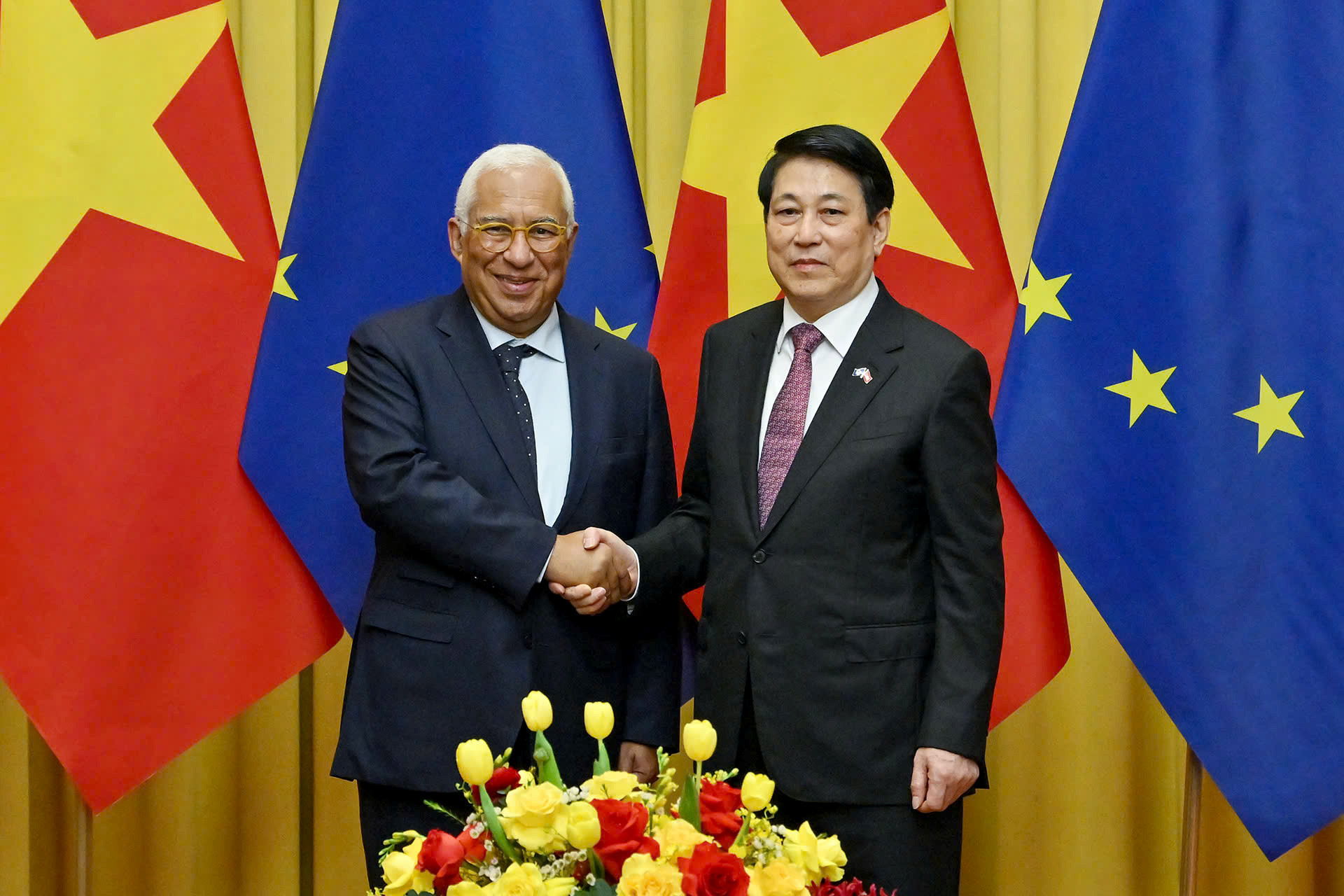
President Luong Cuong and European Council President Antonio Costa during their bilateral meeting.
President Luong Cuong praised the visit as especially meaningful, marking the first time since 2012 that a European Council President has visited Vietnam - and the first European leader to do so following the conclusion of Vietnam’s 14th National Party Congress.
The two leaders agreed that the elevation of the partnership signals a new chapter in Vietnam–EU relations.
President Cuong reaffirmed Vietnam’s commitment to strengthening ties with the EU, which he called one of the country’s most important diplomatic partners. He emphasized Vietnam’s desire to build a deeper and more comprehensive relationship with both the EU and its member states.
The Vietnamese head of state also highlighted the EU’s global role in upholding multilateralism and international law, and its contribution to peace and stability.
Sharing outcomes of the recent 14th Party Congress, Cuong underlined Vietnam’s two centennial goals: to become a modern industrialized country with upper-middle income by 2030, and a high-income developed country by 2045.
Vietnam, he said, is determined to pursue a new growth model driven by science, technology, innovation, digital transformation, and green development - and is ready to work closely with the EU in this new development era.
He proposed that both sides actively implement the Joint Statement on the upgraded partnership, with six key focus areas: enhancing political trust through high-level exchanges, activating and expanding cooperation mechanisms, prioritizing economic cooperation as a growth engine, and positioning science, technology, and innovation as a core pillar of collaboration.
Cuong also called on the EU to boost maritime cooperation, support Vietnam’s efforts in building a sustainable fisheries sector, and urgently remove the IUU “yellow card” on Vietnamese seafood exports.
He expressed Vietnam’s full support for strengthening ASEAN–EU relations and affirmed Vietnam’s readiness to serve as a bridge between the two regional blocs - especially as they prepare to celebrate the 50th anniversary of ASEAN–EU relations in 2027.
A historic turning point
President Antonio Costa expressed his honor at being the first European leader to visit Vietnam following the Party Congress - a moment he described as crucial to the country’s future orientation.
He commended Vietnam’s impressive development achievements and emphasized the country’s central role in the EU’s ASEAN and Indo-Pacific strategies. Vietnam, he noted, shares key values with the EU, including respect for international law, free trade, and freedom of navigation.
Costa described the elevation of ties as a “historic moment”, not only as a culmination of 35 years of diplomatic relations but also as proof of shared long-term vision and trust in a volatile world.
He said the EU sees tremendous potential for expanded cooperation with Vietnam in trade, sustainable development, innovation, ocean economy, governance, security, and people-to-people exchange.
The EU also looks forward to deepening its collaboration in traditional areas like trade and investment, agriculture, and climate action, while expanding into new fields such as green and digital transformation, fair energy transition, infrastructure development, and transportation connectivity - in line with the comprehensive strategic partnership’s scope.
Following the talks, both leaders officially announced the new partnership status and agreed to develop an action plan to implement the joint declaration effectively.
They affirmed their commitment to making science, technology, and innovation a central pillar of cooperation - especially in areas where the EU excels, such as digital transformation and connectivity. Both sides also pledged to fully and effectively implement the EU–Vietnam Free Trade Agreement (EVFTA) and to soon ratify the EU–Vietnam Investment Protection Agreement (EVIPA).
The two sides further agreed to sustain the EU–Vietnam Defense and Security Dialogue, strengthen collaboration on UN peacekeeping operations, and expand cooperation in maritime security, cybersecurity, and crisis management.
Other priority areas include environmental protection, climate change adaptation, green economy, circular economy, marine economy, and clean energy development.
On regional and international affairs, the two sides pledged to coordinate more closely in addressing global challenges, advancing multilateralism, upholding international law, and promoting peaceful dispute resolution in line with the UN Charter.
Tran Thuong
.svg)
