 Vietnamnet.vn

 Podcast



Vietnamese traffic police have fined the first two drivers for failing to maintain a safe following distance on an expressway, as stricter enforcement of the rule from August 27 fuels debate among motorists over how distances can be judged in real-world traffic.
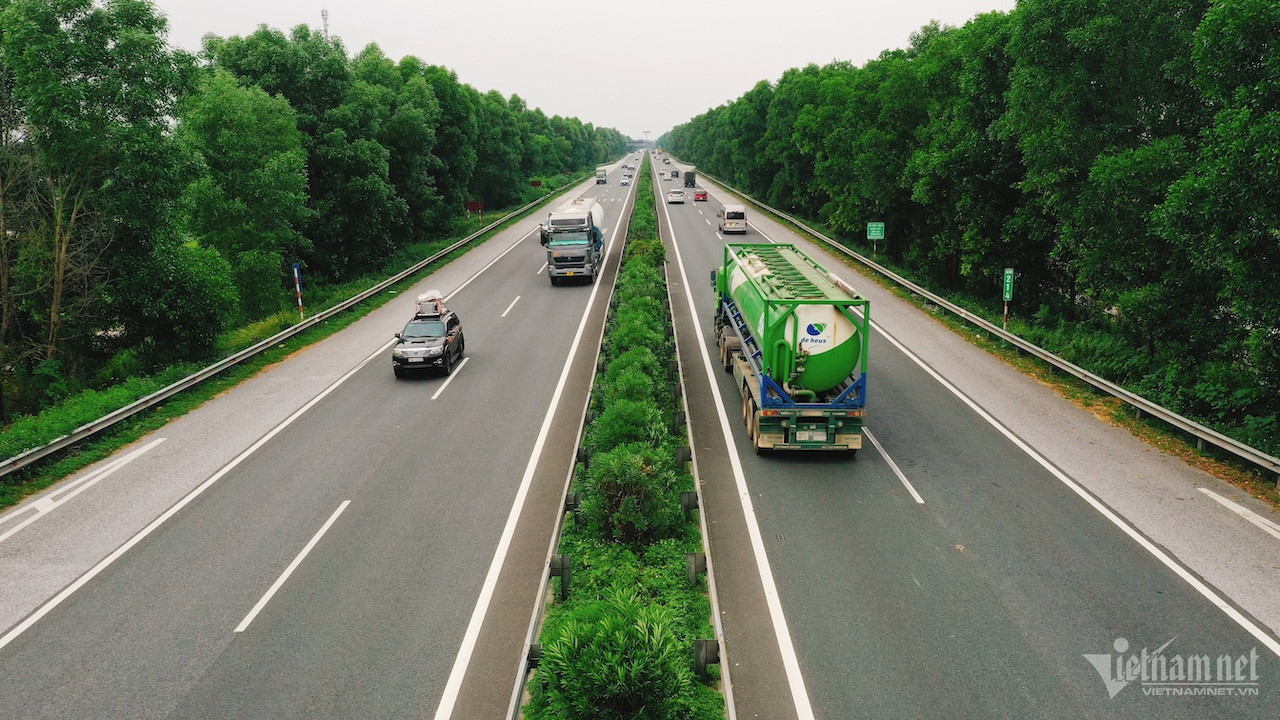
The enforcement campaign covers the Phap Van - Cau Gie - Cao Bo - Mai Son - National Highway 45 - Nghi Son expressway corridor. While drivers broadly agree that keeping a safe distance is essential, some question how they can accurately judge distances while driving and how the rule will be applied when vehicles cut into the space ahead.
Under existing regulations, vehicles traveling at 60 km/h must maintain a minimum distance of 35 meters from the vehicle ahead. The minimum rises to 55 meters at speeds above 60 km/h and up to 80 km/h, 70 meters at above 80 km/h and up to 100 km/h, and 100 meters at above 100 km/h and up to 120 km/h.
Drivers must increase those distances when it is raining or foggy, the road is slippery or winding, or visibility is limited.
Drivers struggle with judging safe distances
Duy Khanh, a Hanoi driver who regularly travels on expressways, said he supports maintaining safe following distances but still has concerns about how strictly the regulation can be applied in everyday driving.
“Anyone who drives frequently on expressways knows there are situations where the vehicle ahead is moving slowly, not traveling at the maximum permitted speed or staying in the high-speed lane, making it difficult for vehicles behind to overtake,” Khanh said. “In situations like that, overtaking while maintaining the exact required distance and responding to actual traffic conditions is not always straightforward.”
He said another common situation occurs when a vehicle suddenly changes lanes and moves into the gap between two cars. A driver who has deliberately maintained a safe distance may then have to adjust speed repeatedly.
“If every vehicle maintains at least 55 meters when traveling above 60 km/h, could that contribute to congestion on the expressway? That is something I am curious about,” Khanh said. “In reality, there are many situations where the required distance from the vehicle ahead cannot be maintained for reasons that are not entirely the fault of the driver behind.”
Khanh also argued that a safe distance cannot always be assessed simply by looking at a number. If the vehicle ahead is traveling steadily, traffic is light and visibility is good, a gap of less than 55 meters may still provide sufficient reaction time. Conversely, when there is a potential obstacle ahead or visibility is poor, even more than 55 meters may not eliminate the danger.
“I watched a traffic police video explaining how to overtake on the Hanoi - Hai Phong Expressway, and at certain points it was difficult to tell visually exactly how many meters separated the vehicles,” he said. “That makes me think authorities should provide very specific guidance on the circumstances in which drivers will be penalized, so motorists know exactly how to comply.”
Another Hanoi driver, Hoang Kien, is more concerned about the practical challenge of estimating distance. He said most motorists have no reliable way of determining exactly what 55 meters looks like while their vehicle is moving.
“Few people know how far apart the roadside guardrail posts are so they can use them as reference points. So how is a driver supposed to estimate 55 meters from the vehicle ahead?” Kien said. “Without clear visual guidance, many people will be quite anxious when the regulation is enforced.”
Kien also raised questions about vehicles equipped with radar-based adaptive cruise control. Different manufacturers may configure following-distance settings differently, he noted, while many mainstream and older vehicles rely entirely on the driver’s judgment.
“With cars that automatically maintain distance, drivers at least have technology to assist them. But in ordinary vehicles, accurately judging whether the gap is 35, 55, 70 or 100 meters by eye is not easy,” he said.
‘Don’t wait for a fine before keeping your distance’
Do Xuan Thao, a driver from Hanoi’s Ha Dong area, takes a different view, arguing that following distance should primarily be seen as a safety issue rather than something drivers observe simply to avoid a fine.
“Don’t wait until traffic police start issuing fines before keeping a safe distance,” Thao said. “If the vehicle ahead brakes suddenly, encounters an obstacle or faces an unexpected problem, having enough space gives the driver more time to react.”
At speeds above 60 km/h and up to 80 km/h, the minimum following distance under normal road and weather conditions is 55 meters. Thao said motorists should treat this not merely as a figure they need to remember to avoid penalties, but as a routine highway-driving habit.
Nguyen Viet Hung, another Hanoi motorist, also supports enforcement and believes maintaining safe distances on expressways is necessary.
Hung noted that the safety-distance requirements themselves are not new, having taken effect on January 1, 2025. The advance notice of enforcement, he said, gives motorists time to understand the rules and adjust their driving habits.
“Anyone who travels on expressways during public holidays or Tet knows how heavy the traffic can become,” Hung said. “A minimum distance of 55 meters when traveling above 60 km/h sounds simple, but maintaining it continuously in real traffic is difficult.”
One particularly stressful situation, he said, arises when a driver deliberately creates a safe gap only for other vehicles to repeatedly move into it. The driver must then either slow down again to restore the required distance or narrow the gap and potentially face both a safety risk and enforcement action.
“If you stay close, you worry about an accident. But if you fall back to create another safe gap, cars keep cutting into it. Driving in those situations can be very stressful,” Hung said.
The comments suggest motorists generally do not oppose enforcement of safe-distance rules, whose ultimate purpose is to prevent chain-reaction crashes on expressways. Many, however, want clearer guidance on how distances should be judged and how authorities will handle real-world situations involving lane changes, overtaking, vehicles cutting into gaps and heavy traffic.
The debate comes as traffic police have already recorded the first enforcement cases.
On the afternoon of August 26, the Traffic Police Department under the Ministry of Public Security said Expressway Traffic Police Team No. 3 had issued violation records against two passenger-bus drivers for failing to maintain the required distance from vehicles ahead on the Mai Son - National Highway 45 Expressway.
The two drivers were Nguyen V.D., born in 1984 and residing in Ninh Binh Province, who was driving a 24-seat passenger bus with license plate 18H-038.XX, and Nguyen V.T., born in 1981 and also from Ninh Binh, who was driving another 24-seat bus with license plate 18H-063.XX.
For failing to comply with safe following-distance requirements on an expressway, each driver faces a fine of VND4-6 million (about US$150-230) and the loss of two points from their driving license under Point d, Clause 5, Article 6 of Government Decree 168/2024/ND-CP.
A representative of the Traffic Police Department said maintaining a safe distance is not simply about avoiding penalties. More importantly, it gives motorists sufficient time to respond when the vehicle ahead slows down or an unexpected situation develops.
The department urged motorists to comply with traffic regulations, maintain safe distances and appropriate speeds, and protect both themselves and other road users.
Under Circular 38/2024/TT-BGTVT, which regulates vehicle speeds and safe following distances on roads, minimum distances vary according to speed.
When roads are dry and flat, with no fog or slippery surfaces and with good visibility, a vehicle traveling at 60 km/h must remain at least 35 meters behind the vehicle ahead. At speeds above 60 km/h and up to 80 km/h, the minimum is 55 meters; above 80 km/h and up to 100 km/h, 70 meters; and above 100 km/h and up to 120 km/h, 100 meters.
When driving in rain or fog, on slippery, winding or mountainous roads, or in conditions of limited visibility, motorists must maintain a greater distance than the figure shown on road signs or the minimum prescribed for favorable conditions.
Y Nhuy - Dinh Hieu
.svg)
