 Vietnamnet.vn

 Podcast



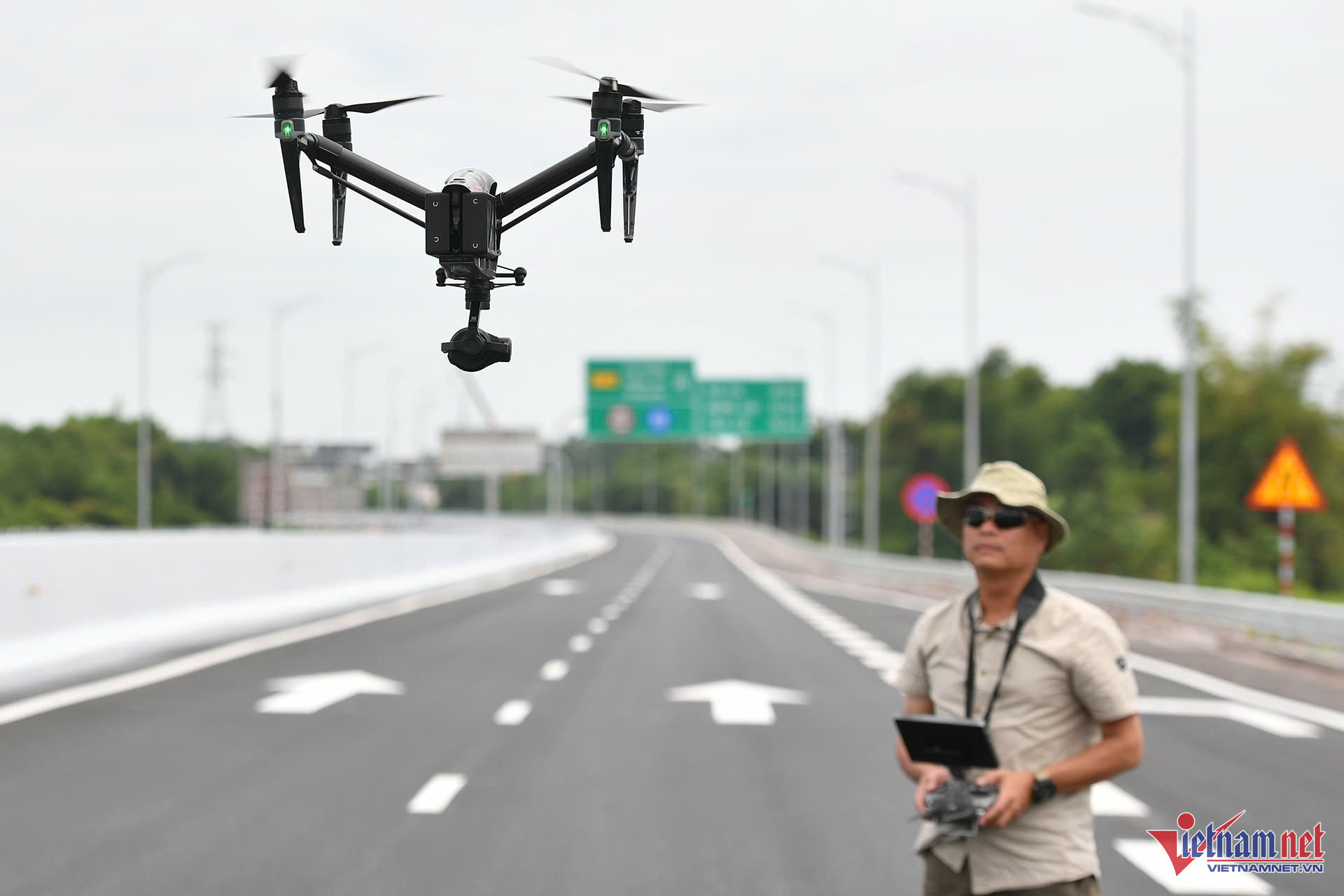
Behind that flight is the low-altitude economy, a market forecast to be worth trillions of dollars, where Vietnam begins the race to master core technology.
The postal transport route using UVAs connecting Can Gio with Vung Tau ward of HCMC was inaugurated in February.
Each UAV can carry a 2kg package, flying a distance of more than 12km each way in about 15 minutes, shortening the time compared to road transport by six times and sea transport by three times. This first cross-sea unmanned postal route in Vietnam is considered a pioneering step in the development of smart logistics.
Recently, UAV test flight activities serving fertilization for coffee trees in an area of Muong Ang commune (Dien Bien) were also performed.
Goods transport, field recording for the digitalization of construction works, inspection of high-voltage power lines, and agricultural production support are all applications belonging to the low-altitude economy.
Citing information from an international study, Luong Viet Quoc, CEO of Real-time Robotics (RtR), a company that designs and manufactures its own UAVs, told VietNamNet that the market scale for general low-altitude economy applications of UAVs could reach $90 billion by 2030.
However, according to Quoc, the UAV market scale changes very rapidly. Even in the defense sector, the demand for UAVs is increasing sharply.
In a study published in October 2025, four members from four different universities in China and Poland cited predicted data that air mobility services combined with the low-altitude economy will exceed $1 trillion by 2040.
China has included the low-altitude economy in its development plan for strategic emerging industries, aiming to contribute more than $500 billion to GDP and create 4 million jobs by 2035. To realize this, 38 aerial altitude corridors and 200 heliports have been planned.
This is within China's sandbox (controlled experimental mechanism) to compete with projects already deployed in the US, EU, Singapore, and UAE. Meanwhile, the International Civil Aviation Organization (ICAO) is developing global rules for the exploitation of low-altitude airspace.
Barriers to be removed
UAVs impact many economic sectors such as agriculture, construction, infrastructure, search and rescue, and defense. Quoc believes that to develop the low-altitude economy, Vietnam must master core technologies in the UAV industry. To have core technology, inventions are mandatory.
“If there are no inventions and we only copy the technology of other enterprises, we will forever be followers. If so, we will never have products superior enough to sell to the world. If UAVs cannot be consumed globally, it will be difficult to even hold the domestic market. Vietnamese UAVs must have inventions and be strong enough to compete fairly in demanding markets,” he said.
Therefore, in the National Science, Technology, and Innovation Program for the development of strategic technology products prioritized for immediate implementation, approved by the Government in December 2025, UAV is identified as one of the strategic technologies.
By 2027, Vietnam aims to master UAV design and product integration, control at least 60 percent of UAV core technologies, and achieve a domestic value-added ratio of at least 50 percent in selling prices. In production costs, the domestic contribution ratio is expected to reach at least 30 percent.
By 2030, Vietnam aims to master at least 80 percent of UAV core technologies, raise the domestic value-added ratio to at least 60 percent of selling prices and 40 percent of production costs, while meeting at least 30 percent of domestic market demand.
Nguyen Hai Nguyen, a lecturer in robotics and mechatronics engineering at RMIT Vietnam, said that for “UAV - make in Vietnam” to truly take off, the key factor is not only manufacturing capability but also research capacity, experimental capability, a legal framework that allows rapid innovation, and effective cooperation between the government, universities and businesses.
Nguyen noted that universities and research institutes in Vietnam are developing rapidly. Many newly established research groups now have personnel trained to international standards, with expertise in automatic control, AI, manufacturing and embedded systems - all foundational technologies for modern UAVs.
Once UAVs are identified as a driving force of the low-altitude economy, universities gain stronger grounds for long-term research investment, building laboratories and developing specialized training programs. Businesses, meanwhile, become more confident in cooperating with academia to jointly develop technologies and gradually commercialize research outcomes.
Nguyen Le
.svg)
