 Vietnamnet.vn

 Podcast



According to the Asia Pacific Outlook 2026 report by Savills, the Asia-Pacific real estate market enters 2026 on a more stable footing compared to recent years, supported by recovering leasing demand, rising consumption and selective growth opportunities.
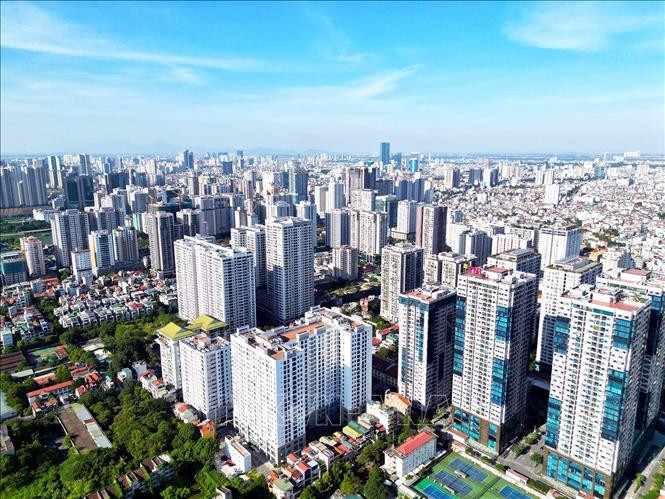
Photo: VNA
Within that regional context, Vietnam continues to be assessed as one of the markets with positive prospects, underpinned by solid macroeconomic foundations, expanding domestic demand and an increasingly prominent role in regional supply chains.
Data from the General Statistics Office and international research institutions show that Vietnam’s GDP growth from 2022 to 2025 reflects a clear pattern of recovery and stability.
After expanding by around 8 percent in 2022, growth moderated to approximately 5.1 percent in 2023 amid global economic headwinds, before rebounding to about 7.1 percent in 2024 and reaching 8.02 percent in 2025.
This trajectory places Vietnam among the faster-growing economies in the Asia-Pacific region.
Beyond headline growth, the quality of expansion has also improved.
According to the Asian Development Bank and the General Statistics Office, Vietnam’s GDP per capita rose steadily from roughly $3,700 in 2022 to nearly $5,026 in 2025.
Rising income levels and a growing middle class are laying a solid foundation for the domestic market, while driving increasing demand for transport infrastructure, logistics, urban development and commercial services - all of which exert strong spillover effects on real estate.
Regional trends reflected with greater depth in Vietnam
Savills notes that demand for Grade A office space across Asia-Pacific is expected to remain positive, particularly in emerging talent hubs such as India, Vietnam and Malaysia, where multinational corporations are expanding their presence to access skilled labor at competitive costs.
The retail property segment is supported by recovering consumption, tourism growth and the return of international brands, even as high-quality supply remains limited in many markets.
In industrial and logistics real estate, “China plus one” strategies, supply chain diversification and the rapid expansion of e-commerce continue to serve as primary drivers.
Savills forecasts that rents in most major markets across the region will maintain an upward trend in 2026, reflecting genuine demand and the increasingly critical role of logistics infrastructure within global value chains.
According to Neil MacGregor, Managing Director of Savills Vietnam, these regional trends are clearly mirrored in Vietnam, though with increasing depth and quality.
“Vietnam has moved beyond a phase where investment attraction was driven mainly by cost advantages,” MacGregor said.
“Capital flows are now increasingly directed toward higher value-added sectors such as technology manufacturing, electronics, modern logistics and industries linked to global supply chains. This is reshaping real estate demand toward higher quality, sustainability and longer-term horizons.”
Infrastructure and FDI anchor long-term outlook
One of the key factors reinforcing the long-term outlook of Vietnam’s property market is the sustained flow of high-quality foreign direct investment.
In 2025, total registered FDI reached approximately $38–40 billion, while disbursed capital hit a record high, reflecting long-term investor confidence in the domestic business environment.
Notably, European capital is becoming more selective, focusing on high value-added sectors such as technology, electronics, deep processing and logistics.
The EU–Vietnam Free Trade Agreement’s roadmap to eliminate import tariffs on over 99 percent of export tariff lines to the EU by 2027 is expected to further strengthen Vietnam’s position within global supply chains and enhance its appeal to long-term investors.
Alongside FDI, large-scale public investment in infrastructure is viewed as a central growth engine for both the broader economy and the real estate market in the medium and long term.
Accelerated implementation of key projects such as the North–South Expressway, Long Thanh International Airport, ring road systems in Hanoi and Ho Chi Minh City, as well as numerous logistics and energy projects, will improve regional connectivity, encourage urban decentralization and create new growth poles along strategic infrastructure corridors.
MacGregor emphasized that infrastructure will be the most important growth driver for Vietnam’s real estate market over the next decade.
As transport and logistics networks are completed, satellite cities and secondary urban centers are expected to emerge as new development hubs, expanding the market’s growth space.
In terms of investment flows, Savills forecasts that Asia-Pacific real estate investment will rise by around 7 percent in 2026, reflecting a more stable cycle compared with the US and Europe.
While China continues to weigh on overall capital flows, markets such as Japan, Australia and South Korea remain attractive due to solid occupancy fundamentals and high stability.
In an environment where global investors are becoming increasingly cautious and selective, markets demonstrating real growth, strong domestic demand and improving legal frameworks - such as Vietnam - are expected to hold a long-term advantage.
“The coming phase will not be about short-term growth, but about capital allocation based on real usage value, infrastructure and a vision for sustainable development,” MacGregor analyzed.
“Markets that execute well on these fronts will become focal points of capital flows for years to come.”
Anh Tuan (TTXVN)
.svg)
