 Vietnamnet.vn

 Podcast



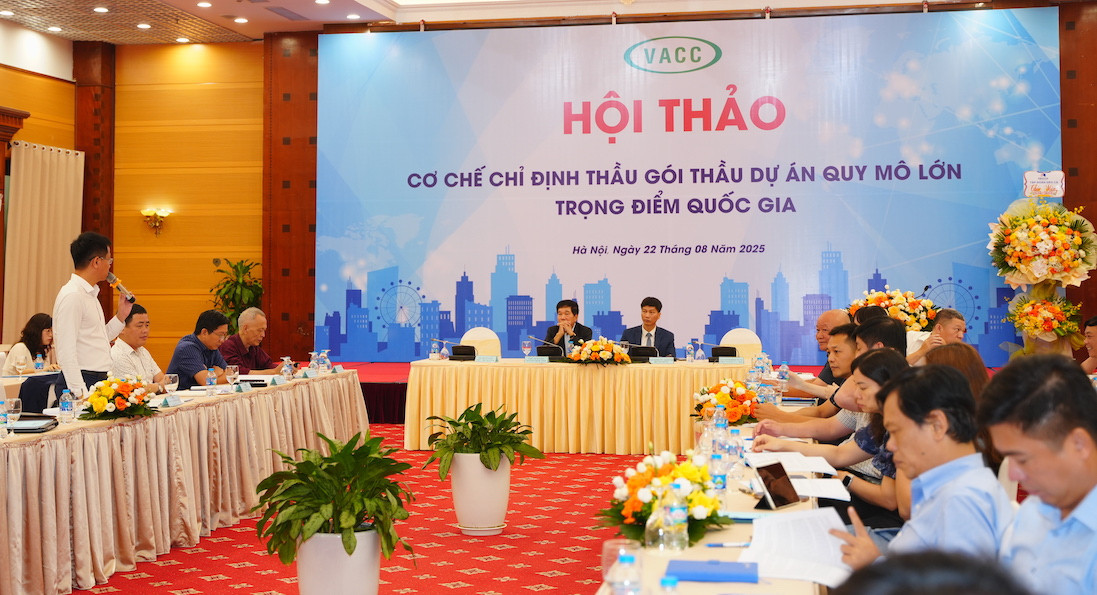
At the conference titled “Mechanisms for direct contractor appointment in large-scale national projects” on August 22, Nguyen Quoc Hiep, Chairman of VACC, stated that Vietnam's construction industry is entering a pivotal phase as a wave of mega projects are being launched nationwide.
On August 19 alone, more than 250 major projects were inaugurated or commenced.
Citing the North-South high-speed railway with an estimated investment of over USD 67 billion as an example, Hiep emphasized that such complex projects demand technical expertise and experience that most domestic contractors have never encountered.
He remarked that the industry is entering a new era marked by both excitement and pressure, driven by large-scale, high-tech infrastructure projects.
Accompanying the workload surge are transformative legal shifts. The National Assembly has recently passed an amended Law on Bidding, while updates to the Construction Law are in progress.
Nguyen Bac Thuy, Head of the Department of Construction Economics and Contracts under the Ministry of Construction, noted that multiple special policies have been enacted to streamline procedures and expedite progress on large infrastructure projects.
Among these is the expanded use of direct contractor appointments, especially for railway projects, including foreign consultants. Some legislative provisions are even being implemented ahead of schedule, based on the philosophy of “building the plane while flying it.”
VACC emphasized that the surge in direct contractor appointments - both within and outside the state budget - requires a clear evaluation framework. However, no unified system currently exists for ranking contractor capacity.
The association proposed ranking about 100 major construction companies that meet the criteria to participate in national strategic projects. This would serve as a critical basis for transparent and effective contractor appointments.
Opportunities and challenges for local contractors
At the conference, a representative from Truong Son Construction Corporation asserted that the direct appointment mechanism not only shortens project preparation and execution timelines but also leverages the capabilities of reputable and experienced contractors. This would support infrastructure development and enhance national competitiveness.
However, they acknowledged that for emerging fields like high-speed rail, offshore wind power, and nuclear energy, most domestic contractors lack the necessary experience in similar contracts.
As such, Truong Son proposed a specific mechanism to prioritize the appointment of capable Vietnamese firms, especially large and military-affiliated enterprises that have successfully delivered large-scale projects ahead of schedule.
Illustrating this point with the Long Thanh Airport terminal project, Hoang Thieu Bao, Deputy Director of Vinaconex Construction Board, said the project is classified as a special-grade civil construction.
“When the bidding document requires building-type structures but the project value is up to VND 35 trillion (about USD 1.38 billion), we found that even when combining several local contractors, their collective portfolio still didn’t meet the required experience. That’s why all three bidding consortiums for the Long Thanh project had to include foreign partners. Vietnamese firms had to form joint ventures of 9–10 members to qualify,” Bao explained.
In such joint ventures, the majority of the contract value usually goes to foreign contractors.
To improve local participation in large projects like the high-speed railway, Vinaconex suggested allowing unincorporated joint ventures. This would let consortium members share risks and profits proportionally without clearly dividing scopes of work.
Commenting on subcontractor management, Deo Ca Group argued that requiring subcontractors to meet the same standards as main contractors is unreasonable. If they were that qualified, they would bid independently.
Thus, the group called for more flexible criteria tailored to specific job characteristics.
For project timeline enforcement, Deo Ca proposed that subcontractors be held to the same accountability as main contractors, including partial contract termination, reassignment, or cancellation with investor and consultant approval. This would improve discipline and ensure on-time project delivery.
Hong Khanh
.svg)
